Cloud WAN migration: A six-phase plan
A six-phase migration strategy transitions global networks from AWS Transit Gateway to AWS Cloud WAN with minimal downtime. This approach leverages Terraform infrastructure as code and the AWS Network MCP Server to orchestrate complex changes without disrupting production workloads.
Managing hundreds of Amazon VPC connections across multiple Regions creates friction in legacy hub-and-spoke models. Manual route management and cross-Region coordination frequently cause configuration drift. Automating these processes reduces the risk of large-scale infrastructure updates. Discovery tools within the MCP Server identify routing anomalies before they impact traffic flow.
This article details the strategic necessity of shifting to a managed global network and the specific architecture required for a phased rollout. Readers will learn how to execute cross-Region federation and integrate hybrid connectivity options like AWS Direct Connect safely. The guide provides a repeatable framework for validating route tables and verifying state changes in real-time throughout the migration lifecycle.
The Strategic Role of AWS Cloud WAN in Global Network Management
AWS Cloud WAN as a Managed Global Networking Service
AWS Cloud WAN functions as a centralized policy engine for global connectivity, overcoming the regional limitations of AWS Transit Gateway. Amazon announced the service during its public preview at AWS re:Invent 2021 to address the fragmentation caused by managing multiple regional hubs. General Availability arrived in June 2022, allowing organizations to deploy production-grade networks requiring unified control across distributed infrastructure.
This architectural shift moves network logic from distributed peering arrangements to a single global fabric. Operators define intent through core network policies instead of configuring individual route tables for every region. Such centralization removes the manual coordination errors frequently observed in large-scale hybrid environments.
Centralizing control creates a dependency on the stability of core policy definitions. Network teams must implement rigorous validation pipelines before deploying changes. Automated discovery tools verify routing behavior prior to enforcing global updates. Efficiency gains from a unified management plane cannot compromise production stability during the transition from regional silos.
Phased Migration Strategy Using Terraform and AWS Network MCP Server
Validated infrastructure as code replaces manual coordination in this six-phase migration approach. The strategy addresses the complexity of moving hundreds of Amazon VPC connections across multiple Regions without disrupting production traffic. Manual tracking of over 100 routes becomes error-prone during cross-Region transitions, making the phased model necessary. Terraform modules enforce consistent deployment states across non-production and production environments.
The migration lifecycle prioritizes risk reduction through incremental validation at every step. AWS Network MCP Server tools provide discovery capabilities that identify configuration drift before it impacts live traffic. Automation eliminates the need for complex CLI queries to verify segment isolation or asymmetric routing.
- Deploy reusable Terraform modules aligned to specific migration phases.
- Apply MCP discovery tools to inventory existing topology automatically.
- Validate route tables and cross-Region changes in real-time.
- Coordinate hybrid connectivity for AWS Direct Connect and SD-WAN integrations.
- Monitor interdependencies between phases to prevent downstream cascades.
Interdependencies between phases mean an early misstep can cascade downstream. A standardized two-phase pattern of federation then substitution suggests organizations prioritize continuity over rapid overhaul. This specific scenario allows for thorough testing before full substitution. Operators must maintain read-only IAM permissions for MCP validation alongside deployment rights. This structured path helps optimize existing IPv4 resources within a unified global fabric.
Operational Risks in Manual Routing Validation and Hybrid Integration
Operators managing hybrid connectivity face significant coordination challenges when integrating AWS Direct Connect, AWS Site-to-Site VPN, and Software-Defined Wide Area Network (SD-WAN) components. Legacy architectures often require manual peering for global connectivity, a process that fragments management across different accounts.
| Risk Factor | Manual Method Limitation | Automated Solution |
|---|---|---|
| Route Tracking | Error-prone beyond 100 entries | Real-time state visibility |
| Team Coordination | Fragmented across silos | Centralized policy control |
| Validation Speed | Hours per phase | Instant verification |
Policy-driven networking eliminates repetitive manual checks by defining match conditions globally. The transition requires careful orchestration of non-production and production workloads to prevent downstream cascading failures. Challenges include orchestrating non-production and production workloads across multiple phases and integrating hybrid connectivity such as AWS Direct Connect. Replacing tedious manual tracking with validated infrastructure as code ensures consistent deployment states. Relying on manual processes for complex global topologies increases the likelihood of missed route updates and service interruption. Automated validation tools provide the necessary oversight to maintain network integrity while reducing the operational burden on engineering teams.
Architecture of a Phased Migration Using Terraform and MCP Server
Mechanics: Terraform Modules and MCP Server Roles in Migration
Phased Terraform Modules, the AWS Infrastructure MCP Server, and the AWS API MCP Server form the backbone of an architecture designed to replace manual coordination with automated precision. Terraform executes reusable code blocks that align infrastructure state with each specific migration stage. This structured approach enforces a standardized two-phase pattern of federation followed by substitution, ensuring organizations prioritize continuity over disruptive overhauls.
Concurrently, the AWS API MCP Server enables natural language validation, allowing operators to query routing behavior without complex CLI syntax. Teams ask plain English questions to verify segment isolation or detect configuration drift before traffic impacts production.
| Component | Primary Function | Validation Method |
|---|---|---|
| Phased Terraform Modules | Deploys Core Network Edges | State file diffing |
| AWS Grid MCP Server | Discovers topology | Natural language query |
Deployment speed often conflicts with configuration immutability. Once Core Network Edges deploy with specific inside CIDR blocks and Autonomous System Numbers (ASNs), these parameters become permanent. Operators must validate these values via the MCP Server before the initial Terraform apply because post-deployment correction requires resource destruction. This constraint demands rigorous pre-flight checks that traditional manual processes often miss.
These AWS Cloud WAN tools eliminate human error in route propagation. The shift from manual tracking to automated discovery keeps complex global networks stable throughout the transition. Automating the verification of BGP path attributes addresses the complexities of large-scale migrations where manually tracking routes proves tedious and error-prone.
Executing Phase Two Peering and Route Federation Steps
Phase two executes three Terraform modules to establish AWS Transit Gateway peering, define policy tables, and attach route tables to segments. This sequence maps existing regional logic to the centralized AWS Cloud WAN fabric without traffic interruption.
- Create AWS Transit Gateway – AWS Cloud WAN peering attachments.
- Generate policy tables that enforce isolation between production and non-production environments.
- Attach route tables to corresponding segments to propagate routes dynamically.
The base architecture aligns three AWS Transit Gateway route tables with three AWS Cloud WAN segments. Operators verify that segment association matches the intended isolation boundary before committing changes. Segmentation relies on this strict mapping to prevent unintended cross-segment communication during the federation window.
| Component | Legacy Function | Cloud WAN Target |
|---|---|---|
| Route Table | Regional hub scope | Global segment scope |
| Attachment | VPC or VPN link | Segment-mapped connection |
| Propagation | Manual or BGP local | Core network wide |
Global core propagation occurs automatically once the attachment state becomes active, differing from the hub-and-spoke model. Operators validate segment membership using AWS Platform MCP Server queries before enabling production traffic flows. This step confirms that the policy table correctly restricts reachability between distinct network zones. Manually analyzing route tables for asymmetric routing and constructing CLI queries to verify segment isolation are time-consuming tasks prone to error. The operator gains a unified view of global reachability only after these three steps complete successfully.
Pre-Migration Discovery and Immutable Configuration Checks
Initiate discovery by querying existing AWS Transit Gateway topologies to inventory route tables before any infrastructure modification. Operators capture a complete backup of these routes because AWS Cloud WAN uses Border Gateway Protocol (BGP) to dynamically propagate paths across Regions, which can inadvertently create a full mesh if legacy entries persist. This flexible behavior necessitates a precise baseline to prevent routing loops during the federation stage.
Simultaneously, validate all Core Network Edge parameters, as specific settings like inside CIDR blocks and Autonomous System Numbers (ASNs) become immutable after deployment. Attempting to modify these values post-creation requires destroying and rebuilding the entire edge, causing unnecessary downtime.
| Check Type | Validation Method | Critical Constraint |
|---|---|---|
| Route Inventory | AWS System MCP Server query | Backup required before BGP start |
| ASN Configuration | Terraform state review | Immutable after creation |
| Segment Mapping | Policy table audit | Must match isolation boundaries |
Use the AWS API MCP Server to execute natural language checks, such as verifying segment isolation, rather than relying on manual CLI scripts that often miss subtle drift. Interdependencies between phases mean a misstep early on can cascade downstream. Every immutable field must match the design specification exactly. This disciplined approach ensures the subsequent substitution phase proceeds without requiring complex rollback procedures.
Executing Cross-Region Federation and Hybrid Connectivity Migration
Automated Route Propagation via AWS Cloud WAN Core Network

Phase three deletes static routes pointing to remote AWS Transit Gateway peering attachments to activate automatic cross-Region pathing.
- Remove legacy static entries from each regional route table.
- Allow the AWS Cloud WAN Core Network to populate paths dynamically.
- Verify traffic flows through CNEs instead of direct peerings.
This transition replaces manual coordination with the automated edge architecture set in modern global topology designs. Operators using Terraform can script this deletion to ensure synchronized removal across environments, mitigating the risk of asymmetric routing during the cutover window.
The limitation is immediate: once static routes vanish, reliance on BGP propagation becomes absolute, leaving no manual fallback if policy errors exist. Rapid automation accelerates migration but increases configuration drift if validation lags. Unlike the fragmented hub-and-spoke model requiring explicit peering management, the core network assumes total routing authority. Validating segment isolation before deleting the final static route helps prevent unintended exposure between production and non-production workloads.
Sequential Hybrid Migration: VPN, SD-WAN GRE, and Direct Connect Gateways
Execute hybrid migration by attaching Site-to-Site VPN links first, followed by SD-WAN GRE peers, and finally Direct Connect gateways. This strict sequence preserves on-premises reachability while the underlying fabric transitions from regional hubs to a global service insertion capable model.
- Provision additional VPN attachments on the Core Network Edge to establish parallel paths.
- Configure SD-WAN Connect Attachments using Generic Routing Encapsulation for BGP session establishment.
- Deploy new Direct Connect Gateways with unique Autonomous System Numbers to advertise routes incrementally.
Operators must validate that BGP sessions reach the established state before decommissioning legacy peering. The Infrastructure MCP Server assists by querying route propagation status across segments without manual CLI traversal.
Maintaining redundant paths while avoiding asymmetric routing during the switchover window creates friction. While the Site-to-Site VPN serves as an immediate backup, advertising identical prefixes via Direct Connect prematurely can cause traffic blackholing if preference values are not meticulously tuned. This risk shows why the migration order prioritizes lower-capacity links before high-volume circuits. The AWS Cloud WAN architecture enables this direct attachment of diverse link types, yet the operational burden of sequence management remains entirely on the implementer. Validating each attachment type individually ensures path consistency before proceeding to the next connectivity tier.
Network Function Group Configuration and Inspection VPC Tagging Rules
Configuration steps include creating an Amazon VPC attachment for the inspection Amazon VPC and tagging it with `InspectionVpcs = "true"`. This specific label allows the core network policy to identify and attach security resources without manual route manipulation. Operators must apply this tag before updating the attachment policy rule to ensure immediate traffic steering.
- Create an Amazon VPC attachment dedicated to the inspection environment.
- Apply the mandatory `InspectionVpcs` tag key with a value of `"true"`.
- Define the Network Function Group in the core network policy document.
- Update the attachment policy rule to associate tagged VPCs with the group automatically.
After migration, the path is optimized to Amazon VPC → segment route table → AWS Network Firewall. This optimization eliminates the complex routing chains previously required for multi-region inspection. The shift enables policy-driven service insertion that scales globally without per-region configuration drift. However, this centralized control introduces a single point of policy failure if the core network edge configuration contains syntax errors. A mistake in the global policy propagates instantly across all connected regions, unlike the isolated impact of regional AWS Transit Gateway errors.
| Feature | Legacy Approach | Cloud WAN Approach |
|---|---|---|
| Traffic Path | Multi-hop via peering | Direct segment routing |
| Policy Scope | Regional | Global |
| Configuration | Manual route updates | Automated tag association |
Validating these tags in non-production segments before applying global policies to production environments helps ensure correct behavior.
Operationalizing Production Cutover and Decommissioning Legacy Gateways
Defining Production Cutover via Route Table Attachment
Attaching the active AWS Transit Gateway route table directly to the prod AWS Cloud WAN segment executes the production cutover. This specific action shifts traffic control from regional hubs to the global core system edge without disrupting active flows. Operators must update Amazon VPC route tables simultaneously to point toward the new segment attachment rather than legacy peering points.
- Attach the production route table to the assigned AWS Cloud WAN segment.
- Modify local Amazon VPC routing entries to target the segment attachment.
- Validate path consistency using MCP Server queries before removing legacy resources.
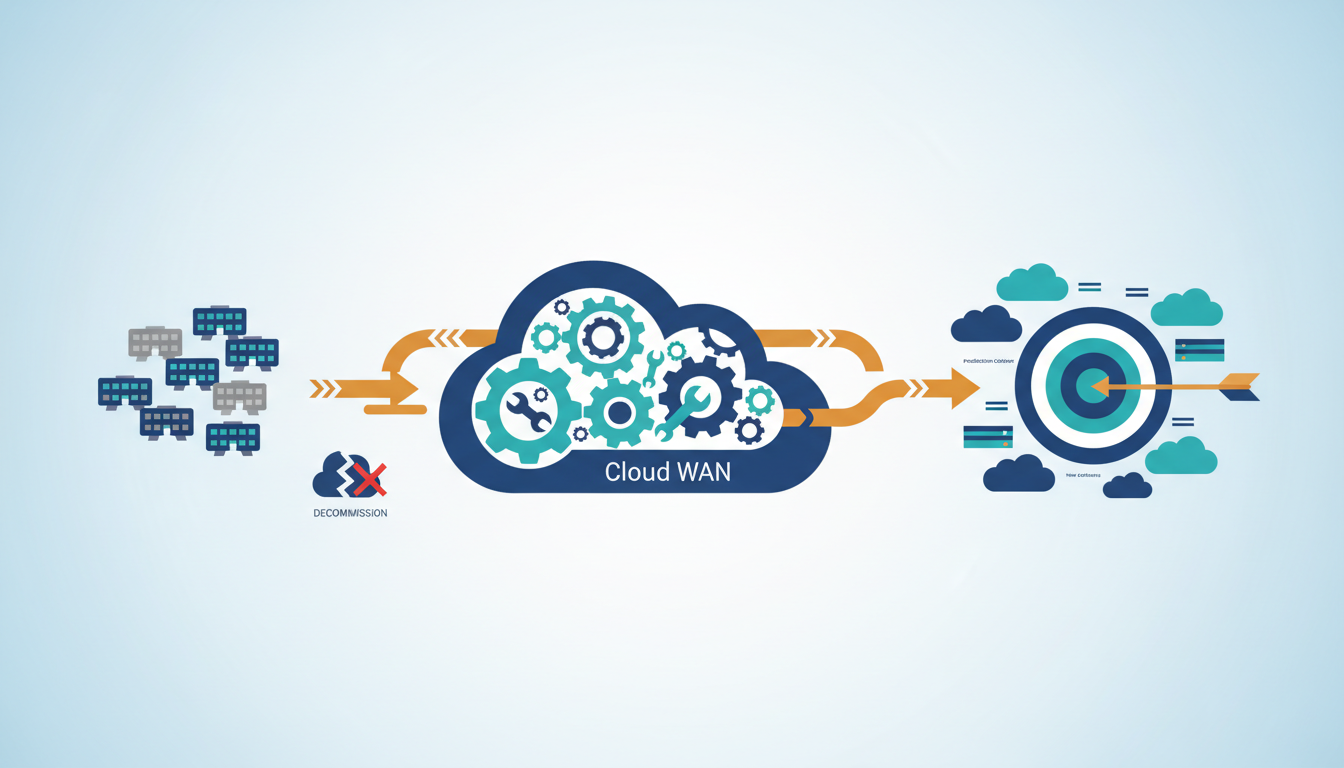
Strict isolation defines this mechanism because segments control communication paths between different parts of the network segmentation. Attaching the route table immediately propagates Border Gateway Protocol (BGP) updates. Any residual static routes pointing to old peerings can cause asymmetric routing loops. Skipping the attachment validation step results in measurable traffic loss during the switchover window. Infrastructure state matches operational reality through this method. Dual charges for per-attachment and data processing disappear while the new global topology secures traffic paths.
Sequential Decommissioning Order for Legacy Transit Gateways
Removal requires a strict sequence to prevent routing loops and ensure orphaned resources do not persist. Removing the AWS Transit Gateway before clearing dependent attachments causes immediate connectivity loss across affected regions. Operators must verify traffic paths using MCP Server validation queries before modifying any infrastructure components.
The mandatory decommissioning order proceeds as follows:
- Remove Amazon VPC route table entries pointing to the legacy gateway.
- Delete AWS Transit Gateway peering attachments to sever regional links.
- Delete AWS Transit Gateway route tables to clear propagation rules.
- Delete the AWS Transit Gateway instance itself.
- Clean Terraform state by removing legacy modules.
| Step | Action | Risk if Skipped |
|---|---|---|
| 1 | Verify paths via MCP Server | Undetected blackholes |
| 2 | Remove VPC route entries | Traffic loops |
| 3 | Delete peering attachments | Stale BGP sessions |
| 4 | Delete route tables | Configuration drift |
| 5 | Delete gateway | Continued billing |
Eliminating these legacy components stops hourly charges and data processing fees associated with redundant attachments. The substitution phase effectively reduces costs by removing dual-infrastructure overhead. Terraform state desynchronization presents a constraint. Modules deleted from the cloud but not the local state file cause future applies to fail or recreate resources unexpectedly. This disciplined approach guarantees a clean state for the global core network.
Financial Exposure from Delayed Legacy Gateway Decommissioning
Dual billing accumulates immediately when legacy AWS Transit Gateway resources remain active alongside the new Core Infrastructure Edge. Decommissioning must be done promptly to avoid simultaneous charges for per-attachment fees and per-GB data processing rates. Financial exposure grows linearly with the number of retained attachments and the volume of traffic still traversing the old path.
The architectural shift implies a move from per-Transit Gateway attachment pricing models to a global core network pricing model, which is a key financial consideration for multi-region deployments architectural shift. Cost optimization is implicitly tied to the "substitution" phase, where removing Transit Gateways entirely eliminates their associated hourly and data processing charges in favor of Cloud WAN's pricing structure cost optimization.
| Cost Component | Legacy State | Optimized State |
|---|---|---|
| Attachment Fees | Per attachment hourly charge | Included in Core Network |
| Data Processing | Per GB throughput fee | Consolidated rate |
| Management Overhead | High manual coordination | Automated via MCP Server |
Legacy infrastructure creates a hidden tax on network operations that offers no functional return after cutover. InterLIR recommends immediate state cleanup to stop this bleeding of capital on redundant capacity.
About
Nikita Sinitsyn, Customer Service Specialist at InterLIR, brings eight years of telecommunications expertise to the complex discussion of AWS Cloud WAN migration. While InterLIR specializes in global IPv4 resource management, Nikita's daily work managing RIPE and ARIN database operations requires a profound understanding of network infrastructure stability and BGP routing integrity. This background makes him uniquely qualified to analyze the transition from AWS Transit Gateway to Cloud WAN, as both domains demand precise coordination of IP resources across multiple regions. His experience in troubleshooting connectivity issues and ensuring clean IP reputation directly correlates with the article's focus on reducing migration risk through incremental validation. At InterLIR, where geographic diversity and network availability are paramount, Nikita understands the critical nature of the operational efficiency gains promised by automating manual network processes. His technical support history ensures the migration strategy is evaluated not just for its code, but for its real-world impact on maintaining smooth, secure network connectivity for businesses relying on reliable cloud architectures.
Conclusion
Scaling network operations reveals that maintaining parallel architectures creates a fragile operational state where human error in state file management directly threatens global connectivity. The true cost of delay is not merely the sum of dual attachment fees but the compounding risk of configuration drift between legacy and modern planes. Organizations must treat the migration window as a strict deadline rather than a flexible timeline, recognizing that every hour of overlap increases the complexity of rollback procedures while draining budget on obsolete capacity.
Teams should commit to a full decommissioning schedule immediately following successful traffic validation, ensuring legacy AWS Transit Gateway resources are removed before the next billing cycle begins. This approach prevents the accidental accumulation of per-GB data processing charges that occur when traffic paths are not meticulously audited and redirected. The shift to a consolidated pricing model only yields returns when the old infrastructure is completely retired, not just bypassed.
Start by running a state refresh on your Terraform workspace this week to identify any orphaned resources that exist in the cloud but not in your local configuration files. This single action reveals the exact scope of potential desynchronization before it causes a catastrophic apply failure during a critical update window.
Frequently Asked Questions
Skipping validation causes early missteps to cascade downstream into production. Manual tracking becomes error prone once you exceed 100 routes in complex deployments.
Yes, a six-phase approach enables migration with minimal or no downtime for production workloads. This method reduces risk through incremental validation at each specific step.
Automation removes manual processes that previously required coordination across multiple teams. This shift improves operational efficiency by eliminating tedious side-by-side routing behavior comparisons.
MCP Server discovery tools provide improved visibility to identify configuration drift before it impacts production traffic. These tools replace complex CLI queries needed for segment isolation.
The guide serves as a framework for a first migration or a repeatable process at scale. It ensures consistent deployments across non-production and production environments.
References