Dedicated Dual EPYC Servers: Real $600 Market Specs
A $600 monthly budget defines the current market entry point for dual EPYC hardware in Southeast Asia. This price point anchors the specific demand for configurations featuring 256GB of RAM and 1.5Gbps unmetered bandwidth, a pattern emerging clearly in recent community requests.
The goal here is straightforward: define high-performance specifications that satisfy the dual EPYC Rome or Milan preference while acknowledging Intel Xeon Gold as a viable alternative. We must then address the mechanics of BGP routing, specifically the operational necessity for providers to handle gateway functions. Many operators refuse to manage routed L3 setups on the client side. Furthermore, support for IPv6 prefix announcements and RPKI validation has shifted from a "nice-to-have" to a non-negotiable baseline for network-heavy deployments.
Finally, we analyze regional network performance. The priority is outbound routes optimized for Google, Cloudflare, and Telegram, rejecting generic global paths in favor of precision. Data from LowEndTalk highlights a market shift: buyers now demand ten usable IPv4 addresses included within the base cost, not as expensive add-ons. This granular procurement strategy reflects a maturing market where users demand provider-managed complexity for unmetered traffic flows.
Defining High-Performance Dedicated Server Specifications for Southeast Asia
Dual EPYC Rome vs Milan CPU Specs for 256GB RAM Servers
High-performance dedicated infrastructure requests in Southeast Asia frequently specify Dual EPYC processors. The objective is sustaining throughput for CDN origin traffic. Operators targeting the Hong Kong, Singapore, or Johor corridor often prefer Rome or Milan architectures to maximize core density alongside 256GB DDR4 memory pools. This configuration supports the requested 1.5Gbps dedicated unmetered bandwidth standard required for modern network services. Intel Xeon Gold or Platinum alternatives are also acceptable, providing similar performance levels for these dense deployments. A market benchmark near $600/mo typically covers this hardware profile when paired with adequate NVMe storage and IPv4 allocation.
| Feature | AMD EPYC Preference | Intel Xeon Alternative |
|---|---|---|
| Architecture | Rome / Milan | Gold / Platinum |
| Socket Count | Dual Socket | Dual Socket |
| Memory Support | 256GB DDR4+ | 256GB DDR4+ |
| Primary Use | High-core throughput | Similar performance level |
Choosing Milan over Rome signals a preference for newer generation architecture, though both are explicitly requested for high-performance tasks. However, the cost delta between generations may outweigh performance gains for static content delivery where disk I/O matters more. The real trap lies in the port. It is advisable to verify that the 1.5Gbps port delivers actual unmetered throughput rather than a capped burst limit.
Verifying 1.5Gbps Dedicated Unmetered Bandwidth and IPv6 BGP
True 1.5Gbps dedicated throughput requires confirming the port allows full transfer without hidden caps. Operators should demand explicit confirmation that the bandwidth is "1.5Gbps dedicated unmetered, not a 1.5Gbps port with limited transfer" to avoid costly overage fees or throttling. The technical distinction often lies in the provider handling the gateway, as some users prefer not to manage a routed L3 setup on their side.
Validating an IPv6 BGP session involves checking for RPKI ROA support requirements and ensuring the provider accepts customer-owned prefixes. This configuration enables direct prefix announcements without requiring a routed subnet from the host.
| Feature | Standard Offering | High-Performance Requirement |
|---|---|---|
| Port Speed | Shared | Dedicated |
| Traffic Model | Capped Transfer | Unmetered / Unlimited |
| Routing | Static / NAT | Native BGP Session |
| Validation | Optional | RPKI / ROA status to be confirmed |
Accepting default gateway configurations sacrifices control over route selection policies. While provider-managed gateways simplify deployment, they can obscure underlying path selection logic necessary for low-latency routing to Cloudflare or Google networks. Market solutions exist for redistributing optimized IPv4 resources that integrate smoothly with such high-demand dual EPYC environments. Proper validation ensures the infrastructure supports the rigorous demands of modern content delivery without compromising on address scarcity solutions.
Validating a 10 IPv4 block requires explicit confirmation of pricing, setup fees, and total lease costs before commitment. Operators targeting the Hong Kong, Singapore, or Johor corridor must verify that offers detail the specific Dual EPYC architecture and 2TB NVMe capacity alongside network guarantees. While some marketplaces list rates near $0.269 per IP, others position closer to a higher rate, creating a significant variance that impacts total operational expenditure. Buyers must distinguish between mere port availability and true unmetered throughput to prevent performance degradation during peak traffic.
| Requirement | Verification Target |
|---|---|
| Compute | Dual Rome or Milan CPUs |
| Network | Dedicated 1.5Gbps unmetered pipe |
| Addresses | Ten usable IPv4 addresses |
| Cost | Clear setup fee and monthly rate |
Neglecting IPv6 BGP validation details often leads to routing failures for origin traffic. Providers must explicitly state if RPKI ROA validation is required for session establishment or if there are associated monthly fees. Securing verified resources ensures stable connectivity for critical network services without unexpected administrative overhead.
Mechanics of BGP Routing and IPv6 Prefix Announcements
RPKI ROA Validation Requirements for IPv6 Prefix Announcements
This security mechanism cryptographically verifies that the announcing Autonomous System holds the right to originate the specific route, preventing hijacking attempts before they propagate. The technical process involves the provider checking the Route Origin Authorization object in the global RPKI repository against the AS path and prefix length presented during session establishment. Without this check, a misconfigured or malicious actor could redirect traffic intended for legitimate origins. Operators should therefore coordinate prefix registration timelines with their hosting provider to avoid service interruption. The implication for network architects is clear: BGP IPv6 support now demands synchronized database management alongside hardware provisioning.
| Feature | Optional Validation | Mandatory Validation |
|---|---|---|
| Route Security | Low | High |
| Setup Complexity | Minimal | Requires ROA pre-registration |
| Hijack Risk | Elevated | Mitigated |
InterLIR ensures all leased IP resources include full documentation to satisfy these rigorous validation checks immediately upon deployment.
Configuring BGP Sessions for Hong Kong and Singapore Network Routes
Establishing IPv6 BGP sessions requires declaring a unique ASN and valid prefix block before peers accept route updates. Operators targeting the Hong Kong and Singapore corridor often seek dedicated infrastructure capable of sustaining 1.5Gbps unmetered throughput to handle intense origin traffic loads. Successful deployment hinges on verifying that the provider supports full prefix announcement capabilities rather than simple static routing.
- Configure the neighbor relationship using the provider's gateway IP and your assigned Autonomous System Number.
- Apply outbound filters to advertise only your specific IPv6 prefix to Google, Telegram, and local networks.
- Validate inbound path selection to ensure optimal return traffic from Cloudflare and regional peers.
| Requirement | Standard Hosting | BGP-Enabled Dedicated |
|---|---|---|
| Prefix Control | Provider Assigned | Customer Owned |
| Routing Protocol | Static Default | Full BGP Session |
| Topology | Single Homed | Multi-Homed Capable |
Bringing your own ASN increases complexity in troubleshooting asymmetric routing paths without proper looking glass tools. Neglecting these validation steps can result in route leakage or complete prefix invisibility globally.
Validation Checklist for BGP Setup Fees and ASN Ownership
Confirming BGP setup fees prevents unexpected capital expenditure before deploying production traffic. Operators must verify if the provider charges a one-time activation cost or recurring monthly fees for maintaining the IPv6 BGP session. If an operator lacks a registered Autonomous System Number, they must acquire one or apply a shared ASN model offered by the host. The decision to bring your own IPv6 prefix directly impacts routing policy complexity and filtering requirements on edge routers.
| Requirement | Verification Action |
|---|---|
| Fee Structure | Request written confirmation of all setup and monthly recurring costs. |
| ASN Status | Determine if a personal ASN is mandatory or if a shared pool exists. |
| Prefix Ownership | Validate ability to announce customer-owned IPv6 blocks via RPKI. |
This approach ensures consistent routing policies regardless of the underlying hardware provider. IPv6 BGP session support remains a baseline expectation for serious infrastructure projects.
Comparative Analysis of Hardware Architectures and Regional Network Performance
Defining Dual EPYC Rome vs Milan and Xeon Gold Performance Tiers

Dual EPYC Rome or Milan architectures serve as the preferred CPU models for high-throughput CDN origin nodes in the APAC region. These AMD generations are specified alongside 256GB RAM configurations to maximize throughput, serving as a primary choice over alternative Intel Xeon Gold or Platinum designs. Operators targeting the 1.5Gbps network standard often select these dual-socket configurations to handle network-related services and origin traffic efficiently. Legacy applications may still apply Xeon Platinum frequencies, yet the request explicitly prioritizes Dual EPYC Rome or Milan for new deployments. Selecting the wrong tier for a memory-bound workload wastes capital on unused clock cycles rather than expanding IP allocation. Market requests indicate a strong preference for AMD-based clusters for new deployments requiring extensive IPv6 prefix announcements. The architectural efficiency of Rome and Milan directly supports the complex routing tables found in Hong Kong and Singapore exchanges.
Applying 1.5Gbps Unmetered Throughput to HK-SG-Johor Network Routes
Unmetered 1.5Gbps throughput eliminates transfer caps that typically constrain CDN origin synchronization across the HK-SG-Johor corridor. This bandwidth specification distinguishes high-performance dedicated hosting from standard cloud VPS offerings which often throttle bandwidth or charge heavily for overages. Operators delegating gateway management to providers achieve their desired setup by having the provider handle the gateway rather than requiring a routed L3 setup on the client side. Congestion on shared uplinks common in legacy facilities creates a bottleneck when inbound Cloudflare routes arrive.
A tension exists between raw port speed and consistent IPv6 delivery; a 10Gbps port shaped to 1.5Gbps often provides more stable peering than a native high-speed circuit. InterLIR recommends verifying that the unmetered designation applies to the full 1.5Gbps rate rather than a lower base allowance. Network operators must confirm RPKI validation status to prevent route rejection by upstream peers demanding strict security compliance.
Comparing IPv4 Block Costs and IPv6 BGP Announcement Policies
A standard deployment in this corridor allocates exactly 10 usable IPv4 addresses while mandating full IPv6 BGP session support for prefix announcements. Operators must distinguish between static IPv4 assignments and the flexible routing flexibility required for modern CDN origin traffic. Enterprise-grade requests now explicitly demand RPKI/ROA validation to secure the global routing table against hijacks unlike legacy setups. Providers offering true colocation-like control allow customers to announce their own IPv6 prefixes without restrictive L3 routed setups. Managing an autonomous system requires rigorous monitoring of inbound route quality from substantial peers like A low-cost backup option exists, yet it rarely supports the necessary BGP sessions for production redundancy. InterLIR solves this availability gap by redistributing unused IPv4 resources alongside compliant IPv6 routing policies. Network engineers should verify that gateway handling does not compromise the ability to validate routes against regional registries. Failure to secure proper BGP sessions results in suboptimal peering and increased latency for end users.
Implementing Optimal Network Configurations for CDN Origin Traffic
Defining 1.5Gbps Dedicated Unmetered Bandwidth for CDN Origins
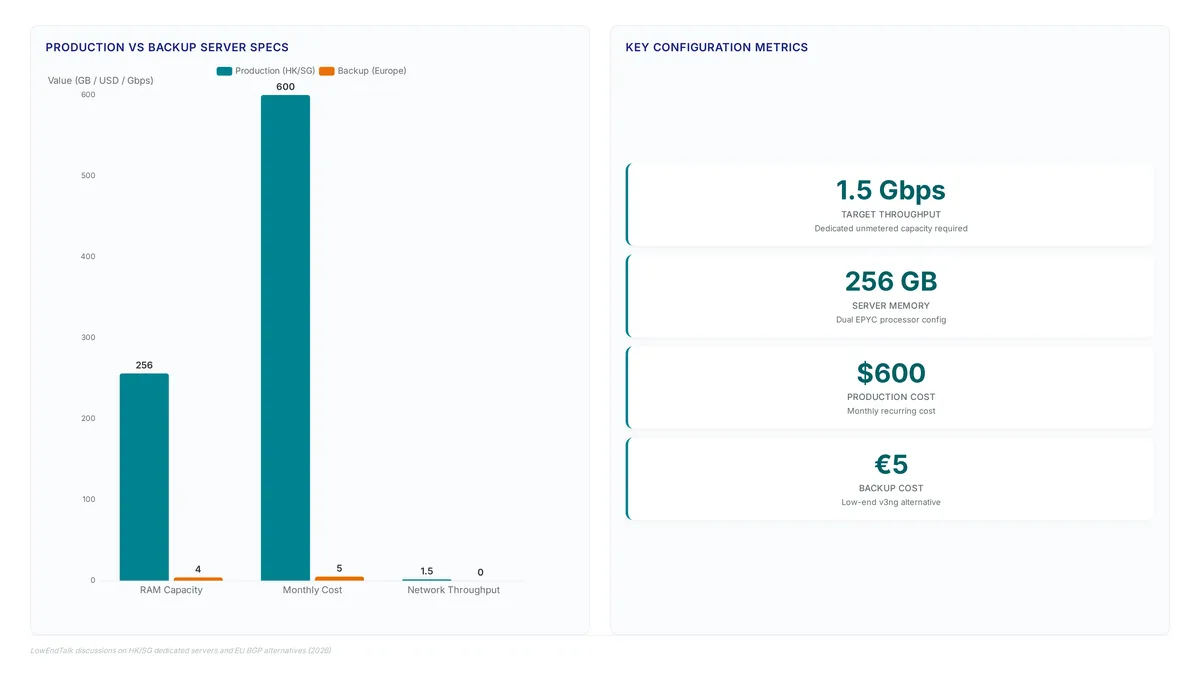
True 1.5Gbps dedicated unmetered capacity requires confirmation that the bandwidth is not a 1.5Gbps port with limited transfer. Operators targeting the HK/SG/Johor corridor frequently seek offers that distinguish between port speed and traffic allowances, as this configuration impacts CDN origin consistency during traffic spikes. Users must confirm bandwidth is 1.5Gbps dedicated unmetered to sustain the steady flow required by modern content delivery networks. A server configured with 256GB RAM and dual EPYC processors relies on sufficient network capacity to avoid bottlenecks. Verifying that the port speed guarantee aligns with the unmetered traffic policy is necessary before deployment. The cost of misconfiguration is measured in dropped packets and failed cache fills, not monthly overage fees.
Configuring Provider-Handled Gateways for Dual EPYC Origin Servers
This architecture allows the operating system to treat the network interface as a simple connection, relying on the upstream router for outbound routing decisions. Operators specifying 1.5Gbps throughput in the APAC region often request this model, noting, "I do not need a routed L3 setup on my side."
While this setup prevents granular traffic engineering via local policy, it lowers the risk of configuration errors that cause connectivity loss. This approach suits teams prioritizing stability over custom BGP manipulation on the host itself. The limitation remains a dependency on the provider's internal routing logic, which may not always align with specific peering preferences for every destination network.
Validating IPv6 BGP Support and IPv4 Block Pricing in Offers
Enterprise procurement for CDN origin traffic demands explicit confirmation of IPv6 BGP session capabilities before hardware selection proceeds. The following matrix contrasts compliant enterprise specifications against incomplete budget listings often found in regional markets.
| Feature | Enterprise Requirement | Budget Listing Risk |
|---|---|---|
| Routing Protocol | Native IPv6 BGP Support | Static Routes Only |
| Validation | RPKI/ROA Ready | Unverified Origins |
| Transparency | Clear Setup Fees | Hidden Monthly Costs |
Operators ignoring setup fee disclosures risk unexpected capital expenditure spikes during deployment phases. Failing to verify RPKI validation support leaves the network vulnerable to route hijacking incidents that compromise origin integrity. Demanding written confirmation of prefix announcement policies helps avoid downstream peering disputes. A provider's inability to supply a looking glass for route verification often signals insufficient infrastructure maturity for production workloads.
About
Alexei Krylov, Head of Sales at InterLIR, brings critical expertise to the complex search for dedicated server infrastructure in high-demand Asian markets. With a specialized background in B2B sales and deep familiarity with Regional Internet Registries (RIRs), Krylov understands that securing hardware in locations like Hong Kong or Singapore often hinges on immediate access to clean IPv4 resources. His daily work at InterLIR, a leading IPv4 marketplace founded in Berlin, involves navigating the precise scarcity issues highlighted in requests for servers requiring multiple IP addresses. While the article focuses on hardware specifications like dual EPYC CPUs, Krylov's perspective connects these physical requirements to the essential network layer. At InterLIR, he ensures clients obtain verified, legally sound IP blocks necessary for deploying reliable dedicated servers. This unique intersection of legal knowledge and network resource management makes him uniquely qualified to analyze the logistical challenges of procuring high-specification infrastructure in constrained geographic regions.
Conclusion
Scaling dedicated infrastructure in APAC reveals that bandwidth guarantees often fracture under sustained load without verified port commitments. The operational cost of ignoring routing transparency exceeds the initial savings of budget listings, as static routes cannot mitigate the volatility of regional peering disputes. Teams must prioritize providers offering native BGP sessions and RPKI validation over marginal price differences in IP leasing. Relying on shared throughput models invites performance degradation that static configurations cannot resolve.
Procurement strategies should mandate written confirmation of prefix announcement policies before any hardware deployment begins this quarter. Operators must treat the lack of a looking glass tool as a disqualifying factor for production workloads involving critical origin traffic. The variance in IPv4 pricing will likely widen as regional scarcity intensifies toward 2026, making long-term lease stability more valuable than spot market fluctuations.
Start by requesting a live route verification test from your current provider to confirm if your 1.5Gbps allocation maintains consistency during peak congestion windows. This single validation step exposes whether your infrastructure relies on genuine dedicated capacity or oversold shared pipes.
Frequently Asked Questions
A $600 monthly budget defines the current market entry point for dual EPYC hardware. This price typically secures the necessary 256GB RAM and high-speed connectivity required for robust regional deployments.
Operators must target 256GB DDR4 memory pools to maximize core density alongside dual processors. This specific capacity ensures the system sustains heavy loads without bottlenecking during peak traffic periods.
True dedicated throughput requires confirming a 1.5Gbps port delivers actual unmetered data transfer. Users must verify this limit is not a capped burst to avoid unexpected throttling or overage fees.
A standard allocation for these deployments involves a block of 10 IPv4 addresses included in base cost. Buyers increasingly demand these usable addresses rather than purchasing them as expensive separate add-ons.
The specific architecture pairs alongside 2TB NVMe capacity to ensure fast disk I/O. This storage volume is critical for static content delivery where read speeds significantly impact overall service latency.
References