Direct RIPE Membership vs Sponsored ASN Paths
Automated LIR sponsoring providers can process an ASN and IPv6 allocation in as little as 2 business days. This velocity exposes the friction inherent in traditional direct membership for organizations that don't need the full administrative weight of a RIPE NCC contract. Direct membership offers control, certainly, but sponsored models deliver identical resource ownership with drastically less overhead for most infrastructure projects.
Independent IP space stops reputation contamination from noisy neighbors on shared subnets cold. We need to talk about the cost gap between the €1,800 annual RIPE NCC fee and the fractional cost of sponsorship. The path from creating an ORG object to deploying BGP sessions no longer requires waiting weeks for manual processing if you know where to look.
Direct membership is mandatory for entities assigning resources to third parties. Yet, it imposes a €1,000 sign-up barrier that many small platforms cannot justify. Data from Planet Node confirms that automated services match the speed of direct interaction while bypassing the complex justification requirements for new members. You can secure a /48 IPv6 block and maintain full portability across upstream providers without the bureaucracy.
The Strategic Role of Independent ASNs and IPv6 Space in Modern Network Architecture
Defining ASN, LIR, and PI IPv6 Allocation Roles
An Autonomous System Number (ASN) marks a network boundary where independent routing policies replace single-provider dependency. This numeric identifier allows organizations to execute multihoming strategies, linking to multiple upstream ISPs while enforcing unique traffic engineering rules. Qualification often hinges on demonstrating intent to peer with at least two distinct providers or describing a unique routing policy unachievable through provider-assigned space alone. A Local Internet Registry (LIR) holds a direct contractual relationship with RIPE NCC for resource distribution. Direct membership demands significant capital commitment, specifically a €1,000 sign-up fee plus €1,800/year annual dues, making it viable primarily for large ISPs.
Real-World Value of Multihoming and IP Portability
Multihoming enables organizations to connect to multiple upstream providers and control traffic flow via BGP routing policies. This architectural choice prevents single points of failure while allowing precise traffic engineering based on latency or cost metrics. Independent IP space ensures these addresses follow the organization when switching providers, eliminating the operational burden of renumbering entire networks during migration. Portability creates a use point in commercial negotiations, as the threat of migration becomes technically trivial rather than a multi-month project.
Reputation isolation remains a primary driver for adopting independent resources. Email and web reputation stay isolated from noisy neighbors when an organization owns its IP allocation rather than sharing a provider's block. This separation is vital for SaaS platforms where deliverability directly correlates to revenue. Transferability extends beyond simple provider switching to include sponsorship models. If an organization is unhappy with a sponsor, they can transfer to another LIR, and critically, their ASN and IP space stay with the organization. This permanence ensures that years of building routing history and reputation are never lost due to vendor disputes. Sponsorship services enable this stability by providing access to necessary independent resources, ensuring your network infrastructure remains under your absolute control regardless of upstream changes.
RIPE NCC LIR Membership Versus Sponsored Resource Costs
Direct RIPE NCC membership demands a €1,000 sign-up fee plus €1,800/year annual dues, creating a high barrier for single-ASN operators. This Local Internet Registry status grants full autonomy but imposes significant fixed costs regardless of resource utilization. Organizations must weigh this capital expenditure against the operational reality that most small networks never require direct contractual use with the registry. The administrative overhead of maintaining compliance often outweighs the theoretical benefits of direct ownership for non-ISPs.
Sponsored models offer a pragmatic alternative, typically costing $60/year to $90/year for an ASN and IPv6 allocation. Providers enable automated processing that completes registration in as little as two business days, drastically reducing time-to-market. This approach separates resource ownership from administrative burden, allowing firms to retain their Org object control while outsourcing registry communications. For many, sponsorship provides identical technical outcomes regarding routing control and portability, preserving capital for hardware rather than bureaucracy.
Comparing Direct LIR Membership Against Sponsored ASN Models for Cost and Control
Direct LIR Contractual Rights Versus Sponsored Resource Ownership
Legal title to network assets stays separate from the administrative body handling the contract. Whether an entity selects direct Local Internet Registry status or engages a sponsoring LIR, the RIPE Database lists the applicant as the sole proprietor via their Org object. This structural divide guarantees resources belong to the holder rather than the service vendor. Direct participation with RIPE NCC demands a €1,000 entry fee plus €1,800/year in recurring dues, offering total contractual authority while imposing significant internal administrative load. Sponsorship arrangements frequently bundle these management tasks, shifting the burden of RIPE NCC correspondence to the provider while preserving the client's property rights.
Ownership persists regardless of the administrative path chosen. Assets remain portable property rather than leased commodities. Should a sponsor relationship deteriorate, the resource holder retains the right to transfer sponsorship without forfeiting their ASN or IP allocations. Operational risk stems not from potential ownership loss but from administrative bottlenecks if the sponsoring entity delays processing RIPE Database updates. Direct LIR membership becomes the mandatory operational choice once an organization sponsors 10+ resource holders or requires the participation in RIPE NCC governance. Below this threshold, the administrative overhead of direct membership often outweighs the benefits for single-entity networks. The financial tipping point occurs when cumulative sponsorship fees approach the fixed €1,800/year annual membership cost plus the initial €1,000 sign-up fee. Operators managing multiple client networks frequently find that paying individual annual rates creates unnecessary expense compared to the flat structure of direct membership.
You want full contractual control, but you also want minimal administrative burden. Sponsors handle daily communications while direct members gain the ability to influence policy through RIPE NCC governance participation. This distinction matters for large ISPs where routing policy impacts regional stability. Relying on a third-party introduces a dependency that direct ownership eliminates entirely. Networks exceeding the sponsorship volume threshold should transition to avoid compounding variable costs.
Executing the RIPE NCC Registration Workflow from ORG Object Creation to BGP Deployment
RIPE NCC Access Account and ORG Object Prerequisites
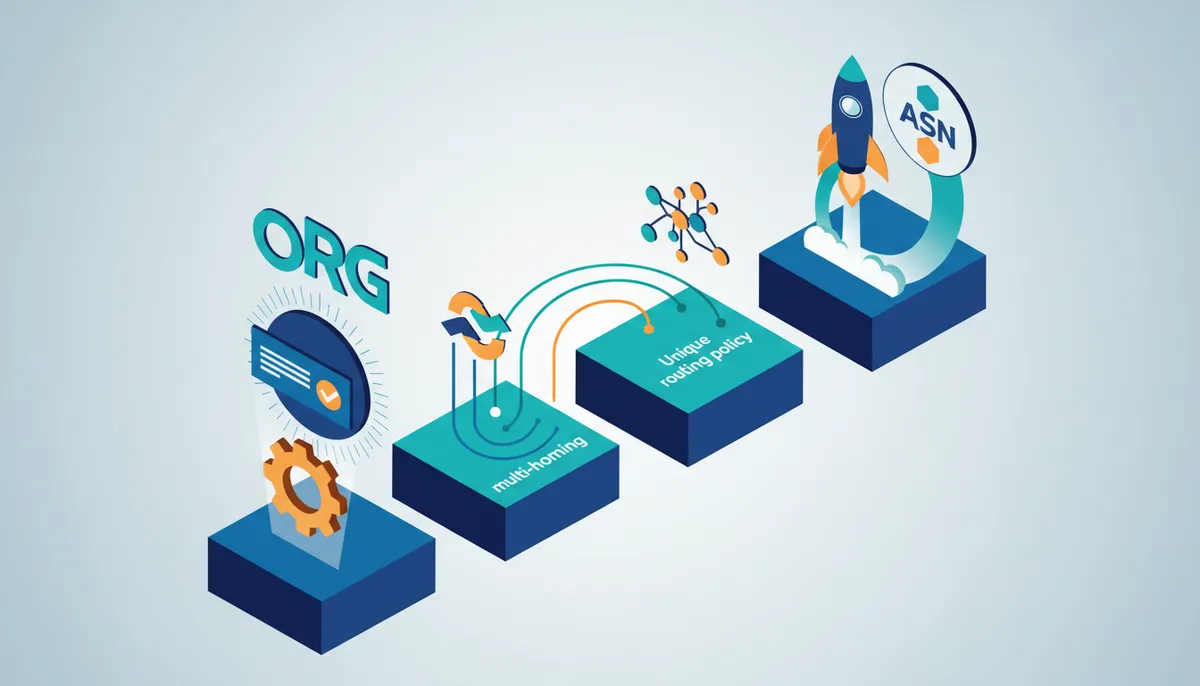
Establishing a valid RIPE NCC Access Account at access.ripe.net constitutes the mandatory technical gateway for managing RIPE Database objects prior to any resource allocation. Without this specific digital identity, operators cannot authenticate changes to the registry or initiate the ORG object creation required to represent a legal entity. The subsequent organization object must strictly define fields like abuse-c and mnt-ref to satisfy policy compliance before an ASN request proceeds.
- Navigate to the portal and register using official corporate credentials.
- Construct the ORG object with precise contact and maintainer attributes.
- Validate that the mnt-by field references an existing maintainer object.
While third-party sponsors may offer expedited administrative handling, the underlying database integrity remains the sole responsibility of the resource holder.
Constructing Peering Justification with Dual Upstream Providers
RIPE NCC requires a demonstration of legitimate need, including at least two upstream providers (or a plan to peer with two), a network description, and intended usage details to validate any ASN application. This technical constraint prevents resource exhaustion by ensuring public numbers are reserved for networks with genuine routing complexity rather than simple single-homed connectivity. Operators must explicitly name their intended transit partners and describe the specific redundancy architecture they plan to implement. The justification requires concrete provider names and a clear routing policy statement, such as detailing a plan to multihome with specific providers for redundancy.
- Identify two distinct upstream ISPs within the service region that support BGP sessions.
- Draft a concise network description explaining why independent routing is necessary for your infrastructure.
- Submit these details to your sponsoring LIR for evaluation against current policy.
The following configuration illustrates the intended neighbor relationship for a dual-homed setup:
Pre-Deployment Validation for BGP Session Configuration
Validating BGP readiness requires confirming your /48 allocation and ensuring the network description matches the registered routing policy exactly. Operators must verify that their intended topology supports multihoming before initiating sessions with upstream providers. This validation prevents immediate session rejection due to policy mismatches in the RIPE Database.
- Confirm the ASN assignment reflects a 32-bit number, standard since 2009.2.
- Verify that the ORG object contains a valid abuse contact to avoid compliance failures.
- Ensure your peering plan includes two distinct upstreams to satisfy justification requirements.
A critical oversight involves private versus public number usage.
Securing Network Infrastructure Through RPKI ROAs and Abuse Contact Management
RPKI ROAs and Abuse Contact Requirements

Prefixes remain vulnerable to hijacking without cryptographic Route Origin Authorizations (ROAs) validating the announcing AS. Operators must generate these records immediately because unverified routes attract malicious traffic that disrupts service availability. The RIPE NCC mandates an abuse-c field in every ORG object to enable incident response during security audits. Neglecting this requirement triggers compliance reviews that can suspend resource management privileges until data currency is restored. Organizations opting for direct membership handle these updates independently, whereas sponsored models often include professional management to maintain data currency. Stale contact information delays mitigation efforts during active attacks on network infrastructure.
Configuring RPKI ROAs to Prevent Route Hijacking
Creating Route Origin Authorizations (ROAs) immediately stops unauthorized ASNs from announcing your prefixes. Without these cryptographic signatures, Border Gateway Protocol accepts false path information that redirects traffic to malicious actors. Operators must log into the RIPE NCC portal to define the maximum prefix length and the specific origin ASN for every allocation. This process transforms a vulnerable announcement into a verified asset that routers globally can trust by default. Neglecting this step leaves infrastructure exposed to hijacking attempts that steal bandwidth and damage reputation.
Generating ROAs introduces a strict dependency on correct configuration syntax, where a single typo in the maximum length field causes legitimate routes to be dropped by validating peers. The operational cost of this precision is low, yet the consequence of error is total loss of connectivity for the affected prefixes. Network architects must balance the speed of deployment with the absolute accuracy required for cryptographic validation.
Omitting abuse-c fields triggers immediate audit failures that suspend resource management privileges. Every ORG object requires a valid contact pointer because RIPE NCC audits periodically enforce this strict compliance standard. Network operators facing configuration gaps must fix missing abuse contact entries to maintain operational status. Missing reverse DNS delegation causes catastrophic email deliverability failures in modern IPv6 deployments. Receiving mail servers reject traffic from domains lacking proper pointer records, effectively silencing new infrastructure. Not setting up reverse DNS is necessary for maintaining email deliverability in production environments. The operational risk extends beyond simple rejection; unverified origins invite spam classification that damages long-term reputation.
About
Alexander Timokhin, CEO of InterLIR, brings deep expertise in IP infrastructure and RIPE NCC procedures to the complex process of securing an Autonomous System Number. With a background spanning IT operations management and certified RIPE Database administration, he understands the critical importance of routing independence and IP reputation for modern networks. His daily work at InterLIR involves guiding organizations through the nuances of acquiring and managing necessary network resources, ensuring clean BGP objects and smooth connectivity. While the article details obtaining IPv6 space and ASNs directly from RIPE NCC, Timokhin's leadership focuses on solving the parallel challenge of IPv4 scarcity. At InterLIR, his team enables the transparent redistribution of unused IPv4 blocks, providing the complementary address space many multihoming organizations require. This practical experience in global IP market dynamics and regulatory compliance uniquely positions him to explain the strategic value of owning your own network identity in today's interconnected environment.
Conclusion
Scaling network operations reveals that manual compliance tracking becomes unsustainable as infrastructure grows, turning routine audits into significant operational bottlenecks. While initial acquisition costs for an ASN remain low, the hidden expense lies in the continuous labor required to maintain database integrity and avoid service suspension. Organizations must transition from reactive fixes to proactive governance models that automate adherence to strict registry standards. We recommend implementing a structured validation workflow for all ORG objects and reverse DNS delegations before any new route announcement. This approach prevents the email deliverability failures and audit penalties that plague unmanaged deployments. Start this week by verifying that every active IP block has a populated abuse-c field and valid reverse mapping to eliminate immediate compliance gaps.
The industry shift toward automated LIR services demonstrates that two-day processing times are now achievable, rendering slow, manual application methods obsolete for competitive operators. Teams should use this speed to secure resources rapidly while maintaining rigorous internal checks. By centralizing your ip resource management with expert support, you ensure that cryptographic validation and routing security remain intact.
Frequently Asked Questions
This fractional price avoids the heavy €1,800 annual fee required for direct RIPE NCC membership, making it ideal for smaller infrastructure projects needing independent routing.
Applicants often pay approximately $15 for initial configuration when acquiring resources. This one-time charge is significantly lower than the €1,000 sign-up barrier for direct membership, allowing organizations to access independent IP space with minimal capital expenditure.
Processing can be completed in as few as 2 business days with automated providers. This speed bypasses the weeks of manual processing often faced by direct applicants, enabling rapid deployment of BGP sessions and immediate network multihoming capabilities.
You must demonstrate intent to connect with at least two upstream ISPs for multihoming. Alternatively, describing a unique routing policy that cannot be achieved with provider-assigned space alone satisfies the requirement for obtaining your own autonomous system number.
The organization retains full ownership and can transfer sponsorship to another LIR at any time. Your ASN and IP allocation stay with your entity, ensuring that years of routing history and reputation are never lost due to vendor disputes.
References