DNS resolver choices: Stop using one for every device
Using the same DNS provider for every device ignores how smart TVs, work laptops, and tablets have distinct security priorities.
Most home networks blindly route traffic through a single recursive dns resolver, creating unnecessary exposure where a tailored approach offers superior protection. Ismar Hrnjicevic argues in his July 2026 analysis that matching specific devices to specialized DNS resolver services creates a more reliable defense than a one-size-fits-all configuration. By segmenting traffic based on device function, users can enforce strict device-specific DNS filtering without installing heavy software on every endpoint.
DNS resolution mechanics effectively block ads and telemetry on resource-constrained smart TVs that struggle with sponsored content. Selecting optimal DNS resolver provider options like NextDNS or AdGuard DNS stops Automatic Content Recognition tracking on streaming boxes. Finally, distinct roles go to different DNS resolver operator configurations, ensuring work devices maintain privacy while kids' tablets access only appropriate content. This strategy transforms a basic network setting into a granular security tool capable of isolating threats before they reach the endpoint.
The Strategic Role of Device-Specific DNS Filtering
Defining DNS Filtering and Sinkhole Mechanics
Think of DNS filtering as a bouncer at a club door. Instead of letting a request hit a malicious server and hoping the endpoint software catches the payload, the filter intercepts the query and redirects it to a non-routable sinkhole IP address. The connection dies instantly. No data leaves the building. Providers map domain categories to these blocking responses, creating distinct family-safe DNS profiles that enforce content restrictions automatically. You don't need complex scripts; changing a single digit in a DNS IP address instantly enables malware and adult content filtering without additional software costs. Modifying a configuration to point toward specialized clusters activates these protections through simple DNS filtering by IP adjustments. Standard setup procedures typically require entering two or more IP addresses to ensure fallback capability if the primary request fails during resolution attempts.
Modern hardware leverages this by applying rules per device. You can lock down a child's tablet while leaving your development machine unrestricted. This granularity solves the age-old conflict between security and usability. However, don't mistake this for a magic bullet. Because reliance on domain-based blocking means encrypted traffic within allowed applications remains visible, you still need complementary security layers for full protection. Optimizing existing IPv4 infrastructure with precise resolver assignments helps maximize network safety and performance.
Assigning Resolvers by Device Risk Profiles
Uniform network settings create uniform vulnerability. Smart TVs, for instance, are privacy nightmares requiring aggressive ad-blocking to counter Automatic Content Recognition telemetry that tracks viewing habits across apps. Children's tablets need strict family filtering to intercept malicious domains before they load. Work laptops? They need speed and specific security postures, not necessarily the same heavy-handed blocklists used for the living room. This targeted approach ensures that critical business video calls remain uninterrupted while recreational devices maintain heavy protection layers.
Executing this requires hardware that understands per-device configuration, such as the Unifi Dream Router 7, which functions as a full network controller. Advanced users define granular policies that apply strict filtering to kids' tablets while allowing open access for professional equipment. Such device-specific rules distinguish modern setups from legacy routers that force one policy on all connected endpoints. Providers like NextDNS support these custom profiles, enabling operators to tailor security postures precisely. But be clear: relying solely on DNS for parental control has limitations; it cannot filter explicit content within encrypted app streams like TikTok. Operators must recognize that while DNS blocks domain access, it does not analyze internal app data packets. Matching each device type to an optimized resolver notably reduces the attack surface compared to default ISP settings. Evaluating current inventory helps identify which assets need protection versus performance optimization.
Privacy Risks in Default DNS Logging Configurations
Your ISP is watching. Default ISP DNS configurations log every website a user visits, creating a significant privacy gap even when encrypted protocols are active. Modern standards prevent network monitors from viewing specific sites, yet the DNS provider itself often retains query logs unless explicitly configured otherwise. This retention occurs by default on many standard plans, meaning privacy is not automatic but requires manual intervention. Cisco offers a specific control option to stop logging DNS lookups on a "go-forward basis," yet this feature remains turned off by default on their free home network plan. Users must actively disable these logging features to ensure true privacy, as passive reliance on encryption alone is insufficient. The risk extends beyond simple history tracking; detailed logs allow providers to build thorough profiles of household activity patterns.
Optimizing current IP allocation ensures full authority over network operational parameters. Relying on default settings leaves query data exposed to third-party retention policies that may not align with security goals. Network operators must recognize that switching resolvers is only the first step; verifying the logging policy of the new provider is equally critical. Without this verification, the perceived security benefit remains illusory.
How DNS Resolution Mechanics Block Ads and Trackers
How DNS Resolvers Intercept Queries to Block Ads
Privacy-focused DNS resolvers halt data exfiltration by blacklisting the specific analytics servers TV manufacturers use. These services function as a DNS sinkhole capable of intercepting outbound requests to drop sketchy telemetry and tracking connections before they reach external networks. When a device attempts to resolve a known ad server, the resolver returns a non-routable address instead of the real IP, effectively silencing the advertisement at the source. This mechanism proves highly effective for clearing home screen banners on Samsung Tizen OS and LG webOS interfaces. Regular ads on platforms like YouTube remain visible because the video content and advertisements share the same domain.
| Feature | Standard DNS | Privacy DNS |
|---|---|---|
| Query Handling | Resolves all | Filters lists |
| Telemetry | Allowed | Blocked |
| Ad Domains | Resolved | Sinkholed |
Don't get complacent. Some smart TVs will bypass custom settings by resolving through a different public DNS if they detect a blocked query. The InterLIR team recommends deploying device-specific profiles to maintain optimal network hygiene across diverse hardware.
Deploying Sinkholes for IoT and Smart TV ACR Protection
Low-power processors inside modern smart TVs struggle when overwhelmed by sponsored content requests. Automatic Content Recognition (ACR) systems continuously scan screen data to transmit viewing habits back to manufacturers, creating significant privacy leakage. Configuring a DNS sinkhole allows network operators to intercept these outbound telemetry requests and return non-routable addresses instead of real IPs. This approach effectively drops sketchy tracking connections before they leave the local network perimeter.
Implementation typically involves cloud-based services like NextDNS or self-hosted options on a Raspberry Pi. These tools act as firewalls for streaming devices, blocking mainstream ad domains while preserving video playback functionality.
| Device Type | Primary Risk | Recommended Action |
|---|---|---|
| Smart TV | ACR Tracking | Apply strict ad-blocking lists |
| IoT Sensor | Data Exfiltration | Block all outbound telemetry |
| Tablet | Malware | Enable family filtering policies |
Smart home devices remain the chattiest components in modern networks, frequently sending insecure data packets to external servers. A single configuration change can immediately begin blocking malware without installing heavy software agents on constrained hardware. DNS filtering alone cannot guarantee total privacy without complementary router-level firewall rules to enforce policy.
InterLIR supports these architectural choices by providing stable IPv4 resources necessary for hosting reliable, self-managed DNS infrastructure. Optimizing your existing IPv4 allocations ensures that local resolvers maintain consistent uptime and low latency for all connected devices.
Limitations of Custom DNS Against Hardcoded Telemetry Paths
Hardcoded paths allow gadgets to bypass custom DNS settings, necessitating firewall rules for absolute protection. Switching resolvers reduces side banners and pop-ups, yet sophisticated devices may resolve queries through alternative public DNS if they detect blocking. A standalone DNS sinkhole cannot guarantee complete telemetry suppression on its own. Network operators must couple sinkholes with strict firewall rules in the router to force all port 53 traffic through the desired resolver. Work websites might appear blocked if the device reverts to an unfiltered path that conflicts with corporate policies without this layer. Hardware like the Unifi Dream Router 7 enables such granular control by functioning as a full-fledged network controller. Relying solely on device-level configuration leaves gaps where hardcoded paths exfiltrate data undetected. True security requires intercepting traffic at the network perimeter rather than trusting the endpoint. Absolute protection demands acknowledging that DNS alone is not a silver bullet against determined telemetry.
Selecting Optimal DNS Providers for Distinct Device Roles
NextDNS vs AdGuard DNS: Filtering Logic and Family Shield Mechanics
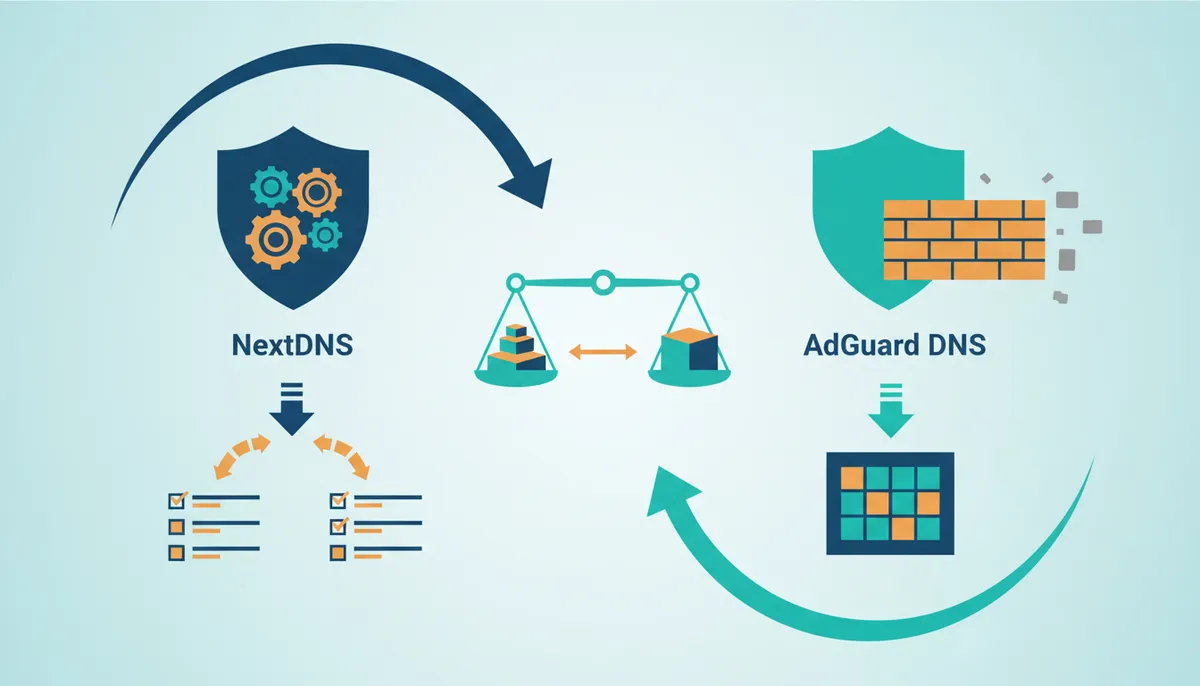
Distinguishing between customizable policy engines and static filtering profiles defines the choice between NextDNS and AdGuard DNS. Both services function effectively as ad blocking dns solutions, yet their operational approaches to family-focused DNS diverge sharply regarding granularity. NextDNS excels by offering per-device rules, a feature allowing network administrators to assign unique filtering profiles to specific tablets or consoles without disrupting the entire subnet. AdGuard DNS applies its filtering logic across connected devices strictly based on the selected DNS endpoint.
Unlike heavy parental control apps, these DNS providers filter malicious domains and often enforce SafeSearch on Google without slowing down devices. Family protection DNS serves only as a first line of defense and cannot block explicit content inside apps like TikTok and Instagram. dns filtering effectively sinks known bad domains but lacks the deep packet inspection required to filter content within encrypted app streams. Households needing distinct policies for children versus adults find that defining per-device rules provides a necessary layer of control static IP switching cannot match. This architectural difference means NextDNS suits complex homes, whereas AdGuard offers a simpler, blanket approach for basic safety needs. The decision rests on whether network strategy prioritizes granular customization or immediate, zero-configuration deployment.
Mapping Cloudflare and Quad9 to Gaming Consoles and Personal Computers
Gaming consoles and personal computers demand performance-first DNS configurations prioritizing low latency over aggressive filtering. Heavy blocking lists often introduce resolution delays or accidentally prevent access to legitimate game servers and company websites. Operators should configure resolvers like Cloudflare or Quad9 for these high-bandwidth devices to maintain speed while retaining necessary threat protection. These services focus on malware prevention without inspecting content categories that could interrupt gameplay. Prioritizing performance and reliability over heavy filtering ensures optimal connectivity for smartphones, desktop computers, laptops, and personal gaming consoles.
Advanced network setups allow administrators to apply distinct policies per device rather than forcing a single setting across the entire home network. Users with capable hardware like the Unifi Dream Router 7 can define specific rules routing gaming traffic through fast resolvers while filtering other devices. This granular approach ensures dns query protection secures the network without degrading the experience on latency-sensitive hardware.
Maximizing throughput requires accepting that some non-malicious but unwanted domains might resolve unless specifically blocked at the endpoint. Network operators must balance the desire for a clean interface against the rigid requirements of real-time online gaming. InterLIR supports this optimized architecture by providing the stable IPv4 addressing resources necessary to maintain distinct, high-performance network segments for every device role.
DNS Provider Selection Checklist: OpenDNS, CleanBrowsing, and Quad9 Features
Start device-specific DNS configuration by matching resolver capabilities to specific household roles. Recommended options for family-focused filtering include OpenDNS FamilyShield, CleanBrowsing Family Filter, and Cloudflare for Families. These services act as a primary defense layer, though they cannot block explicit material embedded within TikTok or Instagram applications. Gamers and PC users should instead prioritize Quad9, which retains real-time threat protection while serving as a performance-first provider minimizing input lag.
Operational tension lies between safety and accessibility; aggressive filtering on a personal laptop may accidentally block legitimate work domains or game servers. Modern approaches allow for device-specific rules applying distinct policies to individual endpoints, unlike static network-wide settings. Family-focused DNS remains merely a first line of defense, not a complete substitute for active parental supervision.
InterLIR recommends optimizing existing IPv4 resources by assigning the correct resolver to each device class rather than upgrading bandwidth unnecessarily.
Implementing Custom DNS Configurations Across Your Home Network
Smart TV ACR Tracking and DNS Sinkhole Mechanics

Smart TVs relentlessly track viewing habits using ACR (Automatic Content Recognition) to log almost everything displayed on screen. These gadgets often pack low-power processors that stutter when telemetry floods the network, creating genuine privacy headaches for families. A DNS sinkhole stops this chaos by resolving known tracking domains to non-routable addresses, cutting off analytics servers before they grab a single byte. Specialized providers function as dedicated firewalls, blacklisting the exact servers manufacturers use to harvest viewing data rather than offering generic resolution.
Securing your streaming environment demands device-specific setup instead of blanket network rules. Follow this path to lock down your entertainment hub:
- Navigate to network settings on your Samsung Tizen OS, LG webOS, or Android/Google TV interface.
- Replace the automatic IP assignment with static addresses from providers that support custom family profiles.
- Verify connectivity by checking for reduced home screen banners and pop-ups immediately after saving changes.
This technique slashes telemetry dramatically yet fails to stop regular advertisements on platforms like YouTube since those ads share domains with the actual video content. Granular control via device-specific DNS rules offers far more precision than network-wide changes that force identical policies on every connected gadget.
Configuring Family DNS Filtering for Kids Devices and SafeSearch
Specific rules turn ordinary routers into powerful filtering appliances that shield children without dragging down tablet performance.
- Identify target devices such as kids' tablets or gaming consoles within your network dashboard.
- Apply family-focused DNS addresses like OpenDNS FamilyShield or CleanBrowsing to these specific units only.
- Enable SafeSearch enforcement to filter malicious domains and restrict explicit results on Google automatically.
Such a setup builds a safeguarded zone where policy enforcement at the DNS level halts harmful content before it ever hits the display. Heavy parental control apps are unnecessary here, meaning no software installation on the child's device is required and performance stays snappy. Differentiation among providers comes from custom family profiles enabling per-device rule configurations for ultimate flexibility.
Parents should view this technology as a strong first line of defense rather than a complete cure-all. Explicit content inside apps like TikTok or Instagram remains accessible, so active monitoring must accompany these technical controls. The limitation is obvious: broad protection against malware and adult sites arrives alongside reduced visibility into encrypted app interiors. Assigning distinct resolvers grants families immediate safety from online threats while keeping connection speeds high for educational tools.
Troubleshooting DNS Bypass Risks and Broken Site Access
Hardcoded telemetry paths let smart TVs ignore custom settings unless firewall rules explicitly block unauthorized outbound queries.
- Inspect router logs to identify devices attempting direct resolution outside your assigned resolver chain.
- Deploy a DNS sinkhole configuration to intercept queries targeting known tracking or ad-serving domains.
- Configure fallback DNS addresses to ensure connectivity remains stable if the primary resolver fails to respond.
Manufacturers sometimes design operating systems to revert to public resolvers upon detecting query failures, effectively sidestepping local DNS filtering policies. This behavior creates friction between strict privacy enforcement and reliable access to business resources. Advanced routers enable granular per-device policies, yet absolute protection demands coupling a sinkhole with upstream blocking at the network edge. Operators must realize that device-specific configurations alone cannot stop an appliance determined to phone home via IP address instead of domain name.
Aggressive blacklisting needs careful handling though; maintaining a lean, verified blocklist often works more reliably than importing massive, unvetted databases that might break connectivity.
About
Vladislava Shadrina, Customer Account Manager at InterLIR, brings a unique perspective to network infrastructure discussions through her daily work managing client relations in the IP resources marketplace. While her professional focus lies in facilitating secure IPv4 address transactions and ensuring clean BGP reputations, she understands that reliable network performance starts with fundamental configurations like DNS resolvers. At InterLIR, a Berlin-based specialist in IPv4 redistribution, Vladislava helps organizations secure the critical address space necessary for reliable internet connectivity. Her expertise in maintaining network availability and verifying IP quality directly connects to the importance of proper DNS management for device security and speed. By overseeing diverse client needs across global markets, she recognizes how misconfigured resolvers can undermine the stability that clean IP resources provide. This article reflects her commitment to educating users on optimizing their network layers, ensuring that the IP addresses clients lease or purchase through InterLIR perform at their highest potential within a well-architected home or business environment.
Conclusion
Scaling DNS privacy from a single router setting to a device-specific architecture reveals where basic configurations fracture. As households assign distinct resolvers to tablets, consoles, and workstations, the operational burden shifts from simple setup to continuous log analysis and policy maintenance. The assumption that changing one setting secures the entire network fails when smart appliances bypass local rules via hardcoded telemetry paths. This fragmentation demands a more rigorous approach than merely toggling a privacy switch in Windows 11 or similar operating systems.
Organizations and advanced home labs must stop treating DNS resolution as a set-and-forget utility. Instead, implement a tiered strategy where critical devices apply strict, filtered resolvers while guest networks operate under separate, monitored chains. This separation prevents a compromised IoT device from poisoning the resolution cache for your primary workstation. The window for relying on blanket network-wide defaults is closing as application-level encryption and direct IP connections become standard.
Start this week by auditing your router logs to identify any device attempting direct resolution outside your assigned chain. Isolate these outliers immediately and apply per-device policies rather than hoping a global rule catches every exception. True network hygiene requires acknowledging that recursive dns resolver configurations must evolve alongside the devices they protect.
Frequently Asked Questions
Yes, changing your DNS IP settings instantly enables malware filtering without additional software costs. This zero-friction approach is ideal for smart TVs with low-power processors that struggle with heavy security applications.
No, custom DNS cannot block ads on platforms like YouTube because they share domains with video content. However, it effectively stops Automatic Content Recognition telemetry and removes home screen banners on most devices.
You typically need to enter two or more IP addresses to ensure fallback capability if the primary request fails. This redundancy prevents connectivity loss when the first resolver encounters an outage or error.
Relying solely on DNS for parental control has limitations regarding encrypted app streams like TikTok. While it blocks malicious domains, it cannot analyze internal data packets within those specific encrypted application connections.
References