Extranet VPC routing: stop overlapping private CIDRs
Overlapping RFC 1918 address spaces break routing when multiple partners share private CIDRs without complex NAT. The solution is an Extranet VPC architecture that enforces strict partner isolation while eliminating IP conflicts. You will learn how the Extranet VPC functions as a secure meeting point, using AWS Direct Connect Gateway to terminate Transit Virtual Interfaces for each external organization. The discussion also covers configuring segmented route tables and allowed prefixes to maintain these boundaries without requiring partners to renumber their networks.
Increasing constraints on IPv4 addresses intensify these challenges for enterprises attempting to scale partner integrations. By using BYOIP or Amazon-owned public IPv4 blocks within IPAM pools, organizations can bypass the limitations of traditional private addressing schemes. This approach simplifies compliance auditing and supports data privacy between competitors who access your infrastructure simultaneously.
The Role of Extranet VPC in Modern Partner Connectivity
Extranet VPC Architecture and Transit Gateway Isolation
Think of the Extranet VPC as a neutral zone where internal services meet external partner networks. This design stops routing failures dead in their tracks when multiple partners apply overlapping RFC 1918 private address spaces. AWS Transit Gateway segments routing domains so each partner remains completely isolated from others. Associating VPC attachments with specific route tables stops lateral movement between competing entities sharing the same infrastructure. Standard VPC Peering alternatives often fail to scale without complex reconfiguration or introducing significant operational overhead.
Strict separation demands disciplined management of allowed prefixes on the Direct Connect Gateway to prevent accidental route propagation. A single misconfiguration in prefix advertising could expose one partner's network to another, undermining the entire security model. Address scarcity intensifies these challenges for enterprises, making efficient address planning necessary. Using globally unique public IPv4 blocks removes the need for multistep NAT workarounds between overlapping private ranges. This strategy ensures scalable partner connectivity while preserving the integrity of the core production environment.
Deploying Public IPv4 Space to Eliminate NAT Workarounds
Public IPv4 addressing provides the globally unique identifiers required to prevent routing collisions in multi-partner environments. Standard private ranges often overlap between organizations, forcing complex NAT workarounds that introduce latency and management overhead. Assigning public space to the Extranet VPC removes this friction by ensuring every endpoint possesses a distinct address reachable without translation layers. Partners connect via AWS Direct Connect using Transit Virtual Interfaces, which terminate on a centralized gateway to maintain strict path segregation. This model relies on the inherent uniqueness of public IP blocks to simplify BGP routing tables and eliminate the need for proxy servers or re-addressing campaigns.
| Constraint | Private IPv4 Approach | Public IPv4 Approach |
| Address Uniqueness | High risk of overlap | Guaranteed global uniqueness |
| Connectivity Logic | Requires multi-step NAT | Direct routing possible |
| Operational Overhead | High configuration burden | Minimal translation rules |
While AWS PrivateLink offers service-level exposure, it does not solve network-layer IP conflicts for broad extranet access. The limitation is the finite availability of IPv4 resources, which necessitates efficient allocation strategies. Enterprises can bring their own IP addresses to IPAM (BYOIP) if they own an IPv4 CIDR block, or they can provision Amazon-owned public IPv4 blocks to IPAM pools. Operators gain immediate architectural clarity by removing translation boundaries that often obscure troubleshooting efforts.
BYOIP Versus Amazon-Provided IPv4 Blocks Cost and Control
Bring Your Own IP (BYOIP) allows organizations to announce a registered CIDR block, avoiding hourly fees entirely. This approach contrasts with provisioning Amazon-owned contiguous IPv4 blocks, which incur charges per address per hour regardless of traffic volume. Since February 2024, AWS applies a $0.005 rate to every public IPv4 address, making idle Amazon-provided space a persistent cost center. BYOIP requires the block to be registered with ARIN, RIPE NCC, or another Regional Internet Registry before integration. Amazon-provided blocks offer instant deployment, yet the cumulative hourly charge escalates rapidly for large extranet architectures requiring addresses. Conversely, BYOIP demands upfront registry validation but eliminates recurring infrastructure tax on unused capacity. Network operators must weigh the administrative overhead of registry coordination against the certainty of avoiding per-hour billing spikes. For partners connecting via AWS Direct Connect, the architecture supports communication even when one of the companies is not running their workloads on AWS. The choice ultimately dictates whether the network operates as a variable cost utility or a fixed asset.
Inside AWS Direct Connect Gateway and Transit Gateway Routing Logic
Architectural Isolation Mechanics of DXGW and TGW Routing Domains
Isolation within this architecture is inherent to the system design, not a result of manual filter configuration. Unlike on-premises Virtual Routing and Forwarding (VRF) instances that demand precise policy application, the AWS implementation enforces segmentation structurally. The AWS Transit Gateway acts as the central hub, where routing domain segmentation strictly associates VPC attachments to specific route tables. This mechanism ensures that traffic from one partner never intersects with another at the control plane level.
The Direct Connect Gateway (DXGW) reinforces this boundary by using allowed prefixes to dictate exactly which routes propagate to external peers. Consequently, the DXGW will not propagate routes from one partner to another, effectively preventing accidental route leaks. Consider a scenario where Partner A uses `192.0.2.0/24` and Partner B uses `198.51.100.0/24`. Both receive announcements only for the Extranet VPC CIDR `203.0.113.0/24`. Neither entity learns the other's addressing scheme through BGP. This structural rigidity eliminates the risk of lateral movement between competitors sharing the same infrastructure.
| Feature | On-Premises VRF | AWS DXGW + TGW |
|---|---|---|
| Isolation Type | Configurational | Architectural |
| Leak Prevention | Policy-dependent | System-enforced |
| Modification Scope | Global | Extranet VPC Admin Only |
Operators must recognize that this design shifts the security perimeter from software filters to the routing topology itself. Increasingly constrained IPv4 addresses intensify challenges for enterprises, making the optimization of non-overlapping public IPv4 blocks necessary to mitigate overlapping address spaces without complex NAT overlays.
Enforcing Route Boundaries with DXGW Allowed Prefixes
A single DXGW scales to 30 partners, yet default BGP behavior risks propagating routes between them without strict controls. The mechanism relies on allowed prefixes configured at the gateway association level to filter outbound advertisements. This configuration ensures the gateway will not propagate routes from one partner to another, effectively silencing cross-partner visibility. For instance, if Partner A announces `192.0.2.0/24` and Partner B announces `198.51.100.0/24`, the Extranet VPC receives both, but the DXGW returns only `203.0.113.0/24` to each peer.
| Feature | Without Allowed Prefixes | With Allowed Prefixes |
|---|---|---|
| Route Propagation | Full mesh leakage possible | Strictly filtered |
| Isolation Model | Configurational (error-prone) | Architectural (enforced) |
| Admin Scope | Shared risk | Extranet VPC only |
Only Extranet VPC administrators possess the privileges to modify these settings via API calls like `UpdateDirectConnectGatewayAssociation`. A critical limitation emerges here: while architectural isolation prevents accidental leaks, it simultaneously removes the ability for partners to validate end-to-end path diversity without explicit coordination. This trade-off demands rigorous pre-deployment planning for BGP routing policies. Optimizing existing IPv4 resources ensures that every partner connection remains distinct and routable without exhausting private address space.
Risks of Manual Route Table Modifications and API Call Gaps
Operational failure in this architecture stems primarily from unauthorized API call gaps rather than protocol defects. While isolation is structural, the Extranet VPC administrators retain exclusive privileges to modify route tables, creating a single point of human error. A mistaken `CreateTransitGatewayRoute` command can inadvertently expose partner CIDRs, bypassing the intended architectural isolation.
To maintain visibility into configuration changes, operators can configure alarms for specific API actions including `UpdateDirectConnectGatewayAssociation` and `CreateTransitGatewayRouteTable`.
| Risk Vector | Consequence | Detection Method |
|---|---|---|
| Erroneous Route Creation | Partner CIDR leakage | Alarm on `CreateTransitGatewayRoute` |
| Association Update | Cross-partner exposure | Alarm on `UpdateDirectConnectGatewayAssociation` |
| Silent Configuration Drift | Loss of audit trail | Continuous API logging |
When BGP fails to advertise the extranet CIDR, verifying that the DXGW association has not been altered by an unmonitored administrative action is a key troubleshooting step. The secure scalable partner connectivity model relies on these strict boundaries remaining intact. Integrating these API monitors directly into network operations centers helps prevent silent route leaks. Without these safeguards, the theoretical security of the design collapses under operational drift. Create alarms for API calls such as `UpdateDirectConnectGatewayAssociation` to detect unauthorized changes.
Configuring Segmented Route Tables and Allowed Prefixes for Isolation
Implementation: TGW Routing Domain Segmentation Mechanics
Assign each VPC attachment to a dedicated route table to enforce strict partner isolation. This architectural approach ensures that routing domains remain separate, preventing any cross-traffic between external entities without complex filtering policies. Unlike traditional on-premises designs relying on Virtual Routing and Forwarding (VRF) instances, this method makes isolation inherent to the cloud topology rather than a fragile configuration option. A single misconfiguration in legacy VRF setups can expose one partner's network to another, whereas the cloud model restricts modification rights to Extranet VPC administrators only.
Operators must execute the following steps to segment traffic correctly:
- Invoke `CreateTransitGatewayRouteTable` to generate a unique routing domain for every partner connection.
- Associate the specific VPC attachment to this new table, ensuring propagation is limited to specific route tables.
- Define static routes or enable propagation strictly for the partner's assigned public IPv4 block, such as `192.0.2.0/24`.
- Monitor `CreateTransitGatewayRoute` API calls to detect unauthorized route injections that could compromise segmentation.
Scalability depends on disciplined administrative control; only authorized personnel should manage these tables. AWS Transit Gateway acts as the central hub where these logical boundaries are physically enforced.
Define the exact allowed prefixes on the Direct Connect Gateway to restrict BGP advertisements strictly to the Extranet VPC CIDR. This configuration ensures the gateway does not propagate routes from one partner to another, maintaining absolute path isolation. Without this filter, a partner could theoretically learn routes intended for a different entity, creating a significant security exposure. The operational reality is that secure scalable partner connectivity depends on this explicit route suppression rather than implicit trust.
Operators must execute the following sequence to enforce these boundaries:
- Identify the specific public IPv4 CIDR block required for partner access.
- Apply the prefix list to the DXGW association using the `UpdateDirectConnectGatewayAssociation` command.
- Verify that the remote peer receives only the intended Extranet VPC CIDR block in its BGP table.
Operational simplicity often conflicts with security granularity. A single broad prefix reduces configuration steps but increases the attack surface if the Extranet VPC itself is compromised. Conversely, highly granular prefixes offer tighter control but require rigorous lifecycle management as partner needs evolve. Relying on overlapping private addresses introduces complexity that DXGW allowed prefixes alone cannot resolve without additional NAT layers. The architecture prevents lateral movement by design, yet the efficacy relies entirely on the precision of these advertised routes. Partners connecting via on-demand private connections gain access solely to the set scope, leaving the rest of the network invisible.
Validation Checklist for Extranet VPC CIDR Design
Verify the private CIDR block serves as the primary address space before associating secondary public ranges. AWS VPCs permit up to five IPv4 blocks, yet the internal subnet must remain the core layer to preserve routing efficiency for application resources. Partners access only the Public CIDR via isolated subnets hosting NAT Gateways and Elastic Load Balancing. This design ensures secure scalable partner connectivity by strictly separating internal data planes from external entry points.
| Component | Address Type | Accessibility |
|---|---|---|
| Internal Subnets | Private Primary | Restricted |
| Partner Subnets | Public Secondary | External |
Execute these validation steps to enforce architectural isolation:
- Confirm the Private CIDR was created first and holds the primary designation.
- Validate that partner-facing NAT Gateways are deployed in subnets with internet connectivity.
- Ensure no BGP advertisements expose internal private ranges to external peers.
- Monitor API calls like `UpdateDirectConnectGatewayAssociation` for unauthorized changes.
The critical trade-off involves address efficiency; while public blocks enable global reachability, they consume finite IPv4 resources that could otherwise support broader infrastructure growth.
Measurable Benefits of Public IPv4 Allocation via IPAM in Extranet Designs
Defining Public IPv4 Allocation Mechanics in AWS IPAM
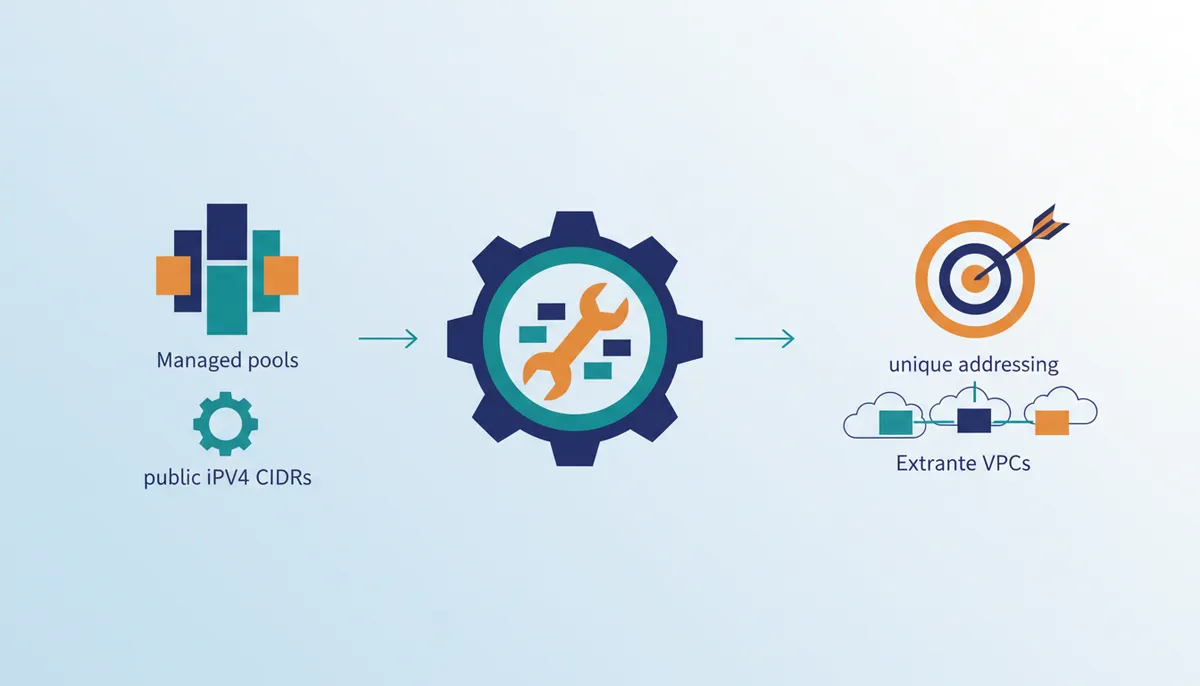
Public IPv4 allocation in AWS IPAM begins by ingesting Bring Your Own IP (BYOIP) or provisioning Amazon-Provided Contiguous IPv4 Blocks. This distinction determines whether an organization manages external RIR registrations or consumes hourly metered inventory. Public space remains mandatory because overlapping private ranges force complex NAT workarounds that break end-to-end connectivity. Operators requiring unique allocations often reference Provider Independent address concepts to maintain global uniqueness across inter-RIR boundaries. AWS offers two primary ingestion paths: importing a registered block or purchasing a contiguous segment directly.
Implementing Dual-CIDR VPCs to Minimize Public IPv4 Consumption
A dual-CIDR VPC design minimizes public IPv4 consumption by strictly segregating internal traffic from partner-facing endpoints. This architecture uses an Extranet VPC to isolate partner flows, ensuring that external access never compromises the internal security posture of the primary environment. Operators must reserve public CIDRs exclusively for these boundary interfaces while retaining private ranges for backend services. Efficient allocation requires IPAM to track every assigned block, preventing waste in an era where you can still buy IPv4 space on the private market despite global exhaustion. Secure connectivity relies on AWS PrivateLink to enable service access without exposing traffic to the public internet. Operational overhead increases when maintaining distinct routing tables for each CIDR block. Merging these spaces creates inevitable address conflicts when partners apply overlapping RFC 1918 ranges. Scarcity of addresses is a documented constraint influencing how organizations approach network design and potentially driving the need for efficient extranet sharing.
| Design Element | Function |
|---|---|
| Public CIDR | Partner-facing endpoints only |
| Private CIDR | Internal service communication |
| IPAM Pool | Centralized tracking and auditing |
Network teams should validate that Transit Gateway route domains enforce this separation at the propagation layer. Failure to isolate these paths allows lateral movement that violates most compliance frameworks.
Validation Checklist for Extranet Pilot Deployment and Route Isolation
Validate pilot isolation by confirming Direct Connect Gateway advertises only allowed prefixes to partners. This configuration prevents BGP from propagating internal routes across partner boundaries. Operators must segment traffic using TGW route domains to contain flows within dedicated logical units. Without this strict segmentation, routing tables may inadvertently expose partner networks to one another.
| Feature | Function | Isolation Scope |
|---|---|---|
| DXGW Allowed Prefixes | Filters advertised routes | Partner edge |
| TGW Route Domains | Segments routing tables | Gateway core |
| Extranet VPC | Hosts shared services | Application layer |
Use Transit Gateway when partner isolation requires architectural enforcement rather than manual filtering. This approach scales better than peering alternatives as partner counts grow. Initial setup complexity exceeds simple VPC peering connections. Operators gain permanent security guarantees that manual policies cannot match over time. InterLIR recommends deploying public IPv4 blocks via IPAM to guarantee non-overlapping address space. This step eliminates the risk of CIDR conflicts during the pilot phase. Failure to validate prefix allowances before production traffic results in immediate route leaks. Secure your IPv4 inventory with InterLIR solutions to maintain strict network availability.
About
Evgeny Sevastyanov, Customer Support Team Leader at InterLIR, brings direct operational expertise to the complexities of building extranet VPCs. At InterLIR, a specialized IPv4 marketplace founded in Berlin, Evgeny daily manages the technical intricacies of network connectivity, including creating objects in RIPE and APNIC databases. This hands-on experience is critical when addressing the IPv4 constraints often encountered in secure partner connectivity projects. As enterprises struggle with overlapping address spaces and routing challenges described in extranet architectures, Evgeny's work ensuring clean BGP routes and verified IP reputation provides necessary context. His role involves solving real-world network availability problems for clients across telecommunications and hosting sectors, making him uniquely qualified to discuss the infrastructure requirements for scalable partner access. Through InterLIR's automated solutions, he helps organizations secure the clean, geographically diverse IPv4 resources necessary to maintain reliable, conflict-free network environments without the operational overhead of traditional address acquisition.
Conclusion
Scaling partner connectivity reveals that manual route filtering collapses under the weight of flexible BGP updates, creating unavoidable operational drag. The real cost here isn't just the hourly charge for addresses, but the engineering hours consumed by troubleshooting overlapping CIDRs and accidental route leaks. You must shift from reactive patching to architectural enforcement using IPAM Pool management to centralize tracking before expanding your partner system. Relying on ad-hoc allocations works for pilots but fails catastrophically at enterprise scale where five-block VPC limits become hard constraints.
Implement strict prefix advertisement filters on your Direct Connect Gateway immediately, specifically before onboarding any new partner logic. This condition is non-negotiable for maintaining extranet architecture integrity. Do not wait for a conflict to occur; the window for safe manual intervention closes once multiple partners share transit paths. Your first action this week is to audit existing route tables for any private CIDR propagation into partner-facing segments and revoke them. Secure your IPv4 inventory with InterLIR solutions to maintain strict network availability and prevent lateral movement across trust boundaries.
Frequently Asked Questions
Idle Amazon-provided space becomes a persistent cost center due to hourly charges. AWS applies a $0.005 rate to every public IPv4 address, making bring your own IP a financially safer choice for large deployments.
The centralized Direct Connect Gateway scales to support up to 30 partners per gateway. This limit allows significant growth before requiring additional gateway resources or complex reconfiguration of existing partner connections.
Shared private CIDRs break routing logic unless complex NAT workarounds are implemented. Using globally unique public IPv4 blocks removes the need for multistep NAT work, ensuring direct connectivity between distinct partner networks.
Requesting network renumbering introduces significant operational overhead and potential communication inconsistencies. The Extranet VPC architecture prevents these issues by allowing partners to retain their existing private subnets while maintaining strict isolation.
Associating VPC attachments with specific route tables stops lateral movement between competing entities. This segmentation ensures that even if partners share identical private subnets, they remain completely isolated from one another.
References