InterRIR transfer timelines: Why moves take weeks
Inter-RIR transfers take between 4 weeks and 10 months to complete depending on the registries involved. This timeline variability proves that moving IP resources across regional boundaries is a bureaucratic marathon rather than a simple administrative task. The article argues that successful global IP mobility relies entirely on navigating the fragmented reciprocal policy environment maintained by the four participating registries.
Readers will learn how multi-stage coordination between separate organizations creates inevitable delays compared to intra-region moves. We examine the specific portal workflows required to satisfy the distinct documentation demands of RIPE NCC, ARIN, APNIC, and LACNIC. The guide details why AFRINIC remains excluded from these transactions due to its lack of a compatible transfer policy.
Expect a breakdown of the strict utilization plans and hold periods that dictate eligibility for incoming resources. Understanding these regional registries and their unique constraints is necessary for any organization attempting to relocate its number resources without triggering compliance failures or indefinite stalls.
The Role of Reciprocal Policy in Global IP Resource Mobility
Inter-RIR Transfer Definition vs Intra-RIR Moves
An inter-RIR transfer is the movement of Internet number resources from one Regional Internet Registry's service region to another. This mechanism differs fundamentally from intra-RIR moves, which occur strictly within a single registry's jurisdiction. While internal shifts require only one policy check, cross-regional actions demand dual approval and strict alignment between distinct regulatory bodies. The core distinction lies in policy jurisdiction and technical execution complexity. An intra-RIR move follows a single manual, whereas an inter-RIR transfer must satisfy the reciprocal policies of two separate regions simultaneously. This duality creates a scenario where synchronized updates across different Whois databases are mandatory for completion. Operators often underestimate the coordination required when time zones and procedural norms diverge between the source and destination registries.
| Feature | Intra-RIR Move | Inter-RIR Transfer |
|---|---|---|
| Policy Scope | Single RIR Manual | Dual Reciprocal Policies |
| Approval Path | One Registry | Source and Destination RIRs |
| Database Sync | Single Update | Cross-Registry Synchronization |
| Timeline | Standard | Extended due to coordination |
A critical limitation often overlooked is that incompatible hold periods can halt a transaction entirely, even if both parties agree. For instance, resources locked by a source region's retention rule cannot move until that specific constraint expires. IPv4 addresses remain the primary asset moved through these complex channels. Understanding these structural differences prevents costly delays in global network expansion plans.
ARIN 24-Month Needs Justification and RIPE 50% Utilization Plan
Recipients moving IPv4 blocks into ARIN or RIPE regions must satisfy distinct needs-based documentation thresholds before approval. The ARIN region mandates that buyers demonstrate a justified requirement for up to a 24-month supply of addresses, ensuring inventory aligns strictly with projected growth rather than speculative holding. This rigorous assessment prevents artificial scarcity by verifying that every requested address serves an immediate or near-term technical function within the network infrastructure. Conversely, the RIPE NCC imposes a forward-looking utilization constraint for transfers originating from needs-based registries. This long-term compliance timeline begins immediately upon transfer completion, creating a binding operational commitment rather than a one-time eligibility check. Network operators often underestimate the administrative overhead required to prove these metrics, leading to delayed acquisitions if documentation remains incomplete. Optimizing existing IPv4 resources through verified channels remains the most reliable path to sustainable network expansion in a constrained market.
Policy Incompatibility Risks: AfriNIC Exclusion and Hold Period Traps
Transfers collapse instantly without reciprocal policy alignment between source and destination registries. Currently, only four of the five RIRs support inter-RIR transfers, leaving the African region isolated due to a missing framework. All four participating registries prohibit moving resources to or from AfriNIC because the necessary reciprocal agreement does not exist. This exclusion creates a hard boundary where valid technical needs cannot be met through global redistribution mechanisms. Hold periods create additional friction by locking assets for fixed durations after allocation or transfer. Under RIPE NCC policy, IPv4 addresses face a mandatory 24-month hold period before becoming eligible for movement. ARIN imposes a shorter 12-month lock on outgoing resources but adds a 36-month restriction on re-application after a transfer out. These divergent timelines trap operators who misjudge the liquidity of their inventory.
| Region | Hold Duration | Re-transfer Restriction |
|---|---|---|
| RIPE NCC | 24 months | Varies by policy |
| ARIN | 12 months | 36 months |
| APNIC | 5 years (103/8) | Varies by pool |
| LACNIC | 36 months | 1 month |
The operational risk lies in assuming uniformity across regions where none exists. A network operator might acquire addresses in Europe only to discover they cannot move them to North America for two years, effectively freezing capital. Failure to account for these policy traps results in stranded assets that cannot serve their intended geographic markets.
Inside the Multi-Stage Coordination Between Regional Registries
Defining the Source RIR Initiation and Hold Period Mechanics
Every valid request originates exclusively from the transferring party at the source RIR, establishing a strict one-way workflow that prevents unsolicited resource claims. This protocol ensures that the current holder explicitly authorizes the movement before any destination registry evaluates the recipient's eligibility. Without this initial signal from the owner, the destination registry cannot process the incoming allocation, creating a fundamental dependency on the sender's active participation. Regulators enforce hold periods to stabilize the market and prevent immediate flipping of newly acquired assets. ARIN imposes a 12-month lock on resources after allocation or transfer. RIPE NCC mandates a 24-month wait following allocation before a block becomes transferable.
Executing Pre-Transfer Preparation and Utilization Plan Creation
Successful IPv4 address transfer execution begins with rigorous verification of entity eligibility and strict account alignment. Operators must ensure legal names match exactly across both regional registries before drafting any documentation. Discrepancies in entity details can lead to processing delays or rejection, requiring corrections before the approval timeline can proceed. Creating a compliant utilization plan requires precise forecasting aligned with the destination region's specific mandates. For recipients entering the RIPE region from needs-based jurisdictions, the policy demands a verified strategy for deploying resources according to long-term compliance obligations that start the moment the transfer completes.
Coordination Risks: Time Zone Delays and Database Synchronization
Operational friction peaks during the dual-RIR coordination phase where staff in disparate time zones must synchronize manual database updates. This logistical constraint inherently extends processing timelines, creating a variable duration depending on the specific registries involved. The Inter-RIR transfer process demands simultaneous registry state changes to prevent routing leaks or dual-registration conflicts. Coordination between RIRs in different time zones is a required step that inherently extends the timeline compared to intra-RIR transfers. The primary failure mode involves asynchronous communication loops that stall progress without generating error logs. Coordination between RIR staff operating in different time zones is a unique constraint that can extend review cycles.
Executing Compliant Transfers Through Portal Workflows
Source RIR Initiation and Legal Entity Verification Steps

The transferring party must strictly initiate the request within the source RIR region to trigger valid processing. This one-way workflow ensures the current holder explicitly authorizes the movement before any destination registry evaluates eligibility. Without this initial signal from the owner, the destination registry cannot legally process the incoming allocation, creating a fundamental dependency on the sender's active participation. Operators must verify that legal entity names match exactly across all accounts before submission. Administrative updates differ fundamentally from resource movement cases, requiring precise alignment with official records to avoid processing delays. Operators must create or verify RIR accounts ensuring legal entity names match.
- Confirm the source organization holds valid title to the IPv4 blocks.
- Ensure account names align perfectly with official company registration documents.
- Submit the request via the specific portal or email path for that region.
- For RIPE sources, send the required documentation directly to [email protected].
A common oversight involves assuming portal submission suffices for all regions; however, RIPE specifically requires email initiation which bypasses standard automated checks found elsewhere. This manual entry point introduces a variable delay where human verification of the initiation protocol becomes the critical path rather than system automation.
Compiling Authorization Letters and Officer Attestation Documents
Submit four specific documents including company registration, authorization letters, proof of ownership, and officer attestation to validate the transaction. Operators frequently encounter submission errors when legal names on these files do not match RIR database records exactly. Legacy resources often trigger unique documentation hurdles because their original allocation terms may differ significantly from current standards. Partial transfers face strict size constraints where the minimum size must remain at least a /24 block, as set by LACNIC and ARIN policies. The complexity of synchronizing these documents across different policy frameworks requires "considerably more work" than standard intra-regional moves.
- Scan original company registration certificates showing current legal standing.
- Draft authorization letters explicitly naming the acting representative for this transfer.
- Provide proof of ownership such as recent invoices or allocation certificates.
- Complete officer attestation forms acknowledging liability and policy compliance.
The administrative burden here acts as a necessary filter to prevent fraudulent claims on scarce IPv4 resources. Operators should treat this paperwork phase with the same rigor as technical BGP configuration to avoid delays, noting that inter-RIR transfer timelines can range from 4 weeks to 10 months depending on the registries involved.
Pre-Submission Checklist for ASN Restrictions and IPv6 Limits
Validate specific resource constraints before submission to prevent immediate workflow rejection at the source registry. Operators must verify that ASN policies align between both regions, as transfers occur only where reciprocal agreements exist. A common oversight involves the mandatory 2-year hold period RIPE imposes on 16-bit ASNs following allocation, which blocks premature transfer attempts regardless of buyer readiness.
| Resource Type | Inter-RIR Status | Critical Constraint |
|---|---|---|
| 16-bit ASN | Allowed | 24-month hold applies |
| IPv6 Block | Prohibited | ARIN bans inbound moves |
| IPv4 Block | Allowed | Needs-based justification |
Note that ARIN strictly prohibits inter-RIR transfers of IPv6 addresses, limiting cross-regional movement exclusively to IPv4 and ASN resources. This regulatory fragmentation forces organizations to retain IPv6 holdings within their original jurisdiction or seek intra-regional solutions. The complexity of synchronizing dual policy frameworks demands significantly more coordination than standard intra-regional moves, often requiring manual database updates across time zones.
- Confirm legal entity names match exactly in both registry portals.
- Check allocation dates against the 24-month restriction window.
- Exclude IPv6 blocks from any transfer scope involving ARIN.
Attempting to force a transfer without verified reciprocity wastes administrative cycles and delays valid projects.
Strategic Value and Operational Risks of Cross-Region Resource Movement
Inter-RIR Transfer Timelines and Fee Structures by Registry
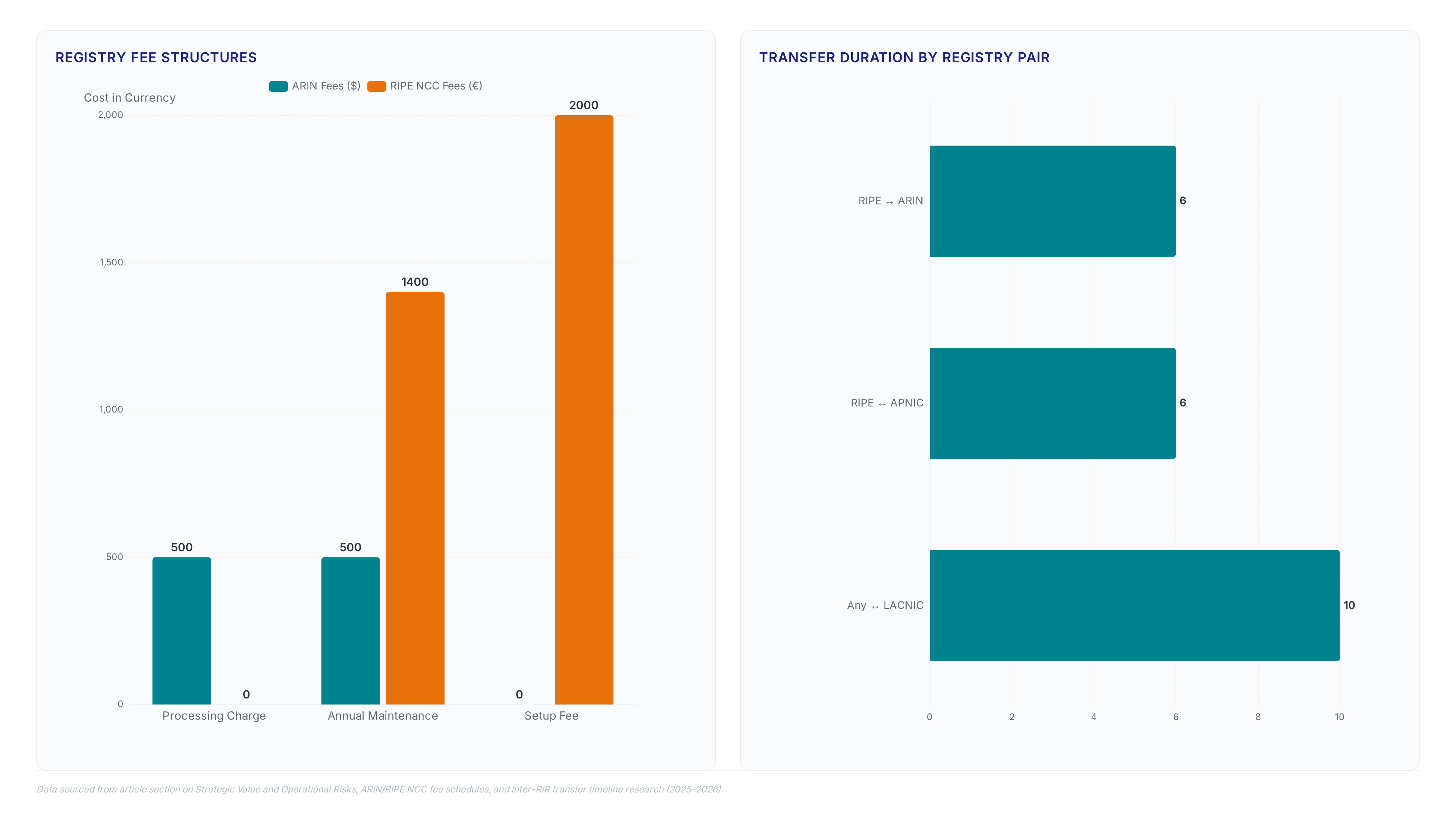
Processing windows for cross-regional IPv4 movement range from Fast Processing (4-6 weeks) to Moderate Processing (8-10 weeks) depending on the registry pair. Well-established procedures between RIPE NCC, ARIN, and APNIC enable the quicker timeline , while LACNIC involvement often extends the duration due to complex coordination requirements.
| Registry Pair | Estimated Duration | Primary Constraint |
|---|---|---|
| RIPE ↔ ARIN | 4-6 weeks | Documentation sync |
| RIPE ↔ APNIC | 4-6 weeks | Time zone lag |
| Any ↔ LACNIC | 8-10 weeks | Policy justification |
Operators must budget for distinct fee structures beyond the asset purchase price. ARIN Fees include a $500 non-refundable processing charge for IPv4 and ASN transfers, plus annual maintenance costs ranging from $150 to $500. In contrast, RIPE NCC Fees focus on membership, requiring a €1,400 yearly contribution and a one-time €2,000 setup fee without separate transfer processing charges.
Application: Strategic Decision Framework for Inter-RIR vs Intra-RIR Moves.
Choose inter-RIR transfers strictly when your target inventory exists outside your current regional registry and internal subnetting cannot accommodate growth. Market activity remains strong, with approximately 8,000 global transactions processed in 2025 alone, signaling that cross-border movement is a viable, albeit complex, supply channel. However, this path demands patience; coordination between distinct policy frameworks often extends completion windows from 4 weeks to 10 months depending on the specific registry pair involved. Operators must weigh the strategic access to IPv4 against significant administrative overhead. Unlike intra-region moves, cross-regional requests trigger dual policy reviews where a single documentation error resets the entire clock. The financial commitment also shifts, requiring budget allocation for legal reviews ranging from $1,000 to $5,000 alongside standard processing charges.
| Decision Factor | Inter-RIR Move | Intra-RIR Move |
|---|---|---|
| Timeline | Variable (Months) | Fixed (Weeks) |
| Policy Load | Dual Jurisdiction | Single Registry |
| Best For | Large Block Acquisition | Routine Expansion |
The hidden tension lies in project scheduling flexibility versus resource urgency. While the market offers volume, the procedural friction means this route suits long-term capacity planning rather than immediate outage mitigation. Prioritize verifying that your legal entity details match perfectly across borders before initiating contact.
Operational Failure Modes: Documentation Gaps and Policy Incompatibility
Transfer requests stall immediately when submitted paperwork fails to match the exact legal entity names registered in the source database. Operators often face needs justification rejection because their utilization plans do not strictly align with the reciprocal policies of the destination registry. A critical tension exists between rapid acquisition and strict policy adherence; rushing a submission without verifying these specific planning constraints guarantees a return to square one. Routing coordination issues frequently arise when operators neglect the time zone delays inherent in cross-registry communication. The coordination required between distinct administrative bodies means that even perfect documentation can suffer from synchronization lags.
| Failure Mode | Consequence | Mitigation Strategy |
|---|---|---|
| Name Mismatch | Immediate rejection | Verify legal titles in both RIR portals |
| Plan Gap | 24-month delay | Draft 5-year usage scenarios upfront |
| Sync Lag | Extended timeline | Schedule updates across time zones |
Ignoring these incompatibilities results in wasted administrative effort and potential loss of the asset to a competing buyer. InterLIR recommends validating every policy requirement against both source and destination rules before initiating contact. The cost of a failed transfer exceeds the price of thorough pre-auditing.
About
Vladislava Shadrina serves as a Customer Account Manager at InterLIR, where she specializes in guiding clients through the complexities of IP resource acquisition. Her daily work directly involves facilitating secure transactions and ensuring strict compliance with Regional Internet Registry policies, making her uniquely qualified to explain the nuances of inter-RIR transfers. At InterLIR, a Berlin-based marketplace dedicated to IPv4 redistribution, Vladislava manages the critical documentation and coordination required when moving resources between different global regions. This article reflects her hands-on experience navigating the specific requirements of RIRs like ARIN, RIPE NCC, and APNIC. By connecting her practical account management role with InterLIR's mission of transparent and efficient IP redistribution, she provides readers with a clear, factual understanding of how to successfully execute cross-regional transfers without hidden pitfalls. Her insights ensure organizations can access vital network resources while adhering to the latest May 2026 policy standards.
Conclusion
Scaling inter-RIR transfers reveals that procedural friction becomes the primary bottleneck, not asset availability. As IPv6 traffic crosses the 50% threshold, organizations must treat IPv4 movement as a strategic bridge rather than a permanent fix. The operational cost here is time locked by mandatory hold periods; RIPE enforces a 24-month wait while ARIN applies a 12-month lock plus a 36-month reapplication ban. These constraints mean rushing a transfer to solve an immediate outage is impossible. You must align acquisition timelines with long-term capacity planning cycles to avoid wasting resources on stalled requests.
Start by auditing your current legal entity records against both source and destination registry portals this week to eliminate name mismatches before they cause rejection. This specific verification step prevents the immediate failure modes that plague cross-border requests. Do not attempt to justify a need for addresses unless your utilization plan explicitly covers a 24-month supply window. The window for casual movement has closed, leaving only those with rigorous documentation and patience able to secure blocks. Focus your immediate efforts on validating that your paperwork matches exact database entries to ensure your transfer request survives the initial review.
Frequently Asked Questions
The transfer cannot proceed without a reciprocal agreement in place. AFRINIC currently lacks this framework, blocking all cross-regional moves. You must wait for policy adoption or seek resources from the four participating regions instead.
No, specific hold periods prevent immediate resale or relocation of assets. APNIC imposes a 5-year lock on resources from the 103/8 free pool. You must retain these addresses until the mandatory restriction period expires completely.
Yes, destination registries enforce strict usage plans before approving incoming transfers. RIPE NCC requires a 50% utilization plan over 5 years for transfers from needs-based regions. Failure to meet this threshold results in immediate application rejection.
ARIN imposes a waiting period before you can request new resources again. Organizations face a 36-month restriction on reapplication after transferring resources out of the region. Plan your inventory carefully to avoid long-term eligibility gaps.
Yes, specific minimums apply to ensure efficient registry management and allocation. LACNIC mandates a minimum transfer size of a /24 block for inter-regional transactions. Smaller blocks cannot be processed through the official inter-RIR transfer workflows.
References