RIPE644 Policy: Unifying Global IPv4 Markets
RIPE644 unites ARIN, RIPE, and APNIC markets, requiring 50% utilization within five years to secure global IPv4 assets efficiently.

Five regional bodies now manage IP space after the original IANA list collapsed under scale. Learn how this 1992 shift supports modern networks.
Starting at a competitive price per IP address, InterLIR provides a set entry point for buyers in the current IPv4 marketplace.
Malaysia's June 2026 consultation targets a ghost. The proposal seeks to revive the National Internet Registry (NIR) model, ignoring that APNIC...
Five Regional Internet Registries sit between IANA and your network. That gap is where Local Internet Registries (LIRs) operate.
A standard /24 block now commands a market price between $16 and $25 per IP according to InterLIR data.
APNIC lease rates now reach $0.60 per IP monthly. Discover how regional supply constraints and block quality impact your network budget today.
A $200 non-refundable deposit starts the clock on IPv4 address transfers in the LACNIC region. This isn't just a fee; it's a filter.
Five Regional Internet Registries govern global IPv4 scarcity. Learn how InterLIR automates compliance for complex IntraRIR and InterRIR transfers.
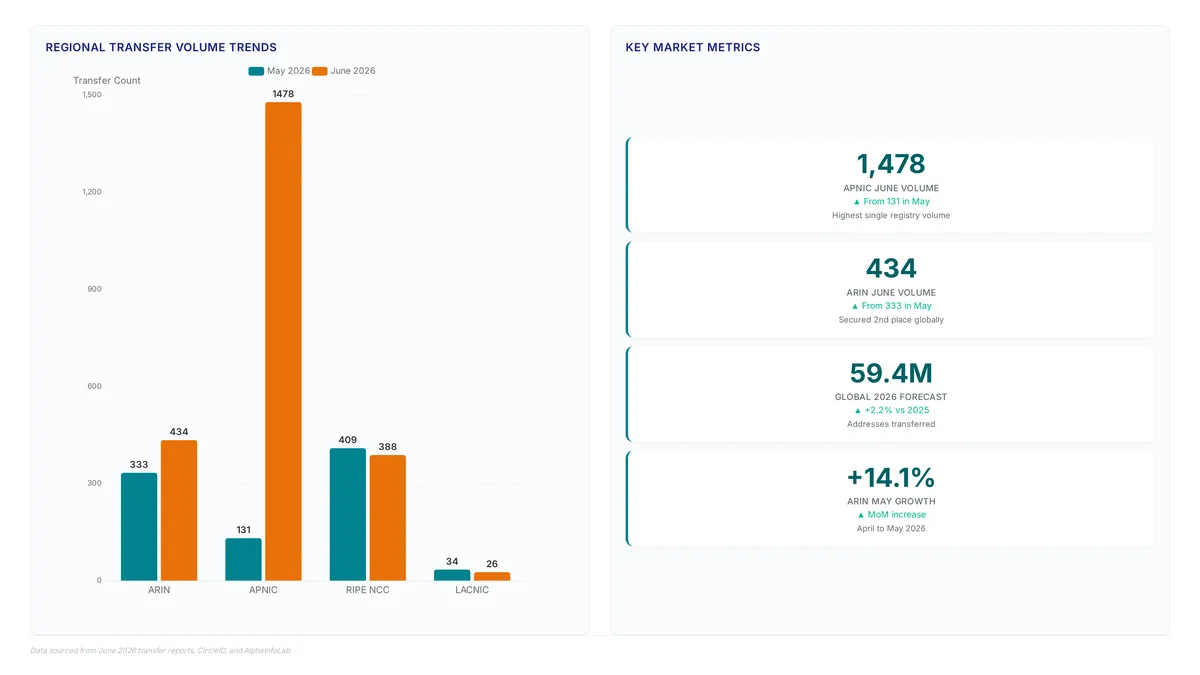
APNIC transfers surged from 131 in May to 1,478 in June, defining the liquidity shock of the 2026 IPv4 market.
The 2022 IPv4 market saw block transactions drop 28% while total addresses transferred surged 35%, per IPv4.Global data.
Discover how the 1992 shift ended centralized NIC control, creating the five-body hierarchy that manages global IP policy and allocation today.
Five RIRs manage global resources with divergent costs like RIPE's €1,000 signup. InterLIR bypasses these fees to secure your IPv4 assets efficiently.
Five Regional Internet Registries manage global IP allocation. Direct registry data offers the only verifiable path for accurate security analysis.
Five Regional Internet Registries coordinate global IP allocation to prevent routing chaos. Learn how this hierarchy secures unique address distribution.
Five Regional Internet Registries currently manage the world's IP addresses, a structure solidified since the first entity launched in 1992.
Access all five Regional Internet Registries via one interface. Managed LIR services let you lease blocks without direct RIR membership fees.
An LIR receives allocations directly from a Regional Internet Registry to sub-assign assets, ensuring routing independence for your network infrastructure.
LACNIC policy 2.21 mandates the original Spanish text overrides translations. Learn how this strict hierarchy impacts your regional IP address allocation...
Only 4 regional registries enable interRIR transfers today. Learn the dual-consent rules and legacy status outcomes for global IPv4 moves.
Year-to-date figures for 2026 show 2,807,296 inbound IPv4 addresses moving into the RIPE NCC region.
InterRIR IPv4 transfers require dual registry consent, creating a mandatory 4 to 8 week window that internal moves simply do not face.
In 2026, RIPE saw 279 inbound vs 22 outbound transfers. Learn the dual-compliance rules needed to secure global IPv4 space today.
Explore how five organizations manage global IP space, from APNIC's 26,067 members to AFRINIC's 2,492, defining strict regional boundaries.
Secure your network identity by aligning with one of the 5 regional registries. InterLIR optimizes IPv4 redistribution within these strict mandates.
The ARIN service area covers exactly 29 listed countries and territories, not just the US and Canada.
Scarcity has birthed a liquid secondary market for IPv4 blocks where unused sub-blocks are sold rather than allocated.
Five distinct zones manage global IP policy under ICANN. Learn how strict governance impacts your network's access to finite IPv4 resources today.
Move IPv4 addresses across the five regional registries. Learn the strict LIR rules and justified need required for a legal InterRIR transfer today.
Recent data shows a weighted average of $19.56 per IP. Discover how to execute valid secondary market transfers and avoid costly routing failures now.
Since IANA's 2011 pool exhaustion, free IPv4 blocks are gone. Learn why leasing is the strategic fix for network expansion today.
Akamai leads with 79.0 Tbps of deployed capacity, proving public peering remains vital for regional traffic distribution and cache efficiency today.
Buying an IPv4 address in 2026 costs between $18 and $45 per IP, while leasing runs $0.30 to $0.50 monthly.
56,629 global IPv4 transactions have occurred since 2012, yet January 2026 saw APNIC transfers drop to just 88. Scarcity has shifted the battlefield.
ARIN charges a fixed $500 annual fee while peers use cost recovery. See how five distinct registries create conflicting rules for your IP assets.
APNIC's 2010 policy shift created IPv4 liquidity by allowing transfers, establishing the /24 minimum block size still used today.
Inter-RIR transfers take between 4 weeks and 10 months to complete depending on the registries involved.
With few hundred thousand IPv4 addresses left, leasing offers speed. Learn how operators bypass ownership delays to scale proxy deployment effectively today.
Navigate InterRIR transfers across 5 global regions. Learn how LIR fee tiers and strict needs-based validation impact your IPv4 acquisition strategy.
Four regions allow InterRIR transfers, but ARIN enforces a strict /24 minimum. Learn how to navigate these specific policy gaps without rejection.
Five regional registries govern global IPv4 blocks, verifying each LIR before allocation to prevent routing conflicts and ensure network stability.
The May 2026 report locks in 5 regional roles. I break down how this rigid framework impacts your IPv4 assets before approval.
The NRO Strategy 2026-28 reads like a coverage win (71% leased-prefix ROA), but the real story is in the security pillar: registries are spending the next three
See how APNIC's open process serves 56 diverse economies. Real operators bridge the gap between clean protocols and messy infrastructure realities.
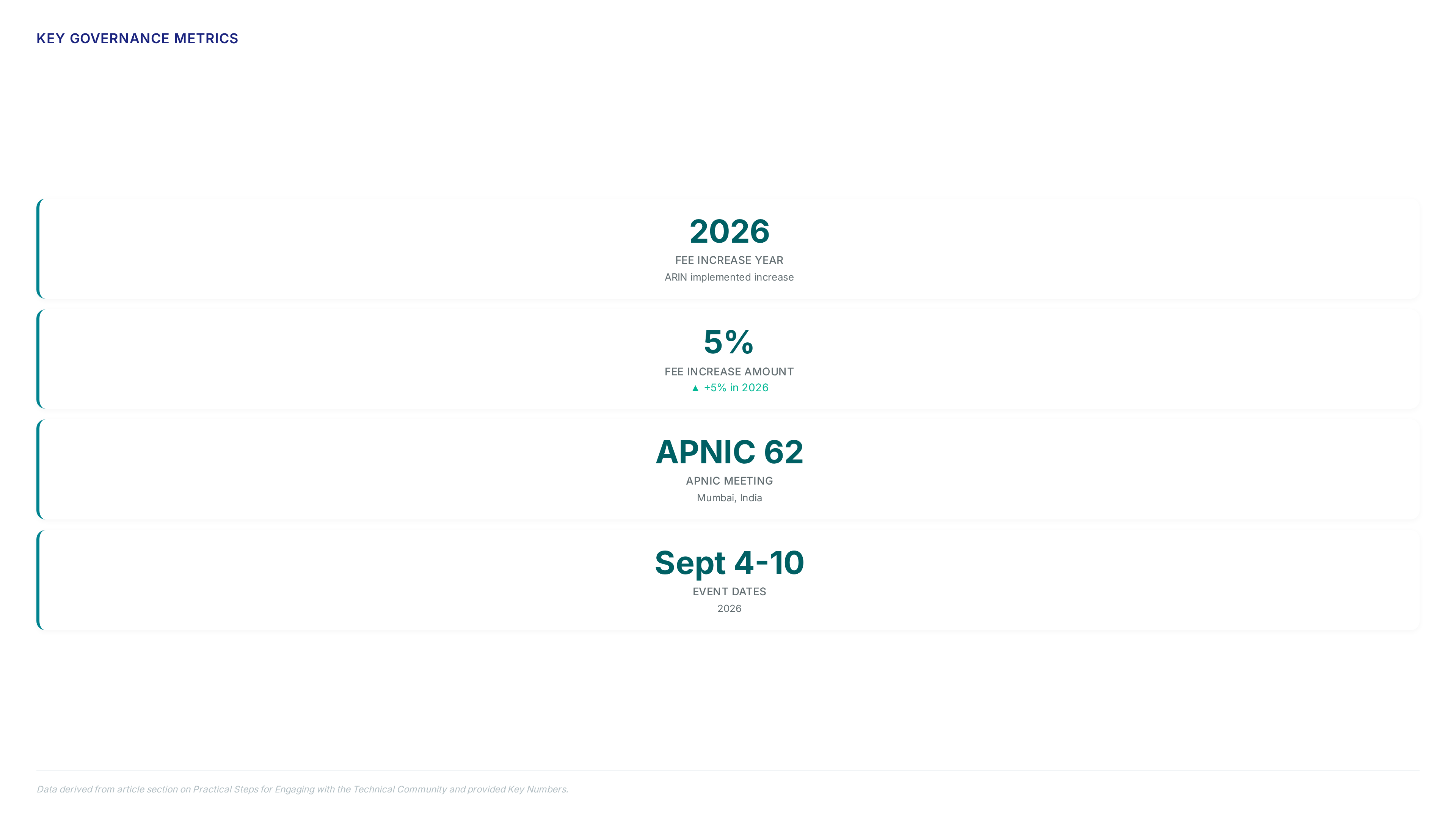
With 21 billion IoT connections coming by 2026, APNIC 62 in Mumbai forces operators to drop legacy manual processes for real automation.
See how Shaila Sharmin guides policy for 56 Asia-Pacific economies through community consensus, not distant bureaucratic mandates.
Join me in Riga this June. With $2.5T in AI spending coming, regional coordination is vital for Baltic network survival. Let's connect!
Seven regional bodies now enforce routing integrity. With TWNIC reaching 98% IPv6 validity, I analyze how NIRs secure our infrastructure.
The NRO NC reviewed feedback from five regional lists. With 15 volunteers debating, these governance ambiguities need fixing before adoption.
With mobile traffic hitting 64%, rigid global governance frameworks are essential. I break down how new policies protect our shared resources.
Since April 2025, AWS charges $0.01 per GB for cross-AZ peering. I show how new billing codes expose these once-hidden network costs.