IPv4 leasing ISP model: how it works
The global IPv4 transfer pool shrank nearly 60% from 2015 to mid-2024, forcing ISPs to adopt leased address blocks. You will learn how this framework delegates routing rights while keeping registration with the original holder, the specific mechanics of RPKI ROA configuration for temporary prefixes, and the lifecycle management required to handle lease expirations without service interruption.
An IPv4 leasing ISP operates under the agreement where usage rights transfer temporarily, yet the Regional Internet Registry database still lists the owner. This distinction allows providers to bypass CGNAT limitations for premium subscribers while avoiding the capital expenditure of buying scarce address space. The model relies on strict Letter of Authorization protocols to authorize the ISP ASN, ensuring that BGP announcements match registry objects exactly.
Operational success depends on aligning route objects and maintaining clean address history to prevent filtering issues. The discussion also covers the logistical challenges of renumbering infrastructure when contracts expire, proving that leased space demands more rigorous lifecycle planning than owned assets.
The Role of Leased IPv4 Address Blocks in Modern ISP Infrastructure
IPv4 Leasing ISP Model and RIR Registry Constraints
An IPv4 leasing ISP functions by using contractually leased address blocks while the original holder retains registration in the RIR database. Providers announce and assign these addresses to customers, yet the title remains with the lessor. This operational model delivers public connectivity without permanent ownership transfer, a necessary adaptation as available supply contracted from tens of millions of addresses in 2015 to approximately tens of millions by mid-2024. The lessee gains rights to announce prefixes via BGP, creating a distinct separation between usage and title.
Technical execution requires precise alignment of registry objects and routing policies to function correctly:
- The address holder issues a Letter of Authorization (LOA) delegating announcement rights to the ISP.
- RPKI ROAs must match the announcing ASN to prevent route filtering by upstream peers.
- Reverse DNS and IRR records are updated to reflect the temporary operator while maintaining owner attribution.
- Lease agreements define the specific duration and renewal terms for the address space.
- Monitoring systems track ROA validity to ensure continuous global reachability.
Leased IPv4 behaves identically to owned space from a routing perspective. Contractual dependency introduces renewal risks absent in permanent allocations. Reliance on external registry coordination means any discrepancy in the LOA documentation or ROA validity instantly invalidates global reachability, regardless of correct BGP configuration. Operators prioritize blocks with verified history and clear authorization chains. The constraint forces a shift from capital-heavy acquisition to rigorous lifecycle management, where continuous compliance with RIR policies becomes as critical as physical network uptime.
Deploying LOA Authorization to Avoid CGNAT Limits
ISPs deploy Letter of Authorization documents to assign public IPv4 space directly, bypassing Carrier-Grade NAT constraints for business clients. This mechanism grants the lessee rights to announce prefixes via BGP while the original holder retains RIR registration. Such alignment allows providers to deliver public IPv4 connectivity where CGNAT breaks application functionality. Since global IPv6 availability hovers around 40%, maintaining strong IPv4 capacity remains an operational necessity alongside migration efforts. The technical workflow involves the owner keeping registration while the lessee receives authorization to use addresses for customer workloads.
| Feature | Leased IPv4 Block | CGNAT Deployment |
|---|---|---|
| Address Type | Public Static | Private Shared |
| Inbound Access | Direct | Restricted |
| Liability | Lessee Managed | ISP Centralized |
Startups and SaaS platforms apply leasing to preserve cash flow while avoiding high upfront capital for purchasing blocks. Strict lifecycle management defines the limitation; lease expiration requires specific planning for renumbering or renewal. Unlike permanent ownership, this model demands active monitoring of contract terms to prevent service interruption. The choice depends on whether immediate public reachability outweighs long-term asset accumulation. Leasing enables organizations to support deployment while preserving cash flow, particularly beneficial for expanding infrastructure teams.
Scarcity Risks: Loss of Large Contiguous IPv4 Blocks
Availability of large contiguous blocks dropped significantly in 2024, creating acute fragmentation risk for scaling networks. This sharp contraction forces operators to choose between paying premium rates for continuity or adapting to smaller, fragmented prefixes that complicate routing tables. Unlike the traditional IPv4 ownership model where blocks remain static, the leasing market reacts instantly to this supply shock. The annual attrition rate being effectively zero means addresses rarely return to the pool, locking current holders in place.
| Feature | Traditional Ownership | Leased Model Response |
|---|---|---|
| Block Size | Static, large /16 or /18 | Fragmented /24 or /22 |
| Availability | Dropped notably | Shifts to smaller units |
| Strategy | Long-term holding | Flexible scaling |
Serious infrastructure operators now face a dilemma where large contiguous blocks are genuinely scarce. Many must lease smaller segments to maintain service levels. This fragmentation increases the complexity of BGP announcements and requires more precise filtering policies. The market has become more price-sensitive as demand diversifies beyond a few dominant players to include regional operators and infrastructure-focused companies. Providers increasingly differentiate themselves through "continuity" features such as guaranteed renewal controls and abuse workflow management rather than just price per IP.
Inside the Mechanics of RPKI and BGP Authorization for Leased Prefixes
RPKI ROA Configuration for Leased IPv4 Prefixes
Configuration success depends on the RPKI ROA matching the specific ISP ASN set in the Letter of Authorization. This technical alignment ensures that when a provider announces a prefix, the cryptographic signature validates the announcing entity against the registry record. Operational delegation relies on synchronizing IRR objects and ROAs to prevent route filtering by upstream peers. The address holder must explicitly authorize the ISP ASN using a Letter of Authorization before any route object creation occurs. Once authorized, RPKI ROAs are configured to match the announcing ASN exactly, creating a verifiable chain of trust for the leased space.
| Component | Function in Leasing | Validation Target |
|---|---|---|
| LOA | Grants announcement rights | Contractual proof |
| ROA | Cryptographic signature | ASN and Max Length |
| BGP | Prefix distribution | Path origin match |
A critical tension exists between rapid deployment and strict registry synchronization; announcing before ROA propagation can result in route filtering by RPKI-aware neighbors. Unlike static ownership, leased assets require continuous coordination between the lessor's registry access and the lessee's routing policy. A misaligned max-length field or incorrect ASN in the ROA renders the entire block unreachable, regardless of valid BGP sessions. Network teams prioritize validating these objects against the active routing table before finalizing lease handovers. This discipline prevents outages caused by silent drops at peering points where strict origin validation is enforced.
Aligning BGP Announcements with Authorized ASNs
BGP announcements must strictly match authorized ASNs to prevent upstream filtering of leased prefixes. Operators define the AS path origin explicitly, ensuring the announcing router identity aligns perfectly with the RPKI ROA signature. If the ASN in the BGP update differs from the authorized entry, global validators reject the route as invalid. This strict validation prevents hijacking but introduces operational friction when configurations drift. The primary failure mode involves ambiguous max-length settings that allow more specific prefixes than intended. Defining ROA max-length explicitly restricts the announcement scope to the exact leased block size. Prefix sizing must respect minimum routable blocks, typically /24, and ROA max-length should be explicitly set to avoid invalid announcements. Leased IPv4 behaves identically to owned space only when registry data matches live signaling.
| Configuration Element | Required State | Risk of Mismatch |
|---|---|---|
| Origin ASN | Matches LOA document | Immediate route rejection |
| Prefix Length | Equals lease size | Potential route leak |
| Max Length | Explicitly set | Over-authorization gap |
However, rigid adherence to these settings complicates emergency renumbering during lease transitions. Lease expiration requires operational planning to renumber or renew to maintain connectivity. Clean blocks with full support are commonly used in ISP environments to mitigate these risks. Network teams must verify that route objects reflect current contractual rights before announcing traffic. Failure to align these elements results in lost connectivity rather than degraded performance. Precise configuration remains the only defense against silent packet loss in a validated internet.
Validating Registry Consistency for Leased Space
Engineers must verify that route objects align with the active Letter of Authorization before announcing leased prefixes. This validation step prevents upstream filtering by ensuring the AS path origin matches the cryptographic signature in the RPKI ROA. Unlike owned space where registry data rarely changes, leased blocks require synchronized updates across multiple databases to maintain validity. Operational delegation relies on precise coordination between IRR objects and ROAs to establish trust. The validation process follows a strict sequence to guarantee consistency:
- Confirm the LOA explicitly authorizes the specific ISP ASN for the target prefix.
- Create or update route and route6 objects in the IRR to reflect current leasing terms.
- Generate RPKI ROAs that match the announcing ASN and define an explicit max-length.
- Verify BGP announcements strictly adhere to the authorized parameters before propagation.
Leased space is routed identically to owned space when these data planes align, yet a single mismatch triggers invalid status globally. This rigidity creates a tension between rapid deployment speed and the absolute necessity of registry accuracy. Provisioning timelines for network operators are described as completing within a short timeframe once all required information is available, though specific durations vary by provider.
| Checkpoint | Required State | Failure Consequence |
|---|---|---|
| LOA Document | Matches ISP ASN | Authorization Rejected |
| IRR Object | Updated Prefix | Route Filtered |
| RPKI ROA | Valid Signature | Announcement Invalid |
InterLIR recommends automating these checks to mitigate human error during the lease term. From a routing perspective, leased IPv4 behaves predictably only when registry authority remains unbroken.
Implementing Leased IPv4 Announcements and Lifecycle Management
Defining the Leased IPv4 Operational Lifecycle

Renewal or renumbering plans must precede lease expiration. Permanent ownership transfers differ fundamentally from the IPv4 leasing model, which introduces policy and lifecycle constraints rather than altering data plane forwarding mechanics. Leased IPv4 behaves identically to owned IPv4 from a routing perspective, though registry authority, contractual control, and long-term planning diverge notably. Operators manage the contractual control timeline explicitly because the underlying registry authority stays with the original holder throughout the agreement term.
The operational workflow demands strict adherence to the following sequence:
- Secure a Letter of Authorization from the address holder.
- Configure RPKI ROAs to match the announcing ASN.
- Execute BGP announcements that strictly match authorized ASNs.
- Initiate renumbering procedures for affected subscribers if the contract is not renewed.
Maintaining service continuity while adhering to contractual end-dates creates tension. Leased space routes and filters exactly like owned space when registry and RPKI data remain consistent. This focus on operational speed and compliance prevents temporary address rights from becoming permanent routing liabilities. Lease expiration requires operational planning to renumber or renew to maintain service availability.
Executing BGP Announcements and Route Object Updates
Configuration aligns the announcing ASN with the specific prefix authorized in the Letter of Authorization to guarantee proper routing.
Operators follow a strict sequence to secure global reachability for leased blocks:
- Obtain an LOA where the address holder authorizes the ISP ASN.
- Create or update route objects in the IRR to match the authorized origin exactly.
- Generate an RPKI ROA that specifies the maximum prefix length, preventing accidental leakage of more specific subnets.
- Announce the prefix via BGP from the network.
Misalignment in technical layers, such as a wrong ROA or outdated IRR object, causes announcements to fail or flap unpredictably across the global routing table. This failure mode highlights a critical tension: while leasing offers rapid scaling, the dependency on external registry synchronization introduces a single point of failure not present in owned space. Unlike permanent transfers, the operational burden shifts toward continuous validation of delegation mechanisms rather than simple hardware provisioning.
Registry consistency is necessary for network availability. Clean IPv4 blocks with full RPKI, rDNS, and LOA support are commonly used in ISP and hosting environments to mitigate these risks. Leased space is routed and filtered in the same way as owned space, provided registry and RPKI data are consistent.
Operational Checklist for Abuse Handling and Lease Expiration
Abuse handling and customer attribution remain the ISP's responsibility regardless of address ownership status. Operators maintain precise customer attribution logs to satisfy upstream escalation paths instantly. Higher-tier plans often include specific abuse workflow management tools to simplify this mandatory compliance step.
| Action Item | Owned Space | Leased Space |
|---|---|---|
| Responsibility | ISP Internal | ISP Internal |
| Registry Contact | Static Owner | Flexible Lessee |
| Expiration Risk | None | High |
Lease expiration requires operational planning to renumber or renew before the contractual window closes. Prefix sizing must respect minimum routable blocks, typically /24. Failure to execute a timely renewal results in the need for renumbering or contract extension. Operational behavior matches owned IPv4 at the network level, but registry alignment and lease lifecycle management are.
Strategic Advantages of Leasing Models for Address Capacity Scaling
Application: Defining the IPv4 Leasing ISP Operational Model
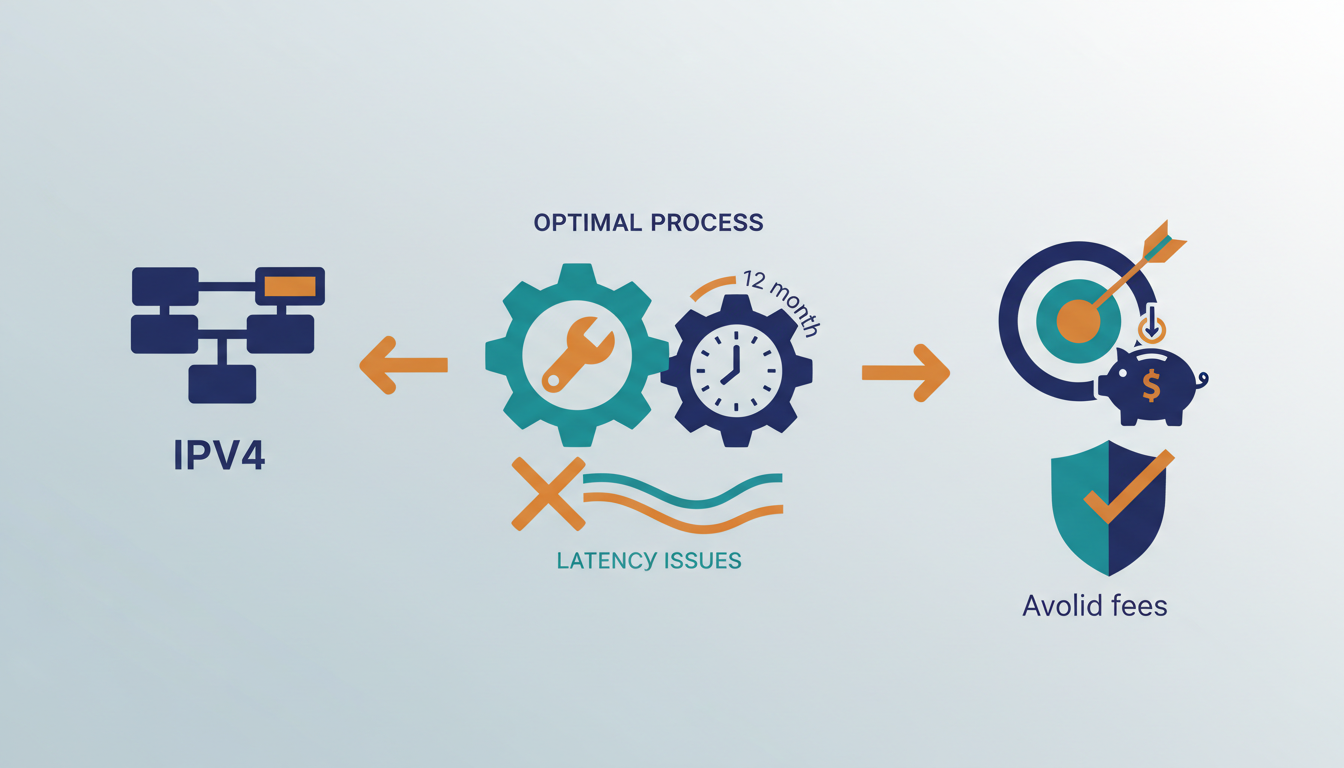
Regional ISPs expand capacity quicker than legacy allocations allow by leasing contractually leased blocks instead of purchasing permanent ownership. The original holder remains registered in RIR databases while the lessee announces prefixes via BGP. Operators deploy this strategy when clean address history and predictable geolocation are required for business subscribers. Unlike permanent transfers, this approach avoids capital lock-in while maintaining full routing validity through LOA and RPKI alignment.
- The ISP receives rights to assign addresses to customers under the agreement.
- Registry objects like inetnum and route align with the leasing ISP operations.
- Lease expiration requires planning to renumber or renew before service interruption.
- BGP announcements must strictly match authorized ASNs to ensure valid routing.
Operational complexity increases slightly because leased space is routed and filtered in the same way as owned space, provided registry and RPKI data are consistent. This model transforms IPv4 from a static asset into a flexible utility, scaling address capacity without the scarcity constraints of the traditional market.
Deploying Leased IPv4 to Avoid CGNAT for Business Subscribers
Business subscribers require public IPv4 reachability that Carrier Grade NAT cannot provide for inbound services. Leasing enables regional operators to expand quicker than legacy allocations allow by deploying temporary address rights immediately. This approach supports access networks where services demand direct inbound connectivity without the latency penalties of translation layers. Startups and SaaS platforms apply leasing to preserve cash flow while supporting deployment, avoiding the high upfront capital required for purchasing IPv4 blocks outright. The financial model shifts expenditure from capital investment to operational expense, aligning costs with active subscriber revenue.
Strict lifecycle management replaces permanent asset accumulation as the primary operational focus. Operators must plan for lease expiration to renumber or renew before service interruption occurs. Unlike owned space, the database registry entry remains with the original holder, requiring precise LOA coordination for continued announcements. This dependency creates a tension between rapid scalability and long-term planning stability. The model is commonly applied to ISPs offering public IPv4 to business or premium subscribers where service level agreements guarantee direct IP access. Operational complexity shifts from acquiring scarce permanent blocks to managing contractual renewals efficiently.
Leasing Versus Transferring: Addressing Supply Scarcity and Fragmentation
Leasing serves as a strategic alternative when large contiguous blocks become scarce in the available transfer pool. While the market previously supported massive acquisitions, current scarcity forces infrastructure teams to aggregate smaller, fragmented prefixes to meet capacity demands. This strategic pivot allows operators to bypass the capital intensity of purchasing scarce assets while maintaining full BGP announcement rights. The availability of large contiguous blocks dropped notably in 2024, highlighting acceleration in scarcity. Consequently, many firms accept fragmented allocation to avoid service degradation. A key tension exists here: prefix sizing must respect minimum routable blocks, typically /24, to ensure valid announcements. However, this constraint is often preferable to the alternative of denying customer connectivity entirely.
Operators using this model avoid the lengthy procurement cycles associated with permanent ownership transfers. The result is a scalable network architecture that adapts to supply constraints rather than collapsing under them.
About
Nikita Sinitsyn serves as a Customer Service Specialist at InterLIR, where his eight years of telecommunications experience directly inform this analysis of the IPv4 leasing ISP operational model. Daily managing RIPE and ARIN database operations, Nikita navigates the precise contractual and technical nuances required when ISPs lease rather than own address space. His frontline work involves verifying IP reputation and ensuring clean BGP announcements, which are critical components for ISPs adopting leasing to bypass IPv4 scarcity. At InterLIR, a Berlin-based marketplace specializing in IPv4 redistribution, Nikita assists clients in structuring these leases to maintain regulatory compliance while avoiding CGNAT limitations. This practical exposure to global IP resource transfers allows him to explain how leasing models function realistically for network operators. By connecting daily database management tasks with broader market trends, Nikita provides an authoritative perspective on how modern ISPs can scale connectivity efficiently through temporary address acquisition.
Conclusion
Scaling this model exposes a critical operational fragility: the shift from asset ownership to contractual dependency means network stability now hinges entirely on administrative coordination rather than technical control. As large contiguous blocks vanish, operators face compounding complexity in aggregating fragmented prefixes while maintaining strict RPKI validation across multiple lessors. This recalibration demands that infrastructure teams treat address space as a transient resource requiring active lifecycle management rather than a static utility. The financial benefit of avoiding upfront capital outlay is real, yet it introduces an ongoing operational tax in the form of rigorous renewal tracking and LOA verification.
Organizations should commit to a leasing strategy only if they possess automated systems for monitoring contract expirations and can tolerate potential renumbering events. This approach suits providers needing immediate capacity for premium services but fails as a long-term substitute for native IPv6 deployment. Do not adopt this model assuming indefinite availability of legacy address space. Start by inventorying your current IPv4 dependencies and mapping every block to its specific lease termination date before the next renewal cycle begins. This immediate audit prevents accidental service outages caused by expired authorizations.
Frequently Asked Questions
Buying blocks is hard because the pool shrank [60%](https://vocal.media/journal/renting-the-internet-s-backbone-how-i-pv4-leasing-actually-works-in-2026) since 2015. Leasing avoids high capital costs while providing necessary public addresses for customers who cannot function behind shared NAT systems.
Large contiguous blocks dropped [a portion](https://vocal.media/journal/renting-the-internet-s-backbone-how-i-pv4-leasing-actually-works-in-2026) in 2024, forcing operators to seek flexible leasing options. This fragmentation makes acquiring owned space difficult, so leasing provides a viable path to secure needed capacity without long waits.
No, because global IPv6 availability hovers around [40%](https://www.pubconcierge.com/blog/ipv4-address-leasing-explained/), leaving most users dependent on IPv4. ISPs must lease addresses to maintain universal connectivity and support legacy applications that still require direct public IPv4 access today.
This severe reduction drives the operational shift toward leasing models as permanent ownership becomes increasingly impossible for many providers.
Yes, leasing platforms offer blocks ranging up to /16 sizes under standard contracts. This allows smaller ISPs to access significant capacity they could not afford to buy, enabling them to scale services and bypass strict CGNAT limitations effectively.
References