IPv4 market shifts: lease blocks, keep equity
No specific market figures exist in the provided source data to quantify current leasing volume, so organizations must rely on structural ownership...

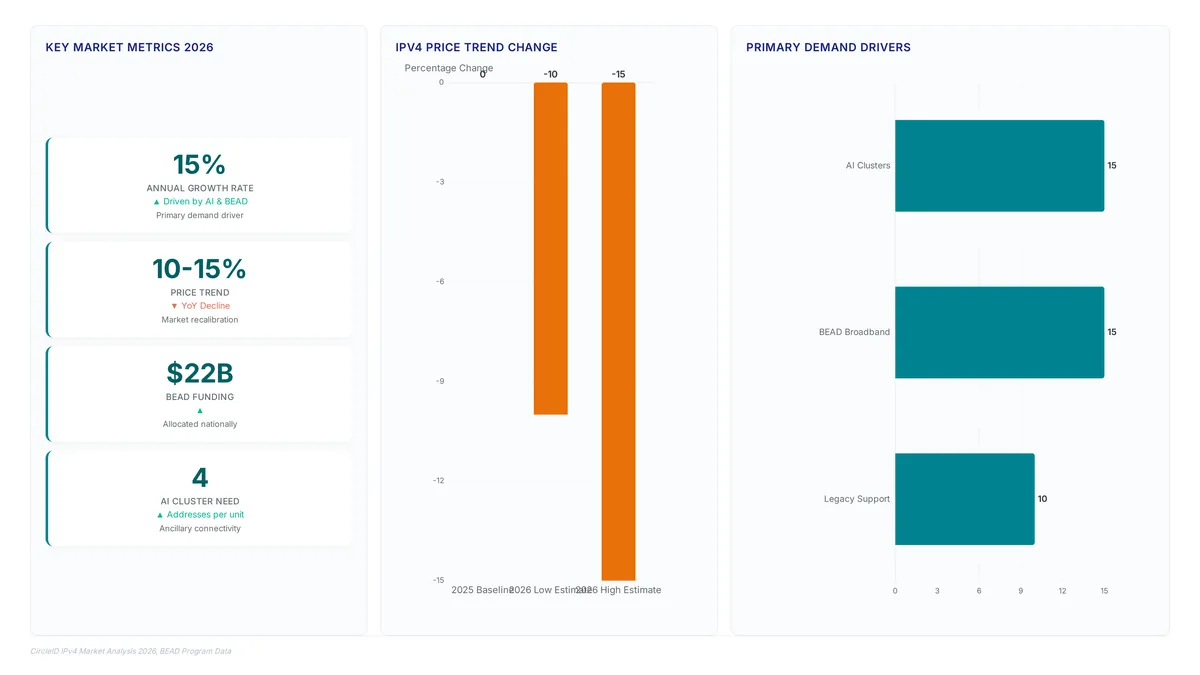
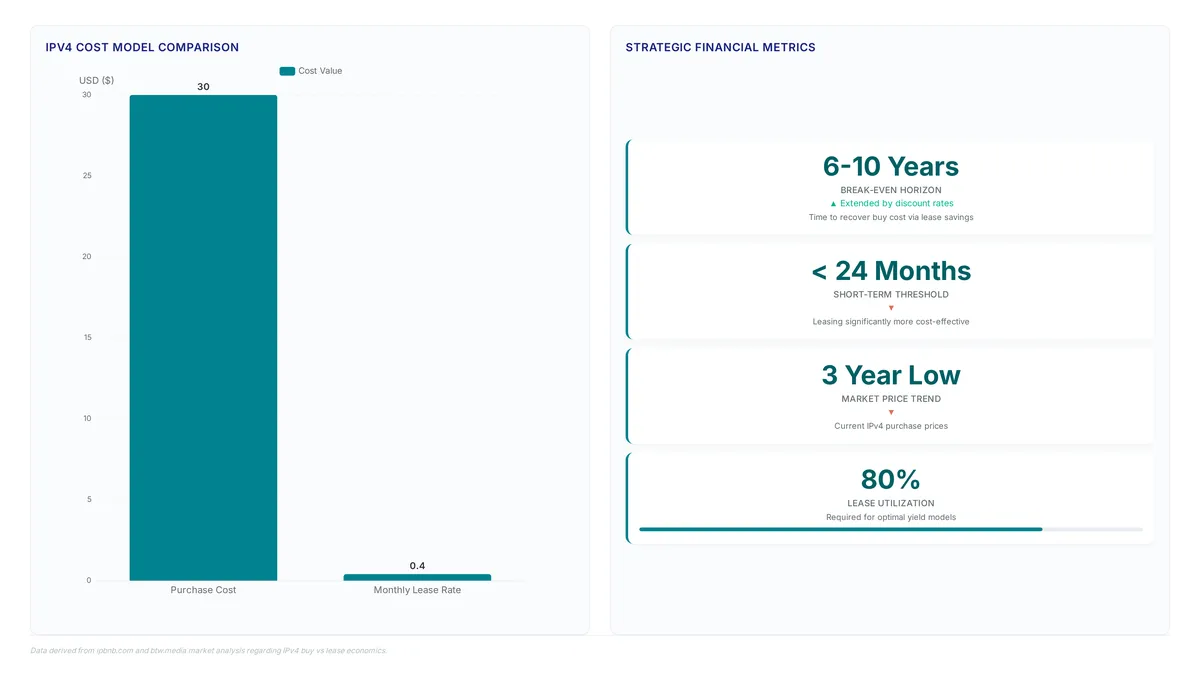
Lease rates hold at $0.40 per IP while purchase values for large blocks correct downward in 2026.
The weighted average price for IPv4 addresses reached $19.56 per IP in April 2026 based on 110 transactions.
With the global IPv4 pool exhausted, unused blocks are now critical capital. Learn to navigate leasing or sales securely without fraud risks.
The global IPv4 pool shrunk 60% since 2015. Legacy blocks are no longer just infrastructure; they are critical capital.
Selling IPv4 addresses requires navigating complex RIR transfer processes to ensure legal ownership changes and maximum asset recovery.
With over 2500 clients relying on IPv4Connect, the market for selling unused IP assets has reached an inflection point.
Five Regional Internet Registries sit between IANA and your network. That gap is where Local Internet Registries (LIRs) operate.
Renting IPv6 /48 blocks costs $66.65 yearly, proving leasing bypasses traditional scarcity while offering immediate network deployment for servers.
Leasing a /24 block costs between $128 and $384 monthly, while specific providers like Host-telecom.com quote quarterly rates starting at 600.00 € for...
IPv4 leasing now serves over 75 industries, turning idle assets into liquid capital while enforcing strict BGP routing security for operators.
Leasing rates define the current IPv4 address economy in 2026. Owners monetize surplus inventory through custom IPv4 lease terms while retaining full...
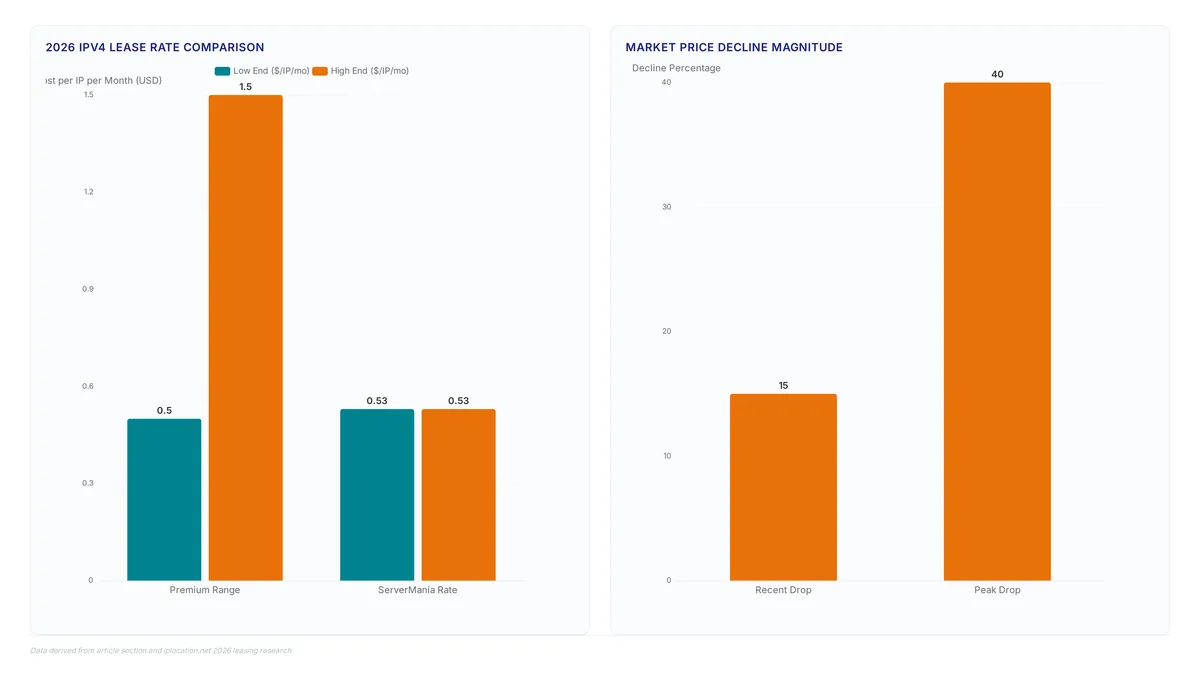
Market data shows IPv4 lease rates hovered around $0.40 to a comparable rate per IP monthly through 2025, making purchasing obsolete for many.
With the global IPv4 transfer pool shrinking nearly 60% since 2015, leasing has become the only scalable strategy for modern network expansion.
Skip 8-week procurement delays; deploy clean IPv4 blocks in 24 hours via automated BGP routing for immediate network scaling.
Leasing a /24 IPv4 subnet starts from $169/month when bundled with infrastructure or $256/month for standalone blocks according to current provider...
APNIC lease rates now reach $0.60 per IP monthly. Discover how regional supply constraints and block quality impact your network budget today.
A perfect 5.0 rating across 32 reviews defines the current standard for trusted IPv4 leasing platforms.
Microsoft paid $11.25 per address to Nortel in 2011, instantly creating a paid market for IPv4 assets.
LACNIC approved 135 intraRIR transfers since 2016. InterLIR verifies eligibility to bypass strict holding periods and secure compliant IPv4 blocks.
IPv4 transfers demand strict eligibility checks and RIR approval to legally move addresses between parties.
X.509 certificates anchor RFC 6480 to prove IP ownership. Learn how strict validation stops origin spoofing without causing outages.
Skip registry delays with 258 subnets ready for immediate deployment. Get full BGP control and clean IPv4 space without the long wait.
Purchase prices hitting $35, 60 per IP make leasing IPv4 blocks at $0.30, 0.50 monthly the only viable scaling strategy for US and EU providers in...
Secure clean IPv4 blocks with full BGP routing. Access inventory from 256 to 2,048 IPs for immediate deployment without capital commitments.
Navigate the 2026 IPv4 market with a strict 5-step workflow. InterLIR ensures clean blocks and full RIR compliance for secure transfers.
Unlock over 10,000,000 IPv4 addresses in global pools. Transform dormant blocks into recurring revenue while keeping full ownership control.
With 4.3 billion addresses as the hard global limit, dormant IPv4 blocks represent tangible capital. Learn to audit and monetize unused ranges today.
Leasing a /24 block costs significantly less than the $15 to $26 per address required for outright purchase via ipbnb.com.
With only 4.3 billion addresses possible, the 32-bit space is exhausted. Learn how secondary markets now drive global infrastructure deals safely.
With 60% of addresses blacklisted, buying verified clean IPv4 blocks prevents delivery failures and protects your network reputation globally.
Unused IPv4 blocks generate zero revenue. Learn how the 24-month RIPE NCC hold impacts your strategy and how InterLIR secures payouts.
APNIC allocations now max out at 512 addresses. Leasing offers the flexible capacity proxy companies need to scale without permanent ownership.
With only 4,294,967,296 unique IPv4 addresses available, global governance strictly controls allocation through regional registries rather than direct access.
Idle IPv4 blocks are lost capital in this exhausted market. Learn to sell or lease surplus assets for immediate revenue without hidden fees.
Secure IPv4 blocks with no-revocation guarantees for 36 to 60 month terms, ensuring stable BGP sessions without capital expenditure risks.
Since RIPE limits new allocations to a /22 block, many firms buy IPv4 space on the secondary market. Learn how verified brokers secure legal transfers.
Leasing IPv4 blocks grants access to inventory but confers zero permanent registration rights or network autonomy.
Unused IPv4 space is now liquid capital. Learn how the 24-month transfer hold forces many holders to lease rather than sell for immediate returns.
Transform dormant inventory into revenue. With 4.3 billion addresses exhausted, learn how leasing surplus blocks creates yield without divesting control.
With over 820 million unused IPv4 addresses sitting idle while the global transfer pool shrank by nearly 60%, leasing has become the only viable...
Paying $1.20 per IP instead of $50 defines the immediate financial logic behind modern IPv4 leasing strategies.
With 3,687,518,752 addresses delegated, APNIC's free pool is history. Discover how strict limits force operators toward leasing and secondary markets today.
Only 3.9 million unallocated addresses remain. The IPv4 leasing market has shifted from an optional tactic to an operational imperative.
The global IPv4 transfer pool shrank nearly 60% from 2015 to mid-2024, forcing ISPs to adopt leased address blocks.
Zen Internet withdraws free IPv4 blocks after originating 500,000 addresses. Learn how the shift to leasing impacts your network budget and planning.
Stop tying up $10,000 in idle assets. Leasing IPv4 blocks offers a flexible OpEx model, letting you scale networks without the heavy capital drag.
Free IPv4 pools are gone. The secondary market is no longer a theoretical alternative; it is the only path forward for network expansion.
Buying IPv4 addresses in 2026 costs between $18 and $45 per IP, a spread driven by block size and region. Stop treating this as a simple utility bill.
Convert idle inventory into liquid capital with InterLIR's automated leasing. Access clean IPv4 blocks delivered in under 24 hours.
Five regional registries govern global IPv4 blocks, verifying each LIR before allocation to prevent routing conflicts and ensure network stability.
461,596 redundant routes now clog the global table. See how rigid classful blocks caused this IPv4 exhaustion and why CIDR aggregation must return.
ARIN filled 67 waiting list requests in April using 40 cleared blocks. Learn why verifying IP reputation is critical before you deploy.
ARIN cleared 149 requests in Jan 2026. I explain why the 388-day queue beats paying $90 per IP on the volatile private market.