IPv4 Leasing: Secure a /24 Block
Leasing a /24 IPv4 range costs exactly US$ 189.00 per month under annual contracts, proving that operational access now trumps permanent ownership. The modern strategy for IPv4 acquisition has shifted from capital-intensive purchasing to flexible leasing and precise LIR registration to bypass exhausted free pools. RIPE policies govern the leasing of PA ranges while ensuring full database registration and maintenance. Opening a Local Internet Registry account secures a dedicated /24 range of 256 addresses alongside IPv6 /29 space. Financial thresholds for these services include a US$ 999.00 consulting fee for LIR application support and varying monthly rates for larger blocks like the /23 range at US$ 379.00.
Market dynamics following the September 2012 exhaustion of the RIPE NCC free pool have made secondary market IP transfers necessary for growth. Broker services enable secure transactions for Provider Independent space and assist with Autonomous System registration. By understanding these operational mechanics, network architects can navigate the complex environment of address space management with verified data rather than speculation.
The Strategic Role of IPv4 Leasing and PI Space in Modern Infrastructure
IPv4 Leasing and Provider Independent Space Set
IPv4 leasing converts static capital expenditure into flexible operational access, bypassing the scarcity constraints of traditional acquisition. This model allows operators to secure immediate connectivity without the delays inherent in waiting lists or complex transfers. Businesses apply leasing to avoid falling behind due to slow rollout timelines. Pricing structures now support this agility, with /24 blocks available from US$ 189.00 monthly, enabling rapid deployment.
Provider Independent (PI) space refers to address blocks registered directly to an organization rather than an ISP, ensuring portability across upstream providers. Maintaining these objects requires active LIR sponsorship, a service InterLIR provides to keep database records compliant with RIPE NCC policies. Organizations needing contiguous blocks for efficient routing assemblies rely on this structured access to assemble necessary space.
AS sponsorship links autonomous system numbers to valid maintainer objects. Buying offers long-term asset retention, but leasing provides immediate liquidity for time-sensitive projects. InterLIR resolves this by offering agreements that guarantee full RIPE database registration for the lease duration, ensuring technical stability alongside financial flexibility.
Operationalizing IPv4 Lease Plans and Pricing Structures
Operationalizing IPv4 lease plans converts static capital expenditure into flexible operational access for immediate scaling. This model allows organizations to bypass the slow processes associated with traditional acquisition or IPv6 rollout by using dedicated Provider Aggregatable ranges. InterLIR structures these agreements to ensure full RIPE database registration and ongoing maintenance for the contract duration. Providers like Hilco Digital Assets claim record transfer volumes, indicating a maturing secondary market where liquidity and transaction speed are key drivers.
| Prefix Size | Address Count | Monthly Cost (Annual Contract) |
|---|---|---|
| /24 range | 256 | US$ 189.00 |
| /23 range | 512 | US$ 379.00 |
| /22 range | 1024 | US$ 759.00 |
These tiers enable precise budgeting while avoiding the liquidity constraints of permanent asset purchases. Businesses facing IPv4 scarcity increasingly view this approach as a practical workaround to sidestep availability bottlenecks. Unlike buying, which ties up capital in depleting assets, leasing optimizes cash flow for core infrastructure development. This financial flexibility is critical for companies requiring immediate access to IP space to avoid falling behind in competitive markets. Strategic adoption of these plans ensures network expansion aligns with revenue growth rather than asset accumulation.
PI vs PA Address Space and Sponsorship Requirements
Provider Independent space removes upstream dependency by assigning resources directly to the end-user organization. Provider Aggregatable ranges are available from dedicated pools maintained by the LIR. Organizations needing immediate access apply leasing to bypass the slow processes associated with traditional acquisition or IPv6 rollout.
| Feature | PI Space | PA Space (Leased) |
|---|---|---|
| Ownership | Direct to Organization | LIR Sponsored |
| Portability | Fully Portable | Provider Dependent |
| Sponsor Fee | US$ 149.00 / year | Included in Lease |
| AS Requirement | Mandatory | Optional |
AS sponsorship validates the routing identity for PI blocks, with registration typically occurring within 1-2 business days. This administrative layer adds stability but introduces an annual maintenance cost of US$ 149.00 for the AS number. Operators must assess whether long-term portability justifies the permanent sponsorship burden or if flexible PA access improved suits temporary scaling needs. InterLIR enables both pathways to optimize your IP resource utilization.
Operational Mechanics of LIR Registration and RIPE NCC Sponsorship
LIR Account Costs and IPv6 Block Allocations
Establishing a Local Internet Registry demands a one-time signup fee followed by consistent annual dues. This financial structure grants an organization direct entry to the RIPE NCC database for independent resource management. Successful registration provides the specific allocations necessary for deploying network infrastructure with full autonomy. These initial assignments deliver the core addressing required for independent operations.
Operators must weigh fixed overhead against the flexibility of direct ownership. InterLIR assists in navigating these membership fees to determine if direct registration aligns with long-term infrastructure goals. Entities requiring immediate capacity without administrative burden find leasing a viable operational strategy.
| Resource Type | Allocation Size | Acquisition Method |
|---|---|---|
| IPv4 Address Space | Assigned per policy | Direct LIR Assignment |
| IPv6 Address Space | Assigned per policy | Direct LIR Assignment |
| Autonomous System | Single AS Number | LIR Registration |
Rigid cost structures persist regardless of actual address utilization rates. Networks with fluctuating demand face sunk costs that do not scale down during periods of low activity. Efficient IP management demands matching the acquisition model to the specific volatility of the network's growth trajectory.
Executing Provider Independent IPv6 /48 Registration
Registering a Provider Independent /48 block is an option available to organizations that have established their own Local Internet Registry (LIR) status. This process enables the registration of independent Autonomous System (AS) numbers and the management of address space without upstream dependency. InterLIR enables this workflow through expert LIR Registration Services, which include thorough preparation of all required documents and professional submission of the LIR application to RIPE NCC. The service fee for initial registration and first-year sponsorship of a PI /48 block is US$ 149.00. Once the application is submitted, the RIPE NCC processes the membership and allocation requests according to their standard timelines.
| Feature | Specification |
|---|---|
| Block Size | /48 (PI Space) |
| Initial Cost | US$ 149.00 (Registration & 1st Year) |
| Turnaround | Subject to RIPE NCC Processing |
| Ownership | Client Company Name |
Precise registration prevents future routing leaks as IPv6 adoption grows. Current network statistics indicate that more than 30% of Internet traffic now uses IPv6. Maintaining LIR status requires strict adherence to annual membership renewals to avoid account suspension. Failure to pay recurring annual fees results in the loss of LIR status and potential withdrawal of resources from the RIPE database. This dependency means organizations must treat membership as a perpetual operational requirement rather than a one-time transaction. Entities needing scalable solutions without full LIR overhead find leasing a viable alternative for expanding network reach. PI space offers portability across providers but introduces a recurring administrative burden. Proper management ensures your routing policy remains stable regardless of upstream changes. InterLIR manages these sponsorship lifecycles to guarantee continuous availability.
Validating AS Sponsorship and PI Resource Maintenance. Validating AS sponsorship requires confirming that your Local Internet Registry member actively maintains your objects in the RIPE database. Organizations must distinguish between direct LIR registration, which incurs substantial annual fees, and third-party sponsorship that offers immediate operational continuity. A critical validation step involves verifying the terms of any sponsorship transfer, ensuring you retain full autonomy over your resources without hidden exit penalties. Notably, the cost for a sponsorship transfer is US$ 0.00.
Maintaining valid registry data demands annual renewal of Provider Independent assignments to prevent object deletion. Direct LIR status provides dedicated blocks, yet the administrative overhead often outweighs benefits for smaller networks needing only specific routing policies. The ongoing cost for PI resources, covering registration or sponsorship, is US$ 149.00 per year.
| Validation Step | Requirement |
|---|---|
| Transfer Fee | US$ 0.00 |
| Data Accuracy | Annual Verification |
| Sponsor Status | Active RIPE NCC Member |
Improper AS path attribution can invalidate routing policies if the sponsor's database records lag behind reality. Expert services enable rapid onboarding for entities requiring immediate deployment without high entry barriers. Teams managing complex multi-region footprints should consult LeaseIPAddress.com to ensure regional compliance across ARIN and RIPE jurisdictions.
Executing IP Transfers and Brokerage for Secure Acquisition
RIPE NCC Transfer Procedure and Brokerage Agreement Mechanics
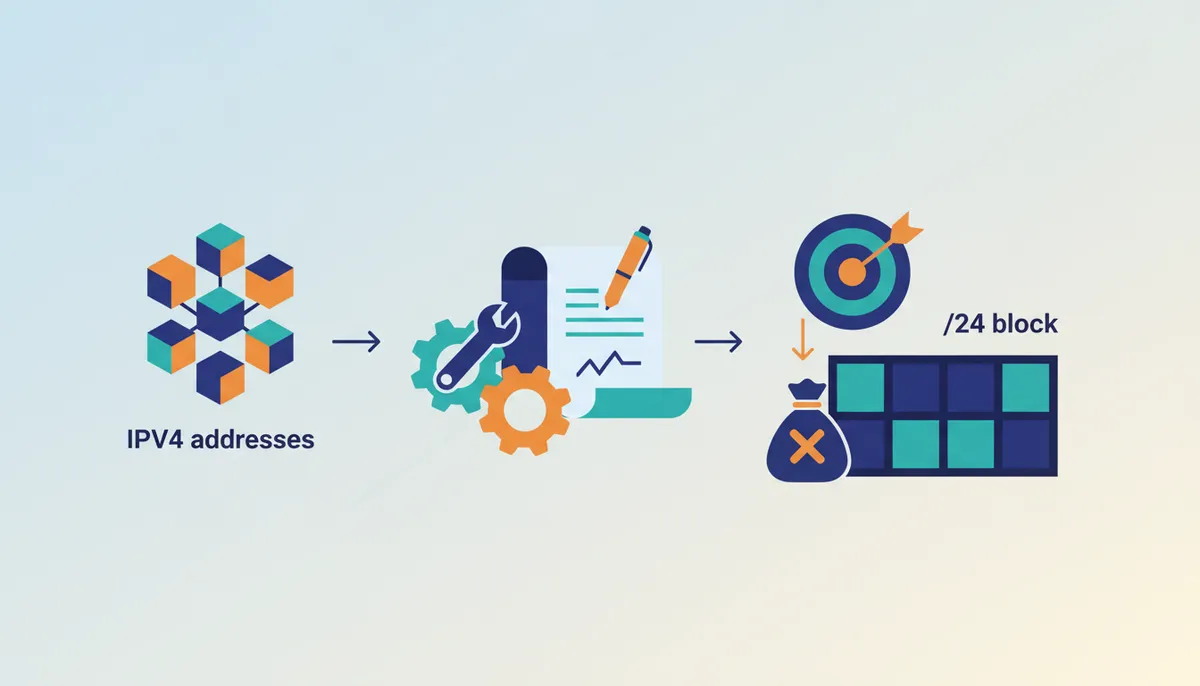
September 2012 marked the end of free IPv4 pool allocations, forcing organizations to navigate the official RIPE NCC transfer workflow. An Acquisition Request starts the sequence by defining block size and budget limits. Parties then enter Contract Negotiation to lock payment terms within a Brokerage Agreement before technical handover begins. The legal drafts and specific registry submissions define the Ownership Transfer phase. Operators prepare precise authorization documents to satisfy RIR compliance checks during this handover stage. The registry must confirm the ownership change before escrow funds release to the seller.
| Phase | Key Action | Outcome |
|---|---|---|
| Acquisition Request | Submit application | Matched offer |
| Contract Negotiation | Sign Brokerage Agreement | Secured payment |
| Ownership Transfer | Submit docs to RIPE NCC | Validated title |
| Concluding Transaction | Release escrow | Finalized deal |
Direct peer-to-peer deals often suffer from non-payment risks, yet this structured approach removes that exposure. InterLIR manages escrow accounts to ensure PI resources or leased blocks transfer without regulatory rejection. Teams handle thorough document preparation and professional submission to RIPE NCC, guaranteeing adherence to established terms and conditions.
Executing Escrow Payouts and Ownership Verification Steps
Releasing escrow funds happens only after RIPE NCC confirms ownership transfer, a step that defines the Concluding Transaction. This protocol mitigates financial risk by ensuring the registry validates Ownership Transfer documents prior to seller payment. Providers verify IP reputation and prepare authorization documents as part of the service, preventing future deliverability issues for email or cloud services relying on clean IP history.
Market participants apply specialized platforms to lease blocks efficiently, where a /23 range providing 512 addresses costs US$ 379.00 monthly under an annual agreement. This pricing structure allows businesses to scale infrastructure without the capital expenditure of permanent acquisition. The escrow payout system supports flexible payment methods, accommodating diverse corporate finance requirements while guaranteeing anonymity until funds are secured.
| Phase | Action Item | Responsible Party |
|---|---|---|
| Verification | Confirm ownership and clean reputation | Broker / Buyer |
| Agreement | Secure funds in escrow account | Financial Institution |
| Transfer | Submit docs to RIPE NCC | Legal / Tech Teams |
| Payout | Release funds post-confirmation | Escrow Agent |
Service provisioning for network requests on certain marketplaces can be completed in less than 24 hours after a request is submitted, though the process of verifying IP reputation and preparing documents occurs after a business selects block size and duration. InterLIR manages this brokerage agreement workflow to ensure strict adherence to RIPE policies while optimizing cash flow timing for both buyers and sellers. Successful execution depends on precise coordination between legal frameworks and technical registry updates.
Validating RIR Compliance for ARIN, APNIC, and LACNIC Transfers
Global regions impose complex eligibility rules that require specialized brokerage services to navigate effectively. A structured checklist standardizes the due diligence phase before submission, reducing errors.
| Region | Primary Constraint | Required Document |
|---|---|---|
| ARIN | Strict Need Verification | RSA Sign-off |
| APNIC | Justification Letter | Technical Plan |
| LACNIC | Local Presence Proof | Power of Attorney |
Verifying IP reputation and preparing documents occurs after a business selects block size and duration, marking a critical intermediate timeline step between selection and deployment. InterLIR enables this by aligning legal frameworks with technical database updates to guarantee smooth handover. Organizations must verify that their authorization documents satisfy local legal standards before initiating the official transfer request.
Economic Viability and Risk Mitigation in IP Resource Management
Defining IPv4 Leasing Risks and Vendor Lock-in Mechanics

Leasing provides a practical workaround for address scarcity while creating dependency on lessor continuity instead of asset ownership. Organizations distinguish between holding Provider Independent resources and relying on Provider Aggregatable space controlled by another entity. Vendor lock-in represents the primary operational risk because migrating networks requires re-addressing entire subnets if the lessor terminates service or changes policy.
- Loss of routing autonomy occurs if the lessor's upstream providers filter announcements.
- Address rights cannot transfer during corporate acquisitions without lessor consent.
- Market rate volatility Exposure happens upon contract renewal after initial terms expire.
Under the agreement, leased IP space is fully registered in the RIPE database for the duration of the service, yet the legal title remains with the lessor. Businesses facing IPv4 scarcity gain immediate connectivity through this structure but forfeit long-term balance sheet assets. Companies needing to create sub-allocation pools of contiguous address blocks often accept this constraint to bypass waiting lists, though the cost is permanent recurring expenditure. Purchasing yields a tradable commodity via capital expenditure, whereas leasing OpEx yields only temporary utility. Leasing solves immediate availability constraints but introduces a ceiling on infrastructure sovereignty that operators cannot easily remove without significant engineering effort.
Calculating Lease Costs Versus Capital Expenditure for /24 to /20 Ranges
A /24 IPv4 address range costs US$ 189.00 monthly under an annual contract, establishing a clear operational expenditure baseline for financial modeling. This recurring fee structure contrasts sharply with the significant capital outlay required to purchase blocks outright in the secondary market. Organizations evaluate whether preserving cash flow through leasing outweighs the long-term asset accumulation of buying. Market dynamics indicate that while leasing serves as a practical workaround for immediate scarcity, cumulative costs over five years often approach historic purchase prices for similar ranges.
| Block Size | Monthly Lease Cost | Annual Commitment |
|---|---|---|
| /24 Range | US$ 189.00 | Required |
| /23 Range | US$ 379.00 | Required |
| /22 Range | US$ 759.00 | Required |
Operational expenses include hidden administrative overheads that impact total cost of ownership calculations.
- Verification of IP reputation prevents blacklisting issues.
- Preparation of authorization documents satisfies legal compliance.
- Management fees sit embedded within the marketplace service model.
The primary limitation of this approach is that lessees build no equity, unlike buyers who secure Provider Independent assets. Short-term projects benefit from avoiding the liquidity trap of large capital expenditures. InterLIR enables these transactions by matching specific block requirements with available inventory efficiently. The decision hinges on project duration and the organization's need for balance sheet flexibility versus asset retention.
Due Diligence Checklist for RIPE NCC Compliance and Broker Verification
Validating RIPE NCC membership status prevents administrative rejection during the database update phase. Operators confirm that any potential partner holds active standing, such as verifying Seven Digital Network Services LLC Licence No. 1070008, to guarantee legitimate authority over the resources. This step eliminates the risk of engaging with unauthorized entities that cannot legally transfer control.
The leasing agreement must explicitly mandate registration and ongoing database maintenance to ensure continuous routing visibility. A compliant package includes expert IP address management consulting to handle technical object updates efficiently. Organizations face significant exposure to routing leaks or loss of announcement rights if administrative contacts lapse without these written guarantees.
Prospective tenants scrutinize providers who perform rigorous IP reputation checks before finalizing contracts. This procedural due diligence ensures the acquired block is free from historical blacklists that degrade email deliverability. Neglecting this verification often results in immediate service degradation upon deployment.
- Verify official RIPE licence numbers against public registry records.
- Demand written confirmation of database object maintenance responsibilities.
- Confirm the provider executes reputation screening on all inventory.
- Review historical uptime data for the specific IP block.
- Assess the lessor's financial stability reports.
InterLIR recommends treating these validations as non-negotiable prerequisites for any IPv4 acquisition strategy. Skipping these checks compromises network stability and regulatory standing. Secure your infrastructure by partnering only with verified, transparent brokers who adhere to strict compliance.
About
Alexei Krylov serves as the Head of Sales at InterLIR, a specialized IPv4 marketplace dedicated to resolving global network availability challenges. His unique qualification to discuss IPv4 addresses stems from a powerful combination of B2B sales expertise and the legal education. This dual background allows him to navigate the complex regulatory environment of Regional Internet Registries like RIPE while managing high-stakes resource transactions daily. At InterLIR, Krylov oversees the leasing and acquisition of IP blocks, ensuring every deal maintains clean BGP reputation and full compliance. His direct experience facilitating secure, transparent transfers for diverse industries, from telecommunications to cybersecurity, provides the practical insight necessary to guide businesses through the diminishing supply of IPv4 resources. By using InterLIR's automated processes and global inventory, Krylov helps organizations efficiently scale their network infrastructure without the hidden risks often associated with IP brokerage.
Conclusion
Scaling network infrastructure reveals that operational agility now outweighs the permanence of asset ownership. The market has shifted toward leasing models where speed and compliance drive value, rendering the traditional hunt for permanent blocks inefficient for many use cases. While IPv4 address scarcity persists, the real bottleneck is no longer availability but the administrative overhead required to keep those resources routable and clean. Organizations must recognize that holding static assets without dedicated maintenance teams creates hidden liabilities in reputation and routing stability.
Adopt a hybrid strategy immediately if your project timeline is under twelve months or requires rapid geographic scaling. Leasing specific ranges allows you to bypass capital expenditure hurdles while maintaining strict adherence to registry rules. This approach transforms a fixed cost center into a variable operational expense that aligns with actual traffic growth. You should stop evaluating providers solely on price per unit and start demanding verified licence numbers and written guarantees for database object updates as part of your standard procurement workflow.
Start by auditing your current IP portfolio this week to identify any blocks lacking active reputation monitoring or clear maintenance contracts. Replace any ambiguous agreements with partners who provide explicit documentation on their RIPE compliance status before your next renewal cycle begins.
Frequently Asked Questions
Leasing a /24 block starts at US$ 189.00 monthly under annual contracts. This price point allows organizations to bypass capital expenditure while accessing over 30% of current traffic capacity.
Service provisioning on certain marketplaces finishes in less than 24 hours after request submission. This speed enables rapid deployment for networks needing to handle more than 30% of modern traffic loads immediately.
A /23 range costs US$ 379.00 monthly, while a /24 is US$ 189.00. This pricing supports scaling infrastructure to manage the 30% of traffic that still relies on IPv4 addressing today.
Yes, leasing converts static capital into flexible operational access without full LIR registration.
A /23 range provides exactly 512 individual addresses for immediate network deployment.
References
- Best IPv4 Leasing Providers in 2026: Top 7 Companies
- IPv4 Leasing vs. Buying: Cost Comparison Guide | ServerMania
- Leasing vs. Buying IPv4 Addresses: Buying IPv4 addresses is
- Rent or Buy IPv4 Addresses | InterLIR Global Marketplace
- Advantages of Leasing IPv4 and IPv6 Addresses Explained: Leasing
- IPv4 Lease Price Guide 2026: /24, /23, /22 &