IPv4 Market: Avoid Buying After 2011 Exhaustion
Buying IPv4 addresses is often unnecessary when IP leasing offers a flexible alternative for the 4,294,967,296 total addresses set by the Internet Assigned Numbers Authority.
Purchasing IPv4 blocks is an outdated strategy for expanding companies. The math no longer works against prohibitive costs and bureaucratic friction. Since the Internet Assigned Numbers Authority assigned the final IP blocks to Regional Internet Registries in 2011, free acquisition has ended. While IPv6 provides vast capacity, legacy dependencies force continued reliance on the scarce IPv4 protocol. This scarcity created a secondary market where transferring usage rights remains a long and complicated process requiring strict policy compliance.
Organizations must pivot from ownership to access models. The mechanics of IPv4 exhaustion drive secondary market dynamics that inflate prices. Modern IP leasing models offer superior financial ROI and risk mitigation compared to traditional purchasing.
The Mechanics of IPv4 Exhaustion and Secondary Market Dynamics
IPv4 Exhaustion Set by IANA's 2011 Final Allocation
IPv4 exhaustion marks the technical milestone when IANA assigned the final address blocks to Regional Internet Registries in 2011. The fourth version of the Internet Protocol provides exactly 4,294,967,296 unique addresses, a finite pool that proved insufficient against exponential device growth since 1981. This hard ceiling created a permanent scarcity where free acquisition from RIRs is no longer possible for most organizations.
Network operators now face secondary markets rather than traditional allocation channels. IPv6 offers a vastly larger address space, yet current infrastructure remains predominantly dependent on legacy IPv4 connectivity. Operators must navigate complex transfer policies or leasing agreements to secure necessary network capacity.
- Global free pools are depleted, shifting focus entirely to resource redistribution.
- Strict RIR policies now govern all remaining address allocations and transfers.
- Secondary markets provide the only viable path for immediate network expansion.
InterLIR Marketplace solves these availability problems by redistributing unused IPv4 resources to companies needing reliable connectivity. Avoiding capital-intensive purchases requires ongoing management of leased assets instead of owning them outright. This model optimizes existing address utilization without requiring massive upfront investment.
Secondary Market Dynamics: Leasing IPv4 Addresses at $0.40 Monthly
The secondary market functions as the primary channel for acquiring address space since RIRs halted free allocations. Businesses can no longer freely acquire IPv4 addresses from Area-based Internet Registries, forcing a strategic pivot toward private transfers and rentals. Speed often outweighs permanent ownership for expanding enterprises.
This stability allows organizations to bypass the substantial upfront capital required for buying, where prices typically span $20 to $35 per unit. Smaller entities specifically benefit from this model. Purchasing often demands justification of need and involves prolonged administrative reviews that stall deployment. Conversely, leasing preserves capital but yields no residual equity upon contract termination. Operators must weigh whether holding a permanent registry record outweighs the agility of scaling resources on demand. For many, the inability to quickly buy IPv4 addresses without rigorous justification makes the rental model the only viable path for rapid growth. InterLIR enables this access by connecting lessees with verified holders, ensuring clean reputation history and immediate usability.
IPv6 Capacity Versus IPv4 Scarcity in Legacy Infrastructure
IPv6 offers 340 trillion trillion trillion unique combinations, yet legacy dependencies force continued reliance on the exhausted IPv4 secondary market. This theoretical abundance contrasts sharply with the practical reality where infrastructure complexity and transition costs slow widespread adoption. Operators cannot simply switch protocols overnight because critical business applications often depend on specific IPv4 configurations that lack native IPv6 support.
| Feature | IPv4 Reality | IPv6 Potential |
|---|---|---|
| Address Count | Limited to ~4.3 billion | 340 undecillion addresses |
| Availability | Secondary market only | Theoretically infinite |
| Adoption Barrier | High cost, scarcity | Legacy system deps |
| Deployment Speed | Immediate via leasing | Gradual migration |
IPv6 was standardized in 1998 to solve exhaustion, yet many organizations still buy IPv4 addresses to avoid service disruption. This creates a persistent demand loop where scarcity drives value even as the alternative protocol matures.
Operators face a strategic choice: invest heavily in dual-stack migration or optimize existing IPv4 resources through flexible leasing. InterLIR Marketplace enables this by redistributing unused IPv4 blocks, allowing companies to scale without massive capital expenditure. Delaying migration increases dependency on a finite resource, yet rushing can break legacy applications. Balancing these timelines requires careful planning rather than an abrupt protocol swap.
Operational Complexities in Buying Versus Leasing IPv4 Blocks
RIR Transfer Protocols and Pre-Approval Timelines
Formal RIR transfer policy mandates a structured review where buyers must justify operational need before any address movement occurs. This procedural gatekeeper ensures scarce resources align with actual network growth rather than speculative hoarding. Operators initiate contact either directly with a registry or through an intermediary, triggering a compliance check required by regional policies.
The pre-approval process typically consumes several days as administrators validate documentation against strict regional guidelines. Once submitted, the file enters a queue for final validation, extending the total timeline to two or three weeks depending on registry workload and data accuracy. This duration contrasts sharply with modern operational requirements for rapid deployment. For instance, the IPXO Platform enables verified lessees to secure resources in mere minutes, highlighting the latency inherent in permanent acquisition. Both parties often face transfer fees starting from $500 at the American Registry for Internet Numbers, adding immediate capital cost to the delay. Buying secures a permanent ledger entry, yet administrative friction creates a window where market opportunities or emergency capacity needs may go unmet. Organizations requiring immediate scaling often find the rigid RIR transfer policy timelines incompatible with agile infrastructure demands, forcing a strategic choice between waiting for approval or seeking flexible alternatives.
Executing Custom Lease Conditions on the IPXO Platform
The IPXO Platform enables operators to search strictly by price and negotiate custom lease conditions that fit specific project timelines rather than rigid standard contracts. This workflow eliminates the multi-week delays associated with traditional transfers, allowing infrastructure deployment within 24 hours of agreement.
- Select blocks from any available pool.
- Define the exact duration needed.
- Sign the digital contract.
- Deploy instantly.
Organizations pursuing global expansion increasingly prefer this model to avoid large capital investments and long-term commitments linked to purchasing blocks. Unlike buying, which locks capital into assets that require active management, leasing converts fixed costs into flexible operational expenses. Relying exclusively on short-term rentals can introduce cost uncertainty if market rates rise notably over extended periods. Leasing offers a solution without long-term commitment, ideal for temporary needs or testing, while buying locks the organization into a specific asset base that may limit flexibility. Securing competitive pricing through negotiated terms ensures budget predictability while bypassing the complex justification processes required for RIR transfers.
Operational Overhead and Management Costs of IPv4 Inventory
Purchasing IPv4 blocks introduces significant administrative burdens that can erode the asset's long-term value if inventory sits idle. Unlike leasing, which shifts maintenance duties to the provider, buying requires internal teams to handle complex inventory management tasks continuously. This hidden operational cost often outweighs the benefit of ownership for flexible networks needing rapid scaling. ARIN fees represent just one component of the total cost of ownership when factoring in staff hours spent on justification reports. Buying IPv4 addresses is an expensive proposition requiring significant upfront capital investment, contrasting sharply with the operational expenditure model of leasing. Companies must also consider that if management becomes too time-consuming or costly, the purchase may not deliver expected returns. Leasing offers a distinct advantage by enabling organizations to deploy infrastructure quickly without waiting for transfer processes. This approach avoids the risk of capital ties in underutilized assets while providing immediate access to necessary resources. InterLIR Marketplace enables this agility, allowing operators to optimize their IPv4 resources without the heavy lift of permanent acquisition.
Financial ROI and Risk Mitigation in IP Leasing Models
Capital Expenditure Savings in IPv4 Leasing Models
Turning IPv4 addressing from a heavy capital burden into a manageable monthly expense changes everything for expanding networks. Purchasing blocks traditionally demands significant upfront liquidity, whereas leasing converts this into predictable operating costs. This price differential allows companies to preserve cash flow for core infrastructure rather than locking funds in static address space.
| Cost Factor | Buying Model | Leasing Model |
|---|---|---|
| Initial Outlay | High capital lock | Minimal entry fee |
| Cash Flow | Front-loaded spike | Smooth monthly spread |
| Risk Profile | Asset depreciation | Flexible scaling |
Strategic planning avoids the trap of over-provisioning where operators buy large blocks to secure future growth, only to leave much of the address space idle and depreciating. Leasing eliminates this waste by aligning costs directly with active utilization. A fixed-term agreement offers flexibility for short-term needs while requiring careful management of lease terms. InterLIR Marketplace enables this financial efficiency by connecting businesses with verified IP holders, ensuring smooth access to IPv4 resources without the heavy balance sheet impact of ownership. Organizations maintain agility in a volatile market by treating IP addresses as a utility rather than an asset.
Flexible Scaling Strategies for Flexible IP Resource Needs
Enterprises launching global expansion projects increasingly select leasing to bypass large capital investments and rigid long-term commitments. This approach allows organizations to treat IP resources as variable operational expenses rather than static assets requiring heavy upfront liquidity. Companies can deploy network capacity within days to match immediate demand spikes by avoiding the multi-week transfer timelines associated with purchasing. The IPXO Platform, described as the world's first fully automated IP lease, monetization, and management platform, enables this agility by enabling rapid resource allocation. Businesses preserve critical cash flow for core innovation instead of locking funds in dormant address blocks. Relying exclusively on ownership introduces risk if market rates fluctuate or needs shift unexpectedly, even though buying may offer advantages for stable, permanent infrastructure.
| Strategy | Best Use Case | Capital Impact |
|---|---|---|
| Leasing | Temporary projects, testing, rapid scaling | Preserves liquidity |
| Buying | Permanent core infrastructure, stable growth | High upfront outlay |
Asset ownership creates tension with operational agility because holding excess inventory incurs management overhead that erodes potential ROI if utilization dips. Network audits often reveal that a significant portion of allocated address space is wasted due to inefficiencies, representing a significant area for immediate reclamation. A balance must be struck between the desire for permanent assets and the need for fluid scaling in a market where IPv4 availability remains constrained. Implementing specific auditing of utilization rates and short DHCP leases for transient clients represents a best practice for managing exhaustion and optimizing costs.
Mitigating IP Reputation Risks and Blocklist Exposure
Acquiring IP blocks from the secondary market requires careful consideration of address history and potential reputation issues. Buyers may inherit unknown reputation baggage when purchasing, whereas leasing through providers often includes managed services to address these concerns. Sellers in the secondary market may not always apply rigorous security measures, leaving new owners vulnerable to delivery failures and trust deficits if due diligence is not performed. Small and Medium-Sized Enterprises have largely shifted to the IPv4 lease market as their primary source for address space because buying is characterized as an expensive proposition requiring significant upfront capital. Direct purchase limitations mean addressing reputation issues can be complex and time-consuming, requiring dedicated resources to resolve. Leasing circumvents this by offering access to resources that align with modern growth patterns and often include provider-managed monitoring.
| Risk Factor | Direct Purchase | Leasing Model |
|---|---|---|
| Reputation History | Requires due diligence | Provider managed |
| Monitoring | Buyer responsibility | Provider managed |
| Abuse Response | Internal process required | Dedicated team support |
Technical control validates the origin of route announcements, ensuring traffic reaches the intended destination without interception. Networks remain exposed to hijacking attempts that can divert sensitive data or cause outages without such validation. Total liability comes with ownership; if an acquired block encounters listing issues, the organization bears the full responsibility for remediation. Providers address this by deploying Abuse Prevention teams that perform checks to guarantee validity. Companies avoid the complex effort of fixing blocklisted IPs after the fact by using provider expertise for maintenance and security.
Executing an IPv4 Lease Strategy with RPKI Security Standards
RPKI Implementation for Secure BGP Routing
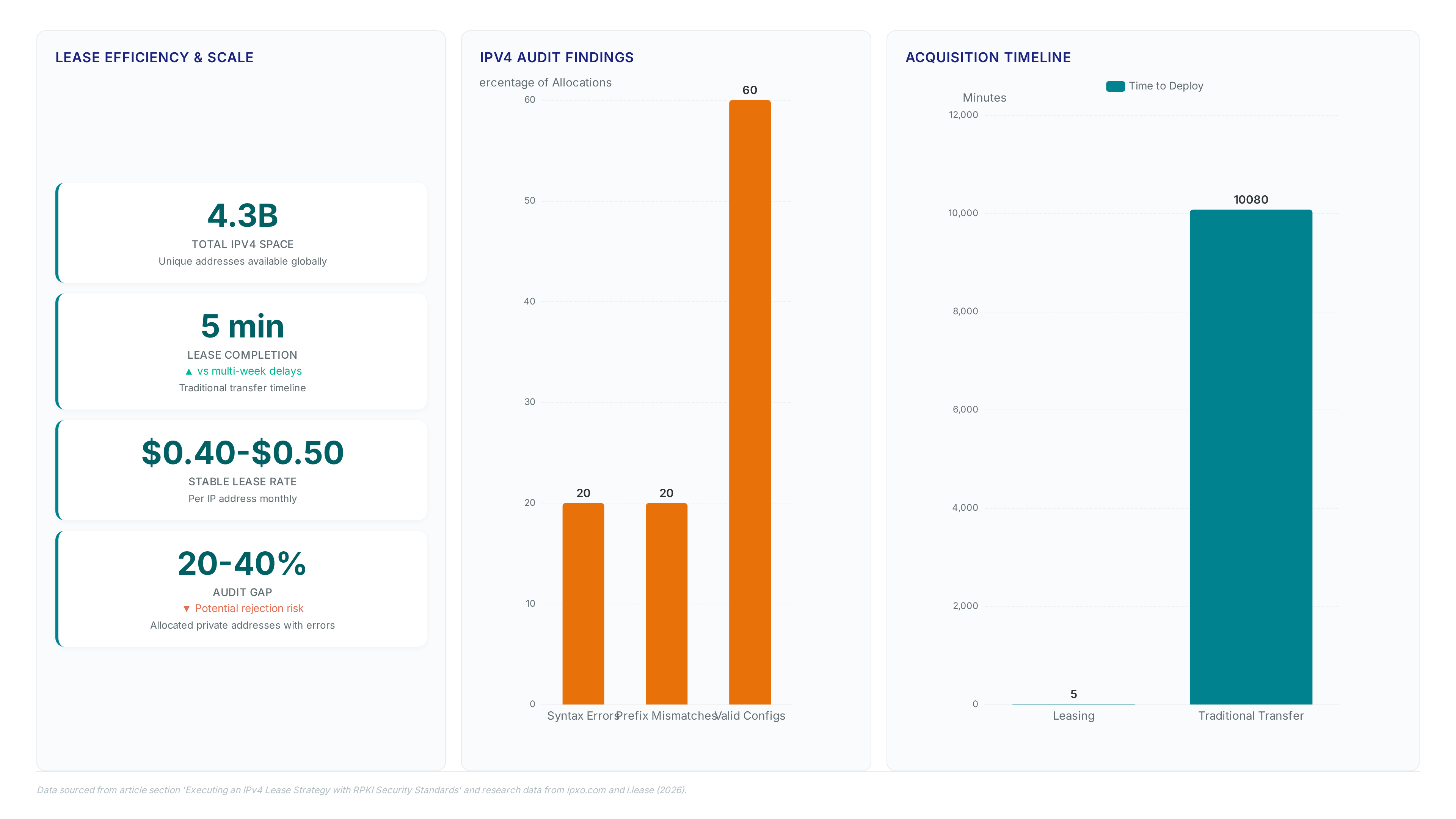
Resource Public Key Infrastructure (RPKI) validates BGP route origins to prevent IP hijacking during lease execution. Operators must generate Route Origin Authorizations (ROAs) to sign their announcements, creating a chain of trust that routers verify before accepting paths.
- Create a key pair within your RIR portal to establish cryptographic identity.
- Publish ROA records linking your Autonomous System number to the leased IPv4 block.
- Configure border routers to reject any BGP updates lacking valid signatures.
Strict validation policies can inadvertently drop legitimate traffic if ROA records contain syntax errors or mismatched prefix lengths. While buying offers ownership, it lacks the built-in security coordination often found in managed leasing environments where providers handle RPKI implementation details. For network teams, the implication is clear: without active monitoring of signature validity, even verified leases face rejection by upstream peers enforcing Route Origin Validation. InterLIR recommends integrating these checks immediately upon resource activation to maintain global reachability.
Implementation: Executing Custom Lease Conditions on IPXO Platform
Verified users on the IPXO Platform complete lease agreements within 5 minutes, bypassing the multi-week delays of traditional transfers. This speed advantage allows operators to deploy infrastructure rapidly without waiting for complex registry approvals or broker negotiations.
- Search the global marketplace for IPv4 blocks filtered by price and region.
- Negotiate custom lease conditions directly with holders to lock in duration and pricing stability.
- Receive automated LOA and ROA updates to synchronize routing policies immediately.
- Deploy resources across substantial cloud providers within 24 hours of signing.
Operators must align these rapid deployments with RPKI validation to prevent route leaks during the transition.
Lessees do not build permanent equity in the address space, requiring continuous management of renewal terms.
Implementation: Mitigating IP Reputation Risks and Blocklist Exposure
Purchasing legacy blocks often transfers hidden abuse residue that triggers immediate filtering by upstream providers. Unlike buying, which burdens owners with management responsibility for historical sins, leasing through InterLIR isolates operators from prior misuse.
- Screen potential lessors for active blocklist monitoring before signing agreements.
- Demand proof of RPKI signing to validate clean origin announcements.
- Use short-term contracts to test IP reputation before scaling deployment.
Sellers in the secondary market frequently skip rigorous security audits, leaving buyers exposed to delivery failures. This risk persists because buying lacks the flexibility to quickly swap contaminated ranges without financial loss. Direct ownership locks capital into assets that may require months to cleanse.
Operators must recognize that a single polluted prefix can blacklist an entire Autonomous System. Rapid rotation of leased space prevents long-term damage to network trust scores.
About
Vladislava Shadrina serves as a Customer Account Manager at InterLIR, a specialized marketplace dedicated to the redistribution of IPv4 resources. Her daily work involves guiding clients through the complex environment of IP address acquisition, making her uniquely qualified to discuss the strategic decision of buying versus leasing IPv4 addresses. At InterLIR, Shadrina directly assists expanding companies in navigating IPv4 exhaustion by providing transparent, efficient solutions for securing clean address space. Her firsthand experience managing client accounts allows her to understand the specific pain points of businesses facing network scalability challenges. By connecting practical customer needs with InterLIR's core mission of ensuring network availability, she offers valuable insights into optimizing IP infrastructure. This article reflects her expertise in helping organizations make informed decisions about their critical network assets without hidden fees or unnecessary intermediaries.
Conclusion
Scaling network infrastructure reveals that direct ownership of IPv4 addresses creates rigid capital traps, especially when legacy blocks carry hidden abuse residue that compromises entire Autonomous Systems. While purchasing locks funds into assets requiring weeks to cleanse, the market is shifting toward moderation and segmentation through 2026, making long-term equity buildup less critical than operational agility. Organizations relying on permanent acquisition face rising opportunity costs as transfer fees and cleanup timelines erode the value of static ownership.
Prioritize managed leasing for any expansion project requiring deployment within 24 hours or involving temporary workloads. This approach converts high-risk capital expenditure into flexible operational spending, allowing immediate swapping of contaminated ranges without financial loss. Direct purchase remains viable only for core, permanent infrastructure where specific geopolitical sovereignty over the asset is legally mandated.
Start by auditing your current IP blocks against active blocklist monitors this week to identify potential reputation risks before they trigger upstream filtering. If your team cannot verify RPKI signing or prove a clean history for existing assets, migrate those specific workloads to short-term leases immediately. This isolates your network from historical sins while you negotiate improved terms. The path forward requires treating address space as a flexible utility rather than a permanent store of value.
Frequently Asked Questions
Buying requires significant capital with prices spanning $20 to $35 per unit. Leasing offers a stable alternative at approximately $0.40 monthly, preserving cash flow for other critical infrastructure investments instead of tying up funds.
Regional registries often apply transfer fees starting from $500 for transactions. This cost adds to the administrative burden, making the leasing model financially attractive for companies needing rapid deployment without heavy upfront paperwork.
IPv6 provides 340 trillion unique combinations, theoretically solving address shortages globally. However, legacy dependencies force many firms to remain on IPv4, requiring them to navigate secondary markets rather than switching protocols immediately.
Smaller entities benefit because buying often demands rigorous justification reports and reviews. Leasing bypasses these hurdles, allowing immediate access to resources without the prolonged administrative delays that stall network expansion projects.
The entire IPv4 space is limited to roughly 4.3 billion addresses. This finite pool is exhausted, forcing organizations to rely entirely on secondary markets or leasing models to secure necessary connectivity for growth.
References
- Leasing vs. Buying IPv4 Addresses: Buying IPv4 addresses is
- IPXO - Leasing vs. Buying IP Addresses: Undeniably, leasing
- Buy vs. Lease IPv4 Blocks: A Practical Playbook for
- IPv4 Address Price History & Market Trends to 2026
- Advantages of Leasing IPv4 and IPv6 Addresses Explained: Leasing
- Renting the Internet's Backbone: How IPv4 Leasing Actually Works