Secondary IPv4 Market: Why Buying Beats Renting Now
Over 3.36 million IPv4 addresses changed hands in Q1 2026 alone, proving the secondary market is the only viable supply chain left.

IPv4 prices now range from €28 per address to €99 for blocks as supply exhaustion drives costs higher.
Lease rates hold at $0.40 per IP while purchase values for large blocks correct downward in 2026.
The weighted average price for IPv4 addresses reached $19.56 per IP in April 2026 based on 110 transactions.
Leasing IPv4 addresses in 2026 costs between $0.50 and $1.50 per IP monthly, a rate that defines current infrastructure budgeting.
With available IPv4 supply shrinking from 44.8M to 18.6M, leasing offers the only viable path for expansion without heavy capital costs.
Since 2018, brokers have defined the IPv4 market. Learn how leasing replaces ownership to meet immediate cloud demands without RIR delays.
Falling 2026 prices signal market maturity, not collapse. With only 18.6 million addresses left, secure transfers and compliance are now critical for success.
Starting at a competitive price per IP address, InterLIR provides a set entry point for buyers in the current IPv4 marketplace.
With the global IPv4 pool exhausted, unused blocks are now critical capital. Learn to navigate leasing or sales securely without fraud risks.
The $60 per IP ceiling reached in 2021 proves that waiting for free allocations is a financial liability.
The 32bit structure of IPv4 defines absolute scarcity. Discover how professional mediation ensures secure transfers and protects buyers from fraud in this...
With over 2500 clients relying on IPv4Connect, the market for selling unused IP assets has reached an inflection point.
A standard /24 block now commands a market price between $16 and $25 per IP according to InterLIR data.
Leasing rates define the current IPv4 address economy in 2026. Owners monetize surplus inventory through custom IPv4 lease terms while retaining full...
The IPv4 address market has shifted from bidding wars exceeding $50 per unit to a moderated system in 2026.
Prices above a nominal threshold per address set the IPv4 market during past bidding wars, but that era has ended.
APNIC lease rates now reach $0.60 per IP monthly. Discover how regional supply constraints and block quality impact your network budget today.
With 4,294,967,296 total addresses fixed, learn how APNIC transfers and leasing models help organizations secure IPv4 space legally.
One LIR held 21 allocations by manipulating accounts, proving RIPE proposal 2010-02 failed to ensure fair competition.
Microsoft paid $11.25 per address to Nortel in 2011, instantly creating a paid market for IPv4 assets.
A $200 non-refundable deposit starts the clock on IPv4 address transfers in the LACNIC region. This isn't just a fee; it's a filter.
APNIC transfers surged from 131 in May to 1,478 in June, defining the liquidity shock of the 2026 IPv4 market.
IPv4 transfers demand strict eligibility checks and RIR approval to legally move addresses between parties.
With IPv4 Connect reporting that 3,000+ companies now trust their marketplace, acquiring RIPE IPv4 addresses has shifted from a bureaucratic hurdle to...
A tenfold surge from $6 to $60 defines the recent valuation trajectory for individual IPv4 addresses.
Extreme scarcity defines the current IPv4 market. Learn how block sizes from /24 to /17 impact your acquisition strategy and final costs.
Navigate the 2026 IPv4 market with a strict 5-step workflow. InterLIR ensures clean blocks and full RIR compliance for secure transfers.
Leasing rates for IPv4 addresses held between a low and high monthly rate per unit from June 2025 through May 2026 according to IPXO data.
IPv4 transfers demand strict RIR coordination to avoid policy violations. Learn how i.LEASE manages the resource review process for secure transactions.
With only 4.3 billion addresses possible, the 32-bit space is exhausted. Learn how secondary markets now drive global infrastructure deals safely.
Scarcity has birthed a liquid secondary market for IPv4 blocks where unused sub-blocks are sold rather than allocated.
Huawei holds 40% of Europe's market as rivals face sales drops. InterLIR ensures your network stays stable by redistributing unused IPv4 blocks today.
Discover why 2026 buyers prefer fixed-price IPv4 deals over volatile auctions. Learn ARIN and RIPE validation steps for secure, clean block transfers.
With 2024 prices stabilizing near $40 per address, leasing IPv4 avoids stranded assets and offers flexible scaling for modern network growth.
Idle IPv4 blocks are lost capital in this exhausted market. Learn to sell or lease surplus assets for immediate revenue without hidden fees.
Recent data shows a weighted average of $19.56 per IP. Discover how to execute valid secondary market transfers and avoid costly routing failures now.
Since RIPE limits new allocations to a /22 block, many firms buy IPv4 space on the secondary market. Learn how verified brokers secure legal transfers.
With 2026 lease prices adjusting due to rising supply, recurring revenue models now outperform one-time IPv4 liquidation strategies.
The 2026 IPv4 market favors calculated private negotiation over auction frenzy. Learn how escrow services and RIR protocols secure your block transfer today.
IPv4 sale prices jumped from $6 to $60 as free pools vanished. See why addresses are now financial assets, not just utilities.
The global IPv4 pool shrank from 44.8 million to 18.6 million addresses. Discover why leasing bypasses capital risks in this tight market.
Over 33 million IPv4 addresses moved via leasing recently. Discover how automated platforms convert dormant blocks into recurring revenue streams.
Unused IPv4 space is now liquid capital. Learn how the 24-month transfer hold forces many holders to lease rather than sell for immediate returns.
Transform dormant inventory into revenue. With 4.3 billion addresses exhausted, learn how leasing surplus blocks creates yield without divesting control.
ARIN manages about 100 /8s, yet cross-border deals stall on policy. Learn how strict chain of custody rules shape the global IPv4 market today.
56,629 global IPv4 transactions have occurred since 2012, yet January 2026 saw APNIC transfers drop to just 88. Scarcity has shifted the battlefield.
With only 0.1811 /8s remaining in the pool as of June 2026, direct allocation from APNIC is effectively dead for most enterprises.
APNIC's 2010 policy shift created IPv4 liquidity by allowing transfers, establishing the /24 minimum block size still used today.
Leasing IPv4 addresses costs $0.30 to $0.55 per IP monthly while purchase prices sit between $38 and $58 according to IPv4.Global data from May 2026.
Zen Internet withdraws free IPv4 blocks after originating 500,000 addresses. Learn how the shift to leasing impacts your network budget and planning.
With only 4.3 billion unique addresses total, the IPv4 market demands agility. Leasing offers a flexible path around permanent scarcity.
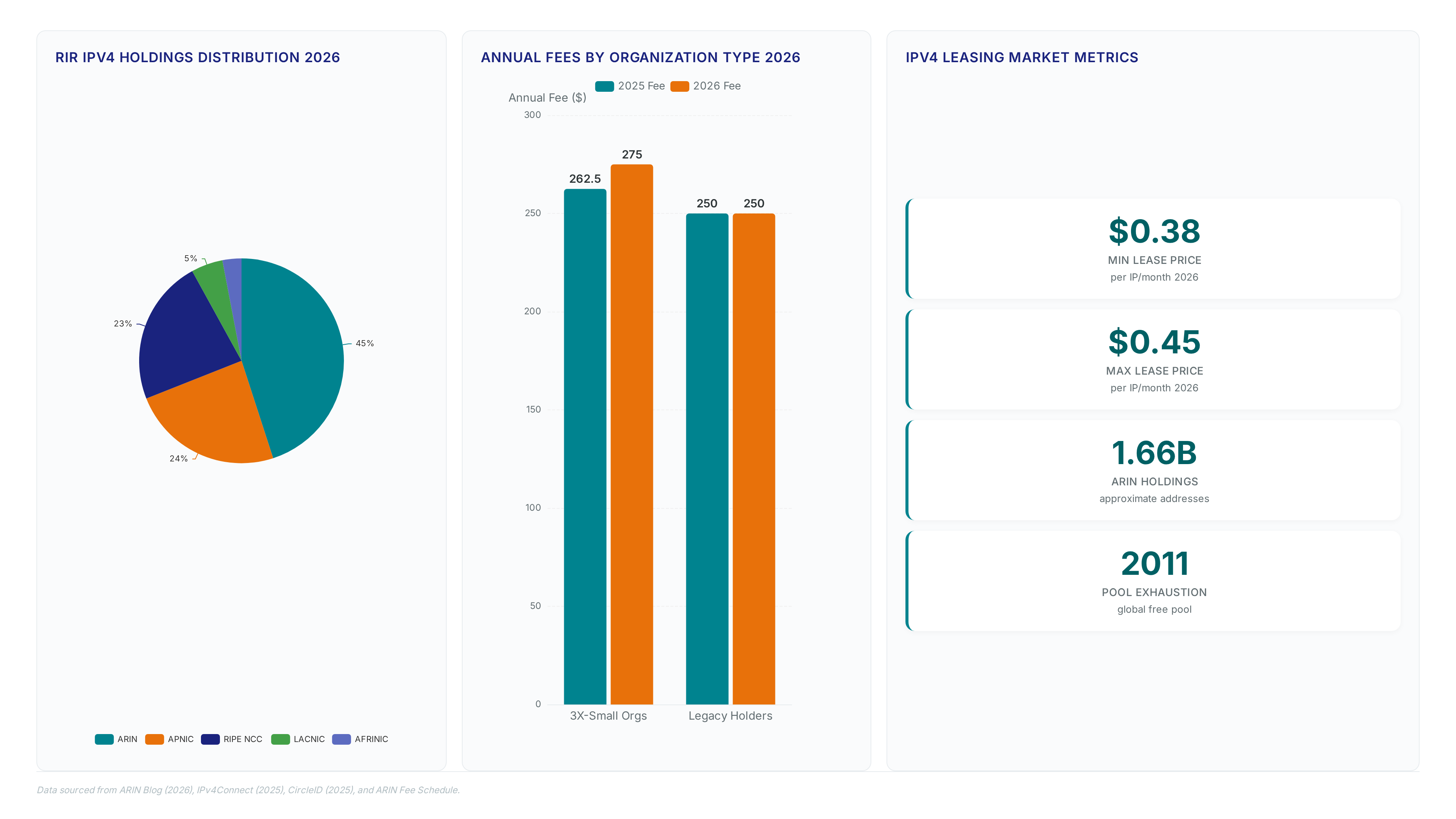
Real enterprise IPv6 sits at 12%. With IPv4 leasing at $0.38, the 2045 sunset date makes economic sense for now.