IPv4 waiting lists now hit 503 days
The dream of free address space is dead. With 841 LIRs stuck on the IPv4 Waiting List for over 503 days, the modern LIR account has mutated. It no longer functions as a gateway to unlimited resources. It is now a strategic asset for navigating a saturated, high-cost routing environment. Membership grows, yet the gap between demand and available IPv4 inventory creates a permanent bottleneck. Operators face a binary choice: enter complex transfer markets or endure prolonged queuing. (RIPE's payment)
We must look harder at Route Origin Validation. While 76% of IPv4 space is covered by ROAs, IPv6 protection lags significantly at just 44%.
Strategic decision-making for IPv6 deployment and IPv4 transfers now happens amidst resilient leasing prices driven by AI and IoT demands. By examining specific registry movements and the stagnation of Policy Proposal 2024-01, network architects can improved understand how to secure routing integrity without relying on obsolete allocation models. Survival depends on precise routing architecture and financial pragmatism.
The State of IP Resource Management and LIR Membership in 2026
LIR Accounts and the RIPE NCC Membership Structure in 2026
A Local Internet Registry acts as the primary distribution point for IP resources within the RIPE service region. The registry currently maintains 20,751 LIR accounts, reflecting a net increase of 34 entities. This structure separates the legal member entity from the technical account used to manage allocations. Operators using the sponsored LIR model initially bypass direct membership fees but face distinct billing triggers upon resource assignment. Financial obligations remain rigid. The current charging scheme mandates full annual payment even for accounts closed mid-year without prior notice. The base fee stands unchanged, yet the cost per ASN assignment adds incremental expense to every new autonomous system deployment.
| Feature | Direct LIR | Sponsored LIR |
|---|---|---|
| Ownership Type | Permanent | Temporary |
| Waiting List | 500 days | <30 days |
| Fee Structure | Fixed Fee | Monthly OpEx |
| Capital Requirement | High CapEx | Low Entry |
| Transfer Speed | Permanent Market Transfer | Leasing <7 days |
Operational agility clashes with financial liability in the 2026 membership environment. Closing an account fails to prorate fees, creating a sunk cost for defunct networks. Administrators maintain dormant accounts rather than incur administrative overhead for termination. The IPv4 Waiting List currently holds 841 LIRs, with the lead applicant waiting 503 days for a /22 allocation. This queue depth forces network architects to evaluate market transfers against operational timelines. The registry processes requests sequentially. The secondary market offers immediate liquidity at a premium. Demand from AI workloads and IoT deployments sustains high valuation for routable space, making leasing a viable alternative to capital expenditure AI workloads. Leasing rates stabilize between a modest fee and $0.50 per IP monthly, allowing operators to scale without long-term asset commitment leasing rates.
Transfers provide permanent ownership but introduce complex due diligence and higher upfront costs. Historical precedents like the Nortel acquisition illustrate the extreme value placed on legacy blocks, driving current market durability Nortel acquisition. Operators must weigh the certainty of a multi-year wait against the volatility of transfer pricing. Budget predictability conflicts with deployment speed. Relying solely on the waiting list risks project delays that exceed typical product lifecycles. The strategic choice depends on whether the address requirement is transient or core. RIPE NCC charging models diverge between the fixed Option A baseline and the resource-weighted Option B category structure. The Executive Board proposes raising the base fee to €1,894 Option B distributes charges across specific resource holdings, altering the financial burden for large holders versus small operators.
Specific assignment costs remain additive regardless of the chosen model. An ASN assignment incurs a flat €50 charge, while independent Internet number resources trigger a €75 fee per transaction. These micro-transactions accumulate rapidly for networks requiring frequent anycast deployments or multi-homing setups. Unlike APNIC, which provides two free ASNs per account, RIPE NCC monetizes every single allocation event. Operators must recognize that closing an LIR account mid-year does not prorate the annual contribution. This rigidity creates a sunk-cost trap for entities merging or exiting the market late in the fiscal cycle. The LIR Portal calculator allows members to simulate 2027 liabilities, yet the fundamental tension remains between stable budgeting and equitable resource-based pricing.
RPKI Architecture and Cryptographic Route Origin Verification
Stricter validation logic for origin claims arrived with the January 2026 update to the Certification Practice Statement. RPKI functions as a distributed ledger where Regional Internet Registries sign resource certificates that bind IP prefixes to specific Autonomous System Numbers. Operators create Route Origin Authorizations by generating a cryptographic object in their registry portal that explicitly permits an ASN to announce a prefix. This process involves four distinct steps: logging into the LIR portal, selecting the target IPv4 or IPv6 block, specifying the maximum prefix length, and signing the record with a private key. The resulting signature allows downstream routers to reject invalid announcements automatically.
Global coverage remains uneven despite available tooling. Data indicates 76% of IPv4 space now carries valid signatures, whereas only 44% of IPv6 addresses possess similar protection. This disparity creates a fragmentation risk where IPv6 traffic traverses less secure paths than legacy flows. The system prevents hijacking but cannot stop authorized leaks where a legitimate holder mistakenly advertises a more specific prefix. Microsoft previously paid $7.5 million for legacy blocks, highlighting the capital risk mitigated by proper origin signing.
Operators must publish Route Origin Authorizations with a maximum prefix length matching the specific announced block to avoid invalid status. The creation process follows four steps: access the LIR portal, select the IP resource, define the authorized ASN, and set the maximum length parameter. This cryptographic binding ensures that routers performing Route Origin Validation can distinguish legitimate announcements from hijacks. Network teams should integrate BGP Routing Security Training into quarterly operational reviews to maintain policy accuracy. The RIPE NCC schedules these technical sessions in cities like Rome and Riga throughout May and June 2026. Attendance equips engineers to manage the Certification Practice Statement updates effectively.
Dependency on upstream providers publishing their own authorizations limits this approach. A local ROA cannot validate a path if an intermediate AS fails to sign its segment. Enterprises deploying complex architectures often apply a Layer 3 model for data center interconnection, which simplifies troubleshooting but requires strict edge filtering. Operators ignoring these steps face increased exposure to route leaks despite holding valid resources. Operators must execute a four-step validation loop: generate keys, sign prefixes, publish to the RIR, and configure routers to reject invalid paths. This process prevents hijacks but introduces operational latency if keys expire during staff holidays. Teams should attend BGP Routing Security courses in Copenhagen or Batumi to master these procedures. Visualizing traffic flow requires new tools like Region Meshes to detect intra-region leaks that standard logs miss.
Neglecting this checklist leaves networks vulnerable to subtle misconfigurations rather than malicious attacks. The cost of false positives remains low, yet many operators skip validation entirely due to perceived complexity. Training gaps often cause more outages than software bugs, making education a primary defense layer.
Strategic Decision-Making for IPv6 Deployment and IPv4 Transfers
Defining the Strategic Trade-off Between IPv6 Deployment and IPv4 Transfers
March transfer volumes jumped by 265,600 addresses as AI workloads drive demand for routable IPv4 addresses Operators face a binary choice between immediate liquidity from the secondary market and long-term infrastructure investment in dual-stack architectures. The transfer market absorbed nearly two million addresses last month, yet 841 Local Internet Registries remain stuck on a waiting list exceeding 500 days. This backlog forces reliance on expensive leasing models rather than direct allocation from the registry. Cisco documentation outlines dual-stack configurations that overlay new protocols without disrupting core services. Paying premium rates for IPv4 while neglecting the cryptographic validation gap in IPv6 space creates a strategic trap. Route Origin Authorizations cover less than half of the IPv6 ecosystem, creating a false sense of security during migration. Waiting times increase monthly, making the cost of delay measurable.
Financial models must contrast recurring IPv4 leasing markets expenses against the one-time engineering cost of dual-stack deployment. Hyperscalers demonstrate the viability of this shift, with 72% of mobile networks now running native IPv6. Enterprises lag at 32% adoption, often due to miscalculated fee structures that ignore long-term lease inflation. The Option A versus Option B charging debate further complicates budget forecasting for the 20,751 existing LIR accounts. Waiting 503 days for IPv4 allocation creates opportunity costs that leasing cannot fully mitigate. A network requiring 10,000 addresses pays a substantial sum annually in leases, exceeding the LIR fee within the first month of operation. Migration stops being optional when lease costs surpass the amortized engineering budget for protocol updates.
Operational Risks of Relying on the IPv4 Waiting List Queue
Queue stagnation exceeding 500 days creates immediate project failure risks for new market entrants. Operators stuck in this bottleneck face indefinite delays while AI workloads drive sustained demand for legacy address space. Uncertainty regarding wait times forces businesses to choose between halted expansion or costly secondary market leases. Small and medium enterprises suffer disproportionately, representing only 17% of adoption due to these barriers. Relying on the waiting list ignores the reality that the RIPE NCC now functions as a primary destination for large-scale transfers rather than a source of fresh allocations. Queue position offers no guarantee of fulfillment within a viable business timeframe because of this structural shift.
Financial exposure compounds monthly as organizations pay premium rates for temporary leases instead of owning assets. Dual-stack deployment eliminates this single point of failure entirely. Continued dependence on IPv4 scarcity mechanisms invites operational fragility that cryptographic validation cannot.
Executing Membership Registration and Community Engagement Protocols
RIPE 92 Registration Windows and LIR Sign-Up Fee Structure
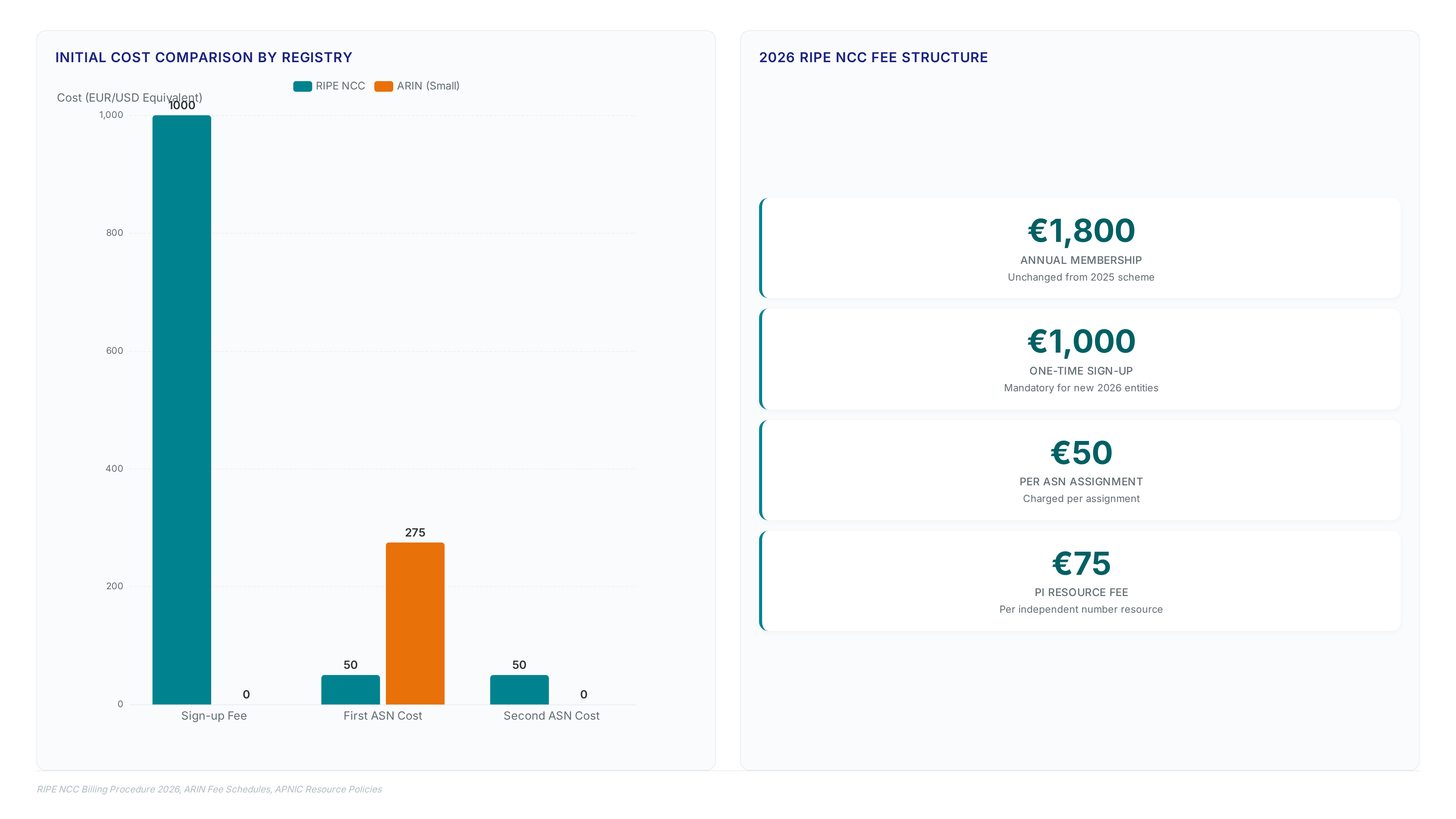
Registration for RIPE 92 opens immediately for the event scheduled from 18-22 May 2026 in Edinburgh. Operators must select between physical attendance or remote participation through the official portal. New entities joining the registry in 2026 face a mandatory one-time sign-up fee of €1,000 before accessing resources. This upfront cost differs significantly from the tiered models used by other regions, such as the $275/year starting rate for small organizations under ARIN fee schedules . The financial barrier aims to filter non-serious applicants while funding initial administrative overhead.
New members pay a €1,000 sign-up fee before assigning their first Autonomous System Number. Operators initiate this process by submitting legal documentation to the RIPE NCC portal for identity verification. The registry then levies a €50 charge per ASN and €75 for each independent Internet number resource. These per-assignment costs accumulate rapidly for organizations requiring multiple routing domains or provider-independent blocks. Contrast this flat fee model with the tiered structures found in ARIN fee schedules , where small entities might pay significantly less annually. APNIC offers a different approach by granting two free ASNs per account, altering the cost calculation for expansion . The RIPE NCC model previously allowed some entities to bypass direct membership through the sponsored.
- Submit organizational proof of existence to the LIR Portal.
- Pay the one-time €1,000 registration invoice.
- Request specific resource blocks via the assignment interface.
- Settle the €50 or €75 per-resource invoices immediately.
- Generate RPKI ROA objects to secure the new announcements.
The rigid per-unit pricing creates a financial friction point for startups needing granular infrastructure segmentation. Operators must forecast total deployment costs including these assignments before committing to the membership track.
Pre-Meeting Validation Checklist for RIPE NCC General Meeting Voting
New members must complete registration for RIPE 92 before analyzing the two proposed charging schemes. Attendees should verify their LIR Portal access to apply the official calculator for fee estimation. Operators must distinguish between the current single-fee model and the proposed category-based alternative. The following steps ensure informed voting on the financial future of the registry. 1. Confirm physical or remote attendance status for the Edinburgh event. 2. Review the Option A projection of €1,894 against current budgets. 3. Compare this with the Option B category structure using the online tool. 4. Validate understanding of how sponsored models impact long-term costs. | Feature | Option A | Option B | | :--- | :--- | :--- | | Basis | Single LIR Account Fee | Resource Category Model | | 2026 Base Cost | €1,894 | Variable by Tier | | Complexity | Low | High |
Failure to model these scenarios risks unexpected capital expenditure increases in 2027. Historical data shows fees rose from €1,400 in 2022 to current levels without member intervention. Operators relying on sponsored LIR models InterLIR recommends treating this vote as a binding financial commitment rather than a procedural formality. The outcome directly dictates operational overhead for all 20,751 connected networks.
About
Evgeny Sevastyanov serves as the Head of Customer Support at InterLIR, a specialized IPv4 marketplace based in Berlin. His daily responsibilities directly align with the complexities of managing LIR accounts and navigating RIPE NCC registry updates. As the leader of InterLIR's support team, Sevastyanov routinely handles the creation and maintenance of objects within the RIPE database, giving him practical, hands-on experience with the exact mechanisms driving the statistics highlighted in this article. His expertise ensures that clients successfully navigate the increasing demand for IPv4 addresses driven by AI and IoT workloads. By overseeing both technical database entries and client relations, he possesses a unique perspective on how LIR account growth impacts real-world network availability. This operational depth allows him to accurately interpret market trends, such as the recent surge in transfers, while guiding organizations through the evolving environment of IP resource management with transparency and efficiency.
Conclusion
Leasing stability between a modest fee and $0.50 per IP masks a critical scalability fracture: the 503-day queue for new allocations renders organic growth impossible for late entrants. Relying on market transfers introduces volatile CapEx, whereas waiting lists freeze deployment timelines indefinitely. Operators must recognize that monthly OpEx for leasing will inevitably outpace fixed fee models as demand tightens further against stagnant supply.
Commit to securing permanent ownership via market transfer immediately if your roadmap requires more than a /24 within the next 18 months. Do not wait for the RIPE 92 voting outcomes to dictate your liquidity strategy; the window for cost-effective expansion is closing as queue depths increase. Treat the current leasing market as a stopgap only for non-critical testing environments. Audit your current IP runway against the 500-day waitlist reality this week and initiate contact with brokers for specific legacy blocks before Q3 pricing adjustments occur. Delaying this procurement calculation risks forcing a reactive, high-premium purchase during future infrastructure emergencies.
Frequently Asked Questions
Leasing provides immediate scaling without long-term asset commitment for your network operations. Current market rates stabilize between $0.38 and $0.50 per IP monthly, allowing operators to manage cash flow effectively while avoiding the multi-year waiting list delays.
Route Origin Validation protects significantly more legacy IPv4 space than newer IPv6 allocations today. Data indicates 76% of IPv4 space now carries valid signatures, whereas only 44% of IPv6 addresses possess similar protective routing security measures.
Waiting for free allocation risks project delays that exceed typical product lifecycles entirely. With the lead applicant waiting 503 days for a small block, most operators choose market transfers or leasing to meet immediate deployment deadlines.
IPv6 migration proceeds sluggishly despite available tooling and urgent security needs for modern networks. Statistics reveal a stark divergence between transfer volumes and the sluggish 2–3% annual growth rate of IPv6 adoption across the region.
Market transfers offer immediate liquidity and permanent ownership compared to the temporary nature of leasing. This approach avoids the 503-day queue depth, ensuring critical infrastructure launches without waiting for scarce free resources to become available.