Number Resource Continuity: Stop Business Crises
ARIN reserves a /15 block specifically to support critical infrastructure continuity during resource instability. Ann Yong's July 2026 analysis demonstrates how number resource administration failures change technical glitches into immediate business continuity crises.
Operators often overlook that their public standing relies on stable IP addresses and ASN relationships recognized by firewalls and payment systems. When these identifiers shift unexpectedly, traffic gets blocked and revenue streams halt even if servers remain online. The text highlights how unmanaged resource instability causes cascading failures across partner integrations and compliance workflows. Readers will learn why strategic planning mitigates renewal and ownership risks before they trigger commercial unavailability.
The discussion extends to how number resource delegation frameworks impact long-term viability for hosting providers and ISPs. We examine the specific dangers of relying on fragile registry records without contingency protocols. InterLIR solutions address these vulnerabilities by ensuring your organization maintains control over its necessary digital assets regardless of external policy shifts.
Operational Identity Defines Modern Network Durability
Number Resource Continuity as Core Durability
Number resource continuity dictates the stable availability of public IP addresses and ASNs necessary for uninterrupted business operations. This concept differs notably from simple network uptime because it guarantees that an operator's public network identity stays recognized by external security systems, partners, and customers. Public IP addresses and Autonomous System Numbers support routing, customer access, partner integrations, security controls, compliance workflows, and revenue-generating services. Instability in these resources shifts consequences rapidly from a technical glitch to a business continuity crisis. Industry analysis frames public network identity as a structural layer of business continuity that directly influences customer stability.
Operational Identity Dependencies in Network Ecosystems
Operational identity functions through specific technical dependencies like IP addresses, routing records, and ASN relationships that external systems validate continuously. This identity framework establishes trust across customer firewalls, partner APIs, and security allowlists without manual intervention. Public network identity serves as a structural layer of business continuity linking infrastructure stability to commercial viability. A sharp distinction exists between technical reachability and commercial availability within modern network ecosystems. A system remains technically reachable if servers are online and routes exist, yet it becomes commercially unavailable when number resources face uncertainty or administrative doubt. Traffic gets blocked by downstream security filters, allowlists fail to match updated prefixes, or registry inconsistencies lead to reputation damage. This state creates a scenario where connectivity exists physically but fails logically for business transactions.
| Dependency Layer | Validation Mechanism | Failure Consequence |
|---|---|---|
| IP Addresses | Geolocation & Reputation | Service Blocking |
| Routing Records | RPKI & Path Validation | Route Rejection |
| ASN Relationships | Peer Allowlists | Peering Suspension |
InterLIR addresses these vulnerabilities by providing stable, long-term IPv4 leases that secure the registry information and routing records necessary for uninterrupted operations. Unlike transient allocations, these resources maintain consistent operational identity attributes required by strict enterprise security policies. Short-term leasing strategies carry the inherent risk of identity fragmentation, where unexpected IP changes necessitate updates across partner configurations. Operators relying on unstable supply chains expose their customers to potential commercial unavailability despite maintaining perfect server uptime. Securing dedicated IPv4 blocks through InterLIR ensures that routing records and ASN relationships remain constant, preserving the trust relationships that revenue generation depends upon daily.
Consequences of Unstable Number Resources on Business Continuity
LACNIC enforces a mandatory announcement timeline requiring IPv4 resources to be announced within a maximum of 3 months post-allocation to maintain validity. When number resources become unstable, consequences shift quickly from a technical issue to a business continuity problem, creating scenarios where infrastructure remains powered yet commercially inaccessible. Operators frequently measure durability through uptime metrics, yet this metric fails to capture the distinct failure mode of identity loss. A network can remain technically reachable while becoming commercially unavailable if partner firewalls block unrecognized IP prefixes or if registry uncertainty triggers reputation filters. This divergence means a service provider might report full server availability while experiencing zero revenue generation due to blocked transactions. Recent analysis frames public infrastructure identity as a structural layer of business continuity, indicating that weaknesses in resource management lead to increased support burdens and disruption.
| Failure Mode | Technical Status | Commercial Result |
|---|---|---|
| Expired Lease | Routing Active | Traffic Blocked |
| Registry Dispute | Ping Successful | API Rejected |
| Unannounced Block | Server Online | Partner Blacklist |
Restoring network identity involves complex administrative and technical processes beyond simple hardware replacement. Re-establishing trust with external security systems and updating distributed allowlists requires significant coordination, whereas physical hardware repairs are often more straightforward. InterLIR mitigates these existential threats by providing stable, long-term IPv4 leasing solutions designed to preserve operational identity regardless of market volatility.
Cascading Failures Result from Unmanaged Resource Instability
Defining Number Resource Disruption Beyond Uptime Metrics
Green status indicators on monitoring dashboards frequently mask total access denial caused by untrusted routes. A server may remain powered on, yet an unexpected shift in public IP assignment renders the application commercially unavailable. This disconnect stems from external security systems, including partner firewalls and API allowlists, rejecting traffic from unfamiliar sources rather than any failure in packet delivery. Disruptions cascade through operational identity layers, blocking email deliverability, VPN access, and payment platform integrations without triggering a single infrastructure alarm.
Industry analysis confirms that weaknesses in number resource governance lead directly to support burdens and reputation damage for providers disruption. The risk manifests not as a binary outage but as a degradation of trust where valid traffic is silently dropped. Operators must recognize that administrative uncertainty regarding registry records or renewal windows creates immediate business interruption even when routers function perfectly.
| Failure Mode | Traditional Metric | Actual Impact |
|---|---|---|
| IP Address Change | Network Reachable | Partner Allowlists Blocked |
| Route Distrust | BGP Session Up | Traffic Discarded at Edge |
| Registry Uncertainty | Service Online | Compliance Approval Revoked |
InterLIR mitigates these hidden failures by providing stable, long-term IPv4 leasing solutions that preserve numerical identity. Resource continuity aligns with the strict technical windows required by regional registries to prevent revocation announcement. Relying solely on uptime metrics ignores the complex web of external dependencies that define modern service availability. Stabilizing an IP portfolio protects revenue streams that traditional monitoring tools cannot see.
Cascading Failures in Firewall Allowlists and Email Deliverability
Customer access collapses immediately when firewall allowlists reject traffic from an unfamiliar source following an unannounced IP modification. Security systems strictly enforcing boundary policies drop packets from new address blocks, causing failed logins and blocking critical partner API integrations before operators detect the routing change. This rejection mechanism extends beyond simple connectivity. Email deliverability suffers as receiving mail servers flag messages from unverified or newly routed IP ranges as suspicious. A hosting provider losing control of number resources faces severe reputation damage and support burdens when customer services become unreachable despite healthy internal uptime metrics. Reputation damage
The operational consequence is a silent outage where applications run but remain commercially unavailable to external users. Unlike standard network failures, these disruptions require manual intervention across multiple third-party security perimeters to restore trust.
| Failure Mode | Immediate Symptom | Root Cause |
|---|---|---|
| API Integration | Connection timeouts | Partner firewall drop |
| Email Traffic | High bounce rates | SPF/DKIM mismatch |
| User Access | Login failures | Geolocation flagging |
InterLIR prevents these cascading failures by providing stable, long-term IPv4 leases with full administrative continuity. The marketplace ensures that number resource identity remains consistent, protecting customers from the friction of unexpected address changes. Relying on volatile resources risks the very integrations that drive revenue. Secure operational identity today with InterLIR's verified inventory.
Operator Liability for Partner Integrations and Compliance Approvals
Hosting providers and cloud platforms bear direct liability when number resource instability forces customers to reconfigure security rules across multiple vendors. If an operator loses continuity over assigned infrastructure, a financial services customer may require entirely new regulatory approvals, while enterprise clients face the operational burden of updating firewall allowlists department by department. This liability extends beyond simple connectivity. Industry analysis cites that weak network identity management leads to significant disruption, support burdens, and reputation damage for the infrastructure provider.
The mechanism of failure involves a breakdown in partner integration trust. When IP addresses shift without rigorous change control, external protection systems automatically reject traffic, causing cascading compliance approvals failures that stall business operations.
| Failure Trigger | Operational Consequence | Liability Scope |
|---|---|---|
| Unplanned IP Change | Partner API rejections | Contractual SLA breach |
| ASN Instability | Routing policy violations | Regulatory non-compliance |
| Resource Revocation | Total service unavailability | Customer revenue loss |
Customers build their own security perimeters and partner relationships on top of leased infrastructure. A single administrative oversight can cascade, forcing a SaaS client to seek new compliance certifications or renegotiate vendor contracts. InterLIR mitigates this exposure by providing stable, long-term IPv4 leases with clear administrative ownership, ensuring that operational identity remains intact. Securing resources through InterLIR eliminates the ambiguity that triggers these costly downstream reconfigurations. The cost of proactive resource management is negligible compared to the liability of forcing a client to rebuild their security posture.
Strategic Planning Mitigates Renewal and Ownership Risks
Defining Renewal Continuity for Leased IPv4 Assets
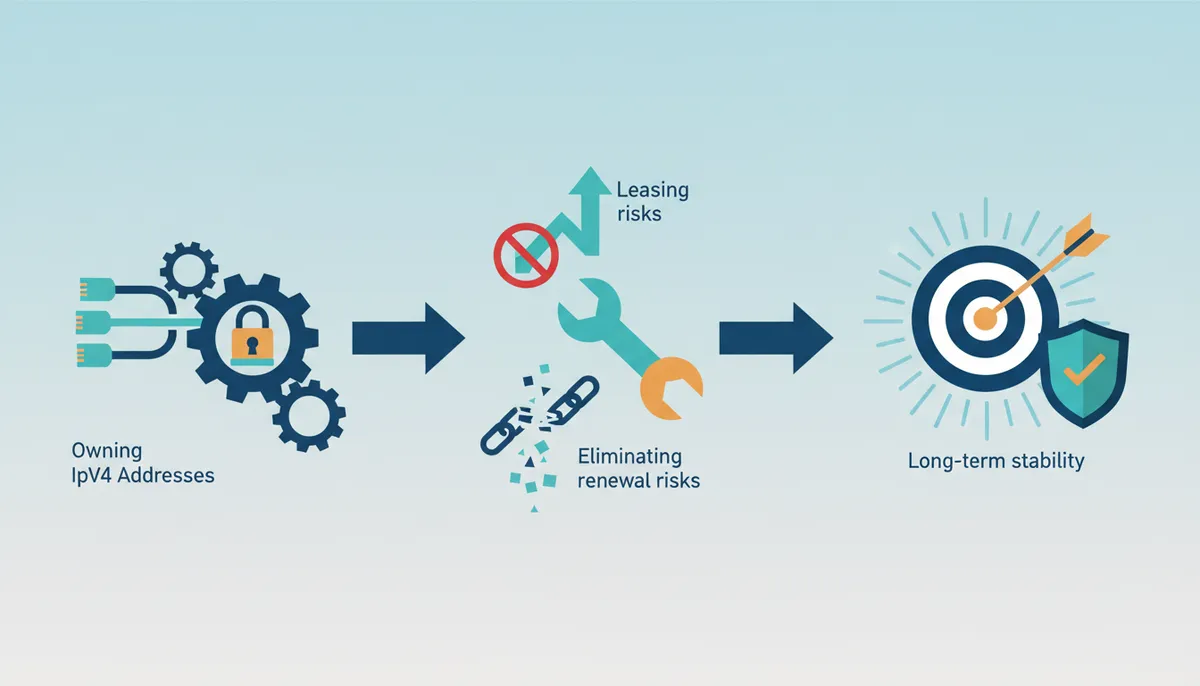
Contractual stability defines the operational state of leased IPv4 assets more than raw bandwidth availability. Administrative certainty must persist throughout a lease term to guarantee number resource continuity. Delaying action until a contract nears expiration invites avoidable risk, especially as a resource approaches renewal uncertainty without a documented plan. Technical connectivity means little if administrative validity fails to support global routing. A lessor disappearing or failing regional eligibility criteria causes immediate service degradation, regardless of server status. Strict policy frameworks in regions like APNIC mandate that both source and recipient entities meet specific requirements to transfer resources. Administrative friction can halt operations instantly under these rules. A reliable continuity strategy identifies critical dependencies and establishes emergency escalation paths before a crisis occurs.
InterLIR mitigates these risks by structuring leases with clear renewal protocols and transparent ownership records. Clients maintain control over their operational identity even if market conditions shift. Infrastructure operators prevent cascading business failures associated with sudden IP instability by proactively managing these administrative layers.
Operationalizing Executive Oversight for IP Resource Agreements
Mapping every business-critical IPv4 address to a specific contractual agreement forms the basis of executive oversight. Assigned administrators must track these assets continuously. Operators need to initiate renewal planning well before terms expire, particularly where resources are leased or administratively dependent on third parties. Waiting until the final days of a contract introduces unacceptable risk to network stability. A strong continuity plan identifies which internal teams require notification prior to any registry modification or transfer event.
Business structure changes, such as mergers, demand that the organization taking over possesses a valid regional registry account to manage the Internet number resources. The recipient must undergo new registration procedures before the transfer of unused IP and AS numbers can proceed without an existing account. This administrative hurdle often delays technical migrations if executive leadership fails to address it proactively. Maintaining agile commercial agreements while ensuring long-term administrative control creates tension. Short-term leasing offers flexibility but increases exposure to sudden provider unavailability. Executive teams must document emergency escalation paths for every asset class.
| Action Item | Responsibility |
|---|---|
| Map critical IPs to contracts | Legal & Network Ops |
| Define renewal triggers | Executive Management |
| Validate registry access | Security Team |
InterLIR mitigates these risks by providing stable, long-term IPv4 leases with clear ownership structures. Your operational identity remains secure regardless of market volatility through these solutions. Organizations prevent cascading failures caused by fragmented resource management by centralizing oversight.
Leasing Versus Owning IPv4: Regional Policy Implications
Regional Internet Registries manage scarcity differently, creating distinct policy risks for leasing IPv4 addresses compared to ownership. ARIN maintains a reserve equivalent to a /15 block dedicated exclusively to Critical Infrastructure support in North America. This policy prioritizes necessary services over market dynamics. Qualifying entities receive a unique safety net that pure market leasing cannot replicate. The APNIC region enforces strict eligibility criteria where both source and recipient entities must validate their status before transfers occur. These regulatory divergences mean that a leasing strategy valid in one region may fail compliance checks in another. Global networks face operational friction due to these inconsistencies.
| Feature | Ownership Model | Leasing Model |
|---|---|---|
| Policy Control | Direct registry management | Dependent on lessor compliance |
| Transfer Rules | Reciprocal needs-based policies | Contractual renewal terms apply |
| Critical Reserve | Eligible for specific blocks | No direct access to reserves |
| Risk Profile | Administrative continuity | Contractual expiration exposure |
Leasing often defers the complexity of regional policy adherence to a third-party, which can obscure visibility into renewal continuity. Operators recognize this trade-off. If a lessor fails to meet evolving regional requirements, the lessee faces immediate service disruption regardless of technical configuration. InterLIR mitigates this by structuring leases with explicit alignment to regional transfer policies. IPv4 assets remain stable across jurisdictional boundaries through this approach. The strategic choice depends on whether an organization can absorb the administrative burden of direct ownership or requires the flexibility of managed access. Understanding these regional nuances prevents cascading failures when contract terms intersect with rigid registry rules.
Executing a Thorough Number Resource Continuity Plan
Implementation: Seven Components of a Number Resource Continuity Plan
Executing a strong strategy begins by linking legal, commercial, and technical duties into one unified framework. A strong continuity plan must connect legal, commercial, technical, and operational responsibilities to prevent fragmentation during critical transitions.
- A complete resource inventory: Operators must maintain accurate records of all public IP addresses, prefixes, ASNs, ROAs, and related contracts. This inventory reveals which services depend on specific resources.
- Ownership and administrative clarity: Documenting the administrative owner ensures authorized personnel can access registry portals and approve changes.
- Renewal and notice tracking: Teams should monitor lease renewals and compliance reviews well before deadlines.
- Customer impact mapping: Classifying resources by business impact highlights mission-critical blocks used for payment systems or partner integrations.
- Change-control procedures: Structured processes manage DNS updates, firewall adjustments, and routing validation during modifications.
- Alternative resource strategy: Operators require backup capacity or transfer plans if a resource becomes unavailable. In the APNIC region, organizations transferring unused IPv4 addresses must adhere to strict policy criteria where both parties meet eligibility requirements to ensure resource continuity.
- Executive-level risk visibility: Leadership must understand revenue dependencies on stable IP resources.
Nigeria's recent ASN shortage demonstrates how lacking core numbering resources renders digital infrastructure invisible, proving that high-level connectivity fails without underlying continuity. InterLIR assists operators in securing stable IPv4 assets to mitigate these systemic risks.
Mapping Customer Dependencies and Administrative Owners
Execution begins by mapping every IP block to its specific service dependencies and assigned administrative owner. This process transforms a static list into a functional operational identity map, revealing hidden risks where critical revenue streams rely on undocumented assets. Without this clarity, a routine update to a single prefix can inadvertently alter enterprise payment gateways or partner API integrations.
Operators must catalog exactly which customers, locations, and external partners depend on each resource assignment. The inventory must explicitly link technical resources to the human owners authorized to approve changes within registry portals. This transfer policy criteria validation in the APNIC region illustrates how administrative readiness dictates the ability to execute resource moves during continuity events.
| Resource Scope | Dependency Check | Owner Status |
|---|---|---|
| Production Prefixes | Verify customer allowlists | Documented |
| Partner Integrations | Confirm API reachability | Verified |
| Legacy Assignments | Assess migration impact | Unassigned |
Implementing strict change-control procedures prevents unauthorized modifications that could fracture trust relationships with downstream networks. A structured workflow ensures that any modification triggers notifications to affected stakeholders before implementation occurs.
The limitation of this approach is the initial labor required to audit legacy records, yet the cost of omission far exceeds the effort of documentation.
Operationalizing Access to Registry Portals and Change Approvals
Formalizing change-control procedures requires designating specific personnel authorized to access registry portals and approve modifications. Continuity risk increases significantly when ownership and administrative clarity are absent, leaving critical updates dependent on single points of failure. Operators must define exactly who can renew agreements, update routing records, and coordinate with external parties to prevent accidental service loss. Without documented protocols, a missing signature can delay necessary renewals or block urgent security patches.
The APNIC region demonstrates how structured transfer of unused IP and AS numbers prevents stagnation by allowing organizations to move dormant assets to entities with immediate needs. This mechanism highlights that administrative readiness is as vital as technical capacity for maintaining business continuity. Nigeria's experience with an ASN shortage further illustrates how a lack of core numbering resources can threaten to make digital infrastructure invisible, proving that high-level connectivity fails without underlying number resource continuity.
InterLIR recommends implementing a strict approval matrix for all IP and ASN modifications to mitigate these risks.
- Identify primary and secondary administrators for every registry account.
- Define escalation paths for urgent renewal notices or dispute resolutions.
- Mandate dual-authorization for any change affecting production routing policies.
- Audit access logs quarterly to verify compliance with internal security policies.
Operators who neglect these protocols face cascading business failures when administrative bottlenecks prevent timely responses to registry mandates.
About
Alexei Krylov, Head of Sales at InterLIR, brings critical expertise to the discussion on number resource continuity. With a unique background combining B2B sales leadership and civil law licensing, Alexei understands that public IP addresses are not merely technical identifiers but vital legal and operational assets. His daily work involves guiding telecommunications firms, hosting providers, and cybersecurity enterprises through the complex environment of IPv4 acquisition and management. At InterLIR, a specialized marketplace founded in Berlin, his team ensures clients secure clean, documented IP resources necessary for maintaining routing stability and business durability. Because InterLIR focuses exclusively on the transparent redistribution of unused IPv4 blocks, Alexei directly observes how gaps in resource planning alter network availability. This article reflects his frontline experience helping organizations treat number resources as a core component of their continuity strategy, ensuring they possess the verified, geographically diverse IP assets necessary to sustain operations in a constrained global market.
Conclusion
Scaling network operations reveals that administrative latency often breaks continuity before technical limits do. While servers may report full availability, the inability to rapidly validate routing changes or transfer assets creates a hidden operational debt that compounds with every policy update. Organizations relying on fragmented documentation face rising costs in dispute resolution and delayed market entry, particularly when regional mandates require proof of utilization within strict windows. Relying on informal agreements for critical infrastructure is unsustainable as regulatory scrutiny intensifies across global regions.
Leaders must treat registry access as a controlled asset rather than an IT afterthought. Implement a formalized governance framework for all number resources immediately, ensuring that dual-authorization protocols cover every modification to production routing policies. This approach mitigates the risk of single points of failure and aligns internal workflows with the rigorous standards expected by regional bodies. Without this structural shift, even reliable networks remain vulnerable to administrative paralysis.
Begin this week by mapping every registry account to a specific, documented escalation path that includes at least two authorized signatories. Verify that these contacts can access portal functions independently of current staff tenure. This single step secures your number resource delegation against immediate personnel changes and establishes the foundation for long-term stability.
Frequently Asked Questions
Unexpected IP changes cause traffic blocking and revenue loss. Systems remain technically online but become commercially unavailable to partners. This instability directly affects revenue by disrupting trusted traffic flows and breaking security allowlists immediately.
Leasing addresses introduces distinct regional policy risks that threaten continuity. Operators depending on public infrastructure must treat resource stability as a core durability requirement. Failure to plan exposes organizations to avoidable commercial unavailability and partner integration failures.
Operational identity defines resilience more than raw uptime metrics alone. A service can report full availability while experiencing complete commercial failure due to blocked traffic. Stability ensures firewalls and payment systems continue trusting the originating network identity.
Unmanaged instability transforms technical glitches into immediate business continuity crises. Cascading failures occur across partner integrations when registry records lack contingency protocols. InterLIR solutions address these vulnerabilities by ensuring your organization maintains control over essential digital assets.
Strategic planning mitigates renewal and ownership risks before they trigger commercial unavailability. Proactive management of these assets prevents the cascading failures associated with unexpected address changes. Securing dedicated blocks ensures that routing remains stable during resource instability events.
References