Route origin rules: enforce crypto route checks
RFC 6483 defines 3 validation states to filter bad routes. InterLIR ensures clean BGP objects for secure IPv4 infrastructure.

The global IPv4 secondary market now exceeds billions of dollars annually. Address space functions as critical capital, not a mere utility.
Comcast integrated RPKI in early 2022, ending fragile manual trust. Learn how cryptographic validation secures route origins against hijacks.
Since APNIC launched RPKI in 2010, five registries now enforce cryptographic certainty, replacing hope-based filtering with valid, invalid, or unknown states.
The 2008 Pakistan Telecom incident proved BGP trust gaps allow silent traffic diversion via unverified prefix announcements in minutes.
Learn how RFC6480 defines the architecture to secure BGP routing. InterLIR provides verified IPv4 blocks that integrate smoothly into these validated...
RPKI replaces blind trust with cryptographic proof to stop route spoofing dead. Learn how operators validate BGP announcements against trusted ledgers.
Stop route leaks by implementing the RFC6480 framework. Learn how X.509 certificates create a binary validity state to secure your BGP announcements.
Over 1,300 Route Origin Authorizations mark the shift to independent servers. InterLIR helps you host your own RPKI infrastructure for full control.
BGP hijacking exploits trust flaws to redirect traffic globally in minutes, as seen when attackers stole over $160,000 in crypto assets.
A single malicious announcement disrupted Google for an hour in 2018. Secure your network integrity with verified IPv4 allocations from InterLIR.
Over 375,000 valid ROA objects now secure the global routing table, replacing fragile honor systems with cryptographic proof for every prefix.
Q1 2026 delivered a stark reminder: Qrator logged exactly 1 confirmed BGP hijack and 7 route leaks.
A CISA probe of 121 networks proves static IP ranges fail. Learn how governed identity frameworks protect routing trust and customer retention.
On May 5, 2026, a DNSSEC signature error at DENIC caused mass SERVFAIL outages, proving how fragile validation chains can be.
With only one-third of routes signed globally, technical fixes like RPKI stall without addressing organizational inertia and skills gaps.
With 393,344 IPv4 ROA objects published, route origin validation replaces blind trust with cryptographic proof to stop prefix hijacks effectively.
With IPv6 growth at just 5%, I explain why IPv8's telemetry claims don't yet justify leaving our stable IPv4 infrastructure behind.
The 2018 MyEtherWallet hack stole $150,000 due to missing route checks. Learn why Pacific operators must deploy RPKI filtering immediately.
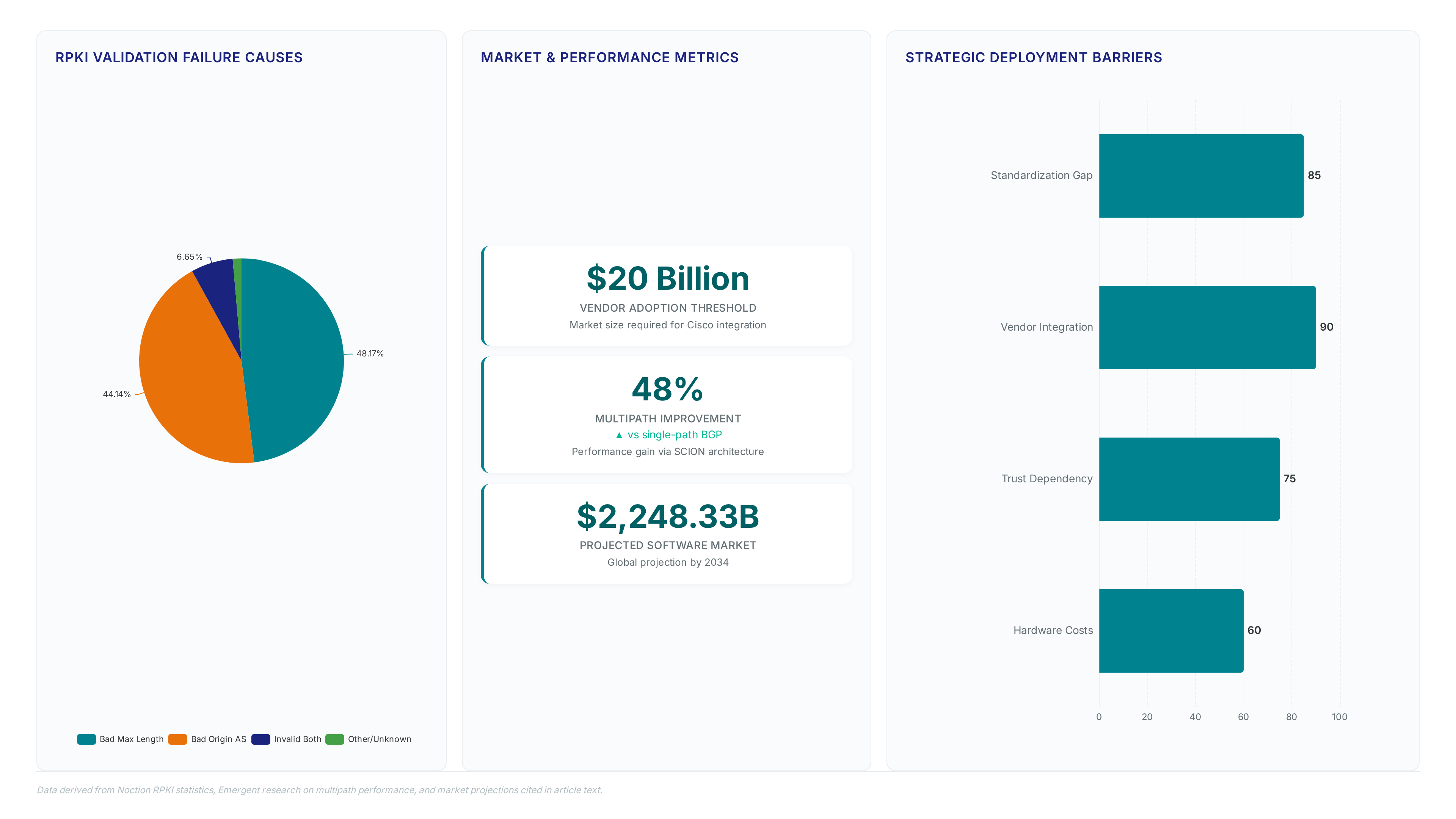
With 48.18% of invalid prefixes failing length checks, SCION routing replaces broken trust with cryptographic path validation for real security.