Route origin validation: Stop blind BGP trust
Over 393,344 IPv4 ROA objects now exist to cryptographically verify route origins, yet BGP still defaults to blind trust. Route Origin Validation transforms the Border Gateway Protocol from a trust-based system into a verified security framework. Without this shift, the internet remains vulnerable to prefix hijacking and route leaks that exploit the protocol's inherent lack of validation.
Resource Public Key Infrastructure relies on Regional Internet Registries acting as root authorities to bind IP resources to specific owners. Route Origin Authorizations function as digitally signed proofs that an Autonomous System holds the right to announce specific prefixes. Alongside the massive IPv4 deployment, there are 86,306 IPv6 ROA objects published in the global system, expanding the scope of protected address space.
Actionable deployment strategies for Cisco and Juniper environments enforce these checks at the router level. Third-party software can reject unauthorized announcements before they propagate. This transition from implicit trust to explicit cryptographic proof stabilizes the global routing table against persistent threats.
The Critical Role of Route Origin Validation in Securing BGP
How RPKI and ROAs Fix BGP Trust Gaps
Border Gateway Protocol (BGP) depends entirely on operator trust to exchange reachability data, a design choice that leaves autonomous systems exposed to prefix hijacks and address spoofing. The Resource Public Key Infrastructure (RPKI) substitutes this fragile trust model with a rigid hierarchical certification framework. This architecture employs Route Origin Authorizations (ROAs), which function as digitally-signed objects binding an address block to a specific originating AS. Traditional Internet Routing Registries permit unauthenticated entries, whereas ROAs deliver a cryptographically secure method for validating route origins.
Executing Route Origin Checking to Prevent Hijacks
Route Origin Confirmation executes cryptographic checks against ROA records to confirm an AS is authorized to announce a specific IP prefix. ROV is executed using ROA, which establishes the list of prefixes that an AS is authorized to announce. This process replaces blind trust with verified data, ensuring only legitimate owners originate routes. A third-party software component, known as a validator, establishes an RPKI-to-Router session to fetch data from trust anchors and perform these necessary verifications. Completing an application for ROV enables the following: Verify whether an AS is authorized to announce a specific IP prefix.
Inside the Mechanics of RPKI Data Validation and Cache Synchronization
Routinator's Role as an RPKI Relying Party
Routinator operates as the necessary link connecting global Trust Anchors to local router enforcement policies. NLnetLabs engineered this open-source Relying Party tool using Rust to systematically query the five RIRs: APNIC, AFRINIC, ARIN, LACNIC, and RIPE NCC. The software retrieves cryptographic certificates and ROAs, verifies signatures against the established chain of trust, and compiles a validated cache for the BGP workflow. This local dataset feeds directly into routers via the RPKI to Router Protocol, described in RFC 8210, enabling the generation of route filters based on verified data. Synchronization between the validator cache and the router session drives the entire validation process. If the RTR session breaks or the validator fails to fetch updates from RIR repositories, the router continues operating on the last known valid data. Maintaining consistent connectivity to trust anchors ensures routing decisions reflect current global registry status.
- Install the software using the system package manager or cargo.
- Initialize the application to accept RIR repository terms.
- Configure the server mode to listen on the standard RTR port.
- Establish a persistent TCP session between the router and the validator.
| Component | Function | Protocol |
|---|---|---|
| Routinator | Fetches and validates data | HTTPS/Rsync |
| Router | Enforces routing policy | RPKI-RTR |
| RIRs | Issue certificates and ROAs | Trust Anchor |
Serving Validated VRP Lists via RPKI-RTR Protocol
Flexible, cryptographically verified data streams replace static prefix lists through the RPKI to Router Protocol described in RFC 8210. These streams update automatically as the global registry evolves. Operators configure border routers to establish a TCP session with the validator, pulling the latest VRP lists without manual intervention. The router assigns one of three distinct states to every incoming BGP route once the session activates based on cached data. Routes matching a valid ROA receive a Valid state. Contradictions to an authorization mark routes as Invalid. Any prefix lacking a specific record defaults to a NotFound state. This triage allows operators to accept legitimate traffic while strictly dropping known hijacks.
| State | Definition | Typical Policy Action |
|---|---|---|
| Valid | Matches a signed ROA | Accept and prefer |
| Invalid | Contradicts a signed ROA | Drop immediately |
| NotFound | No ROA exists | Accept with lower preference |
Security strictness often conflicts with connectivity durability during initial deployment. ROV effectively prevents routing hijacks and reduces common errors, yet its efficacy depends entirely on the availability of ROA records. Valid data exists, but many networks have not yet implemented enforcement policies. Operators must carefully manage policy transitions to maintain connectivity while using available cryptographic signals.
Hardware Requirements for Cryptographic Validation Performance
Deploying a validator requires allocating 1GB of memory to handle the global dataset size effectively. Currently, the global RPKI data set is about 500MB, and this capacity ensures the software maintains a complete cache of certificates and Route Origin Authorizations. Operators should reserve 1GB of disk space to provide ample margin for the RPKI repositories to grow over time as adoption increases.
| Component | Minimum Requirement | Operational Purpose |
|---|---|---|
| Memory | 1GB | Holds active validation cache |
| Storage | 1GB | Accommodates repository growth |
| CPU | Quad-core | Executes cryptographic checks |
Cryptographic validation of this data takes Routinator about 2 seconds on a quad-core i7. Network operators refresh routing policies frequently with this speed, minimizing the window of vulnerability to hijacking events. Local efficiency contrasts with the global state of deployment. An individual operator can secure their edge quickly, yet effective deployment of Route Origin Authentication across the wider internet remains low. Properly configured systems change raw data into actionable route filters, securing the network perimeter against unauthorized announcements.
Deploying Route Origin Verification Across Cisco and Juniper Environments
Routinator Installation and RTR Server Initialization
Installing the Rust compiler via `curl https://sh.rustup.rs -sSf| sh` provides the mandatory toolchain for building the Routinator binary. This method avoids dependency conflicts common in package-manager-only installations. Administrators proceed by installing Cargo with `sudo apt install cargo` and loading environment variables using `source ~/.cargo/env`. The software installation follows with `cargo install routinator`, after which `routinator init --accept-arin-rpa` downloads trust anchors from all five regional registries. Daemon operation demands specific port configurations to function within the network perimeter. Running `routinator server --rtr [SERVER IP]:3323 --http [SERVER IP]:9556 –d` initiates the session, requiring open firewall rules for ports 3323, 9556, and 873. Strict security policies often conflict with the connectivity needed for rsync updates. Blocking port 873 silently prevents cache synchronization while the service status appears healthy. InterLIR network teams suggest validating the initial data pull by executing `routinator -v vrps` to confirm the validated ROA payload renders correctly before connecting production routers. This verification step prevents scenarios where routers establish sessions to an empty or stale cache, inadvertently accepting invalid routes due to missing validation data.
Configuring Cisco IOS XR and Juniper for RPKI-RTR Sessions
Firewall rules must permit TCP port 3323, HTTP port 9556, and Rsync port 873 before routers consume validated prefix lists. These specific ports enable the validator to synchronize with trust anchors and push updates to the forwarding plane without interruption. Operators often neglect that blocking port 873 prevents the initial cache download, leaving the router in a state where no routes receive a validity state.
- Define the RPKI server group with the validator IP address and set the refresh interval to 120 seconds.
- Enable origin validation signaling within the IPv4 and IPv6 unicast address families to propagate status to iBGP peers.
- Apply an import policy that rejects routes marked Invalid while preferring those marked Valid.
Vendor implementations differ slightly in syntax but achieve identical cryptographic verification of the AS path origin. Cisco IOS XR requires explicit transport definitions under the BGP process, whereas Juniper nests the session parameters within the routing-options hierarchy. Detailed configuration templates for Cisco IOS XR and Juniper platforms illustrate these structural variances clearly.
| Feature | Cisco IOS XR | Juniper Junos |
|---|---|---|
| Session Definition | `rpki server` block | `validation` group |
| Transport Port | `transport tcp` | `Port` directive |
| Validation Scope | Per address-family | Global routing-options |
Strict rejection policies create operational tension with network availability during validator outages. Routers lose the ability to distinguish valid from invalid origins if the RTR session drops, potentially accepting hijacked prefixes if the default action is not configured to preserve existing state. This approach ensures continuous protection even when the validator server undergoes maintenance or experiences transient network partitions.
Validation Checklist: VRP Testing and Port Verification
Execute `routinator -v vrps` to print the validated ROA payload list and confirm local cache synchronization before connecting to production routers. This command verifies that the validator successfully retrieved objects from trust anchors, a critical step given that research indicates a large number of networks still do not fully deploy ROV. Operators must then verify firewall rules allow traffic on port 3323 for RTR sessions, port 9556 for HTTP metrics, and port 873 for Rsync repository updates. Blocking port 873 prevents the initial download of the global dataset, leaving the router unable to assign validity states to incoming prefixes.
- Run the VRP subcommand to inspect the current count of loaded authorizations.
- Confirm TCP connectivity on the RTR session port from the border router.
- Validate that the HTTP metrics endpoint returns data for monitoring systems.
- Check that Rsync can reach external trust anchor repositories without filtering.
Configuration explosion becomes the primary risk if port rules are not standardized across the fleet. Proper testing ensures the network uses the existing 393,344 IPv4 Route Origin Authorization objects effectively. Address and set the refresh interval to 120 seconds. Enable origin validation signaling.
Strategic Imperatives for Adopting ROV in Modern Network Infrastructure
Application: Defining the ROV Coverage Gap Between ROA Publication and Enforcement
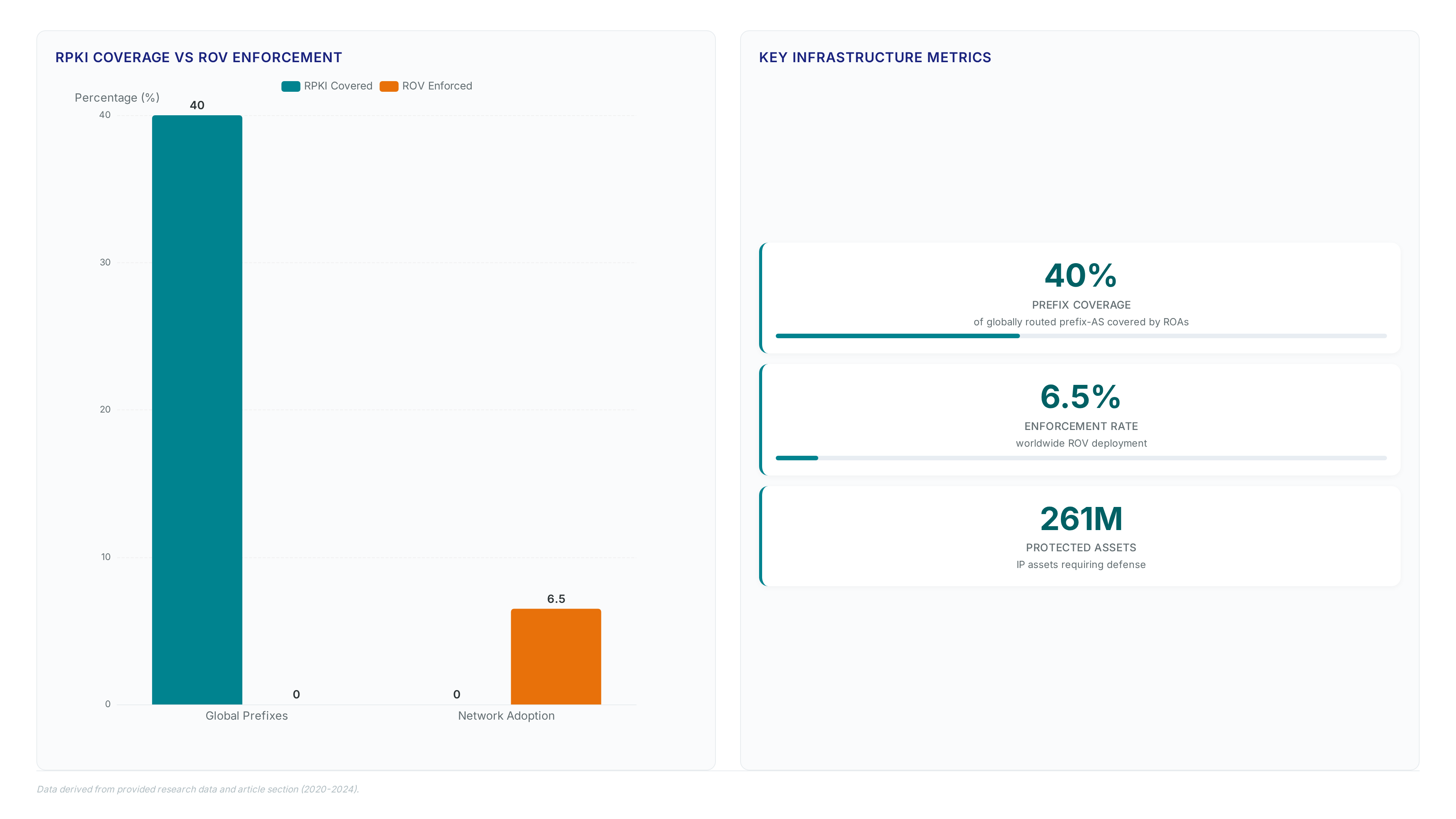
Publication of Route Origin Authorizations generates a cryptographic record, yet routers frequently ignore these signatures absent active enforcement policies. This disparity exposes an operational gap where valid proofs exist but fail to influence forwarding decisions. The mechanism depends on a local validator fetching data from Trust Anchors and pushing state to routers via the RPKI-to-Router protocol. BGP speakers default to accepting hijacked paths despite available warnings unless configured explicitly to reject Invalid states. Passive observation slows the perceived urgency of creating necessary objects because validation yields no immediate benefit without enforcement.
Transitioning from publishing records to enforcing them closes this security gap. InterLIR advises clients that optimizing current IPv4 assets requires active defense of those prefixes against origin spoofing. Upstream filtering provides protection, yet relying exclusively on it may leave networks exposed to local configuration errors or specific peer misbehavior upstream providers miss. Measurable service outages caused by preventable routing incidents define the cost of inaction. Deployment demands policy enforcement at the edge, not registration.
Application: Operationalizing Route Origin Checking to Prevent Prefix Hijacking
Deploying a local validator connects routers to Trust Anchors, enabling the RPKI-to-Router protocol to filter unauthorized announcements. Network equipment cryptographically verifies if an Autonomous System holds the right to announce specific prefixes before accepting traffic. Operators fetch global data and generate route filters that explicitly drop Invalid paths while accepting Valid or NotFound states. Tools like Routinator exist, yet a significant disparity remains between data publication and active enforcement across the global internet. This gap leaves the majority of traffic vulnerable to hijacking even when cryptographic signatures exist. Operational decisions to enforce rejection policies on production borders present the primary limitation, not technical complexity.
The Strategic Risk of Relying on Voluntary ROA Publication Without Active Dropping
High cryptographic coverage does not equal safety when most routers still accept Invalid routes by default. ROAs cover a substantial portion of the internet, yet recent analysis shows only a small fraction of Autonomous Systems actively enforce validation policies to drop malicious announcements. Networks remain exposed to prefix leaking and address spoofing even when legitimate owners have signed their resources. Route origin confirmation requires operators to explicitly configure infrastructure to reject bad paths rather than merely logging them. Cryptographic signatures published in the global system do not prevent acceptance of hijacked routes without active dropping on the forwarding plane. A large number of networks fail to fully deploy ROV, creating a false sense of security across the system. Relying on voluntary publication while ignoring the necessity of active enforcement on the forwarding plane defines the strategic risk. Transitioning from passive data consumption to active filtering mitigates long-lasting negative impacts from routing incidents. InterLIR recommends immediate audit of BGP policies to ensure Invalid states trigger route rejection.
About
Alexei Krylov, Head of Sales at InterLIR, brings a unique perspective to the critical discussion on Route Origin Authentication (ROV). While his daily work focuses on B2B transactions within the IPv4 marketplace, his deep engagement with Regional Internet Registries (RIRs) and IP resource ownership provides necessary context for understanding routing security. At InterLIR, a Berlin-based leader in IPv4 redistribution, ensuring clean BGP and verified route objects theoretical; it is a core operational value that directly impacts asset reputation. Krylov's expertise bridges the gap between commercial IP transfers and the technical necessity of Resource Public Key Infrastructure (RPKI). By managing high-stakes network resources, he understands that relying on trust without validation exposes the global internet to prefix hijacking and leaks. This article uses his practical experience in maintaining secure, transparent IP ecosystems to explain why ROV is vital for stabilizing the very infrastructure InterLIR helps sustain.
Conclusion
Scaling Route Origin Verification reveals that passive monitoring creates a fragile security posture where Invalid paths remain accepted despite available cryptographic proof. The operational cost of inaction is the continued risk of traffic interception, as the global dataset grows rapidly without universal enforcement. While coverage increases, the network remains vulnerable until routers actively reject unauthorized announcements rather than simply logging them. Operators must transition from observation to enforcement to realize the technology's full protective value.
Deploy active dropping policies on border routers within the next quarter, but only after completing a monitor-only phase to baseline legitimate traffic patterns. This timeline prevents accidental outages while ensuring a swift move to security. Do not wait for total global adoption; the value exists in protecting your specific perimeter immediately.
Start by installing a validator instance requiring just 1GB of memory this week to process the current 500MB global dataset. This low-resource setup allows your team to fetch Trust Anchor data and establish the necessary TCP sessions for real-time verification. By localizing the validation logic, you gain the ability to filter updates before they impact your core infrastructure. For a deeper understanding of how this mechanism verifies whether an Autonomous System (AS) is authorized to originate a prefix, review the latest deployment extensions now entering practice.
Frequently Asked Questions
Deploying a validator requires allocating 1GB of memory to handle the global dataset. This capacity ensures the software processes the full 500MB data set efficiently without crashing.
Network operators manage validated data sets that can reach 500MB, requiring dedicated resources. This size necessitates careful planning to ensure your caching servers have sufficient storage capacity.
Existing ROAs currently cover approximately 40% of globally routed prefix-AS origin pairs. This means most traffic still relies on trust, so you must filter unvalidated routes carefully.
Running these configurations on existing IPv4 blocks requires minimal system resources such as 1GB of memory. Most modern quad-core servers can easily accommodate this specific memory requirement.
This manageable size enables validators to refresh routing policies frequently to catch hijacks.
References