Asia Pacific 2026 NRO NC Seat: Who Qualifies?
Nominations for the Asia Pacific seat on the NRO NC opened 10 June 2026. The bar is high: strict conference attendance records are non-negotiable. This election, seeking a successor to Nicole Chan, is a defensive maneuver. It protects the multi-stakeholder model from encroaching treaty-based government control. The stakes extend beyond procedure. As Gartner predicts that 40% of enterprises will adopt hybrid computing architectures by 2028 to manage AI workloads, the council's oversight of Autonomous System Numbers and Resource Certification becomes the bedrock of global routing security.
We must dissect why the NRO NC remains essential, maintaining a bottom-up approach distinct from the International Telecommunication Union even as network requirements shift. The role demands operational grit: monthly 12:00 UTC meetings and three annual conferences.
Eligibility hinges on specific hurdles. Candidates need mandatory registration for APNIC 62 and attendance at one of the last eight regional conferences. (APNIC's nominations now open for nro nc election 2026) Below is the step-by-step guide to submitting a valid nomination before the 9 August 2026 deadline. Only qualified individuals from the Asia Pacific region should attempt this vital two-year term. Preserving the integrity of the Address Supporting Organization amidst rapid technological change requires nothing less.
The Strategic Role of the NRO NC in Global Internet Governance
NRO NC Dual Function as ICANN Address Supporting Organization
The NRO NC functions as the ASO AC, executing the ICANN Address Supporting Organization mandate. It operates on a bottom-up, multi-stakeholder model, standing in sharp contrast to treaty-based bodies like the ITU. This dual identity forces the council to validate global IP policies while simultaneously managing Autonomous System Numbers and coordinating Resource Certification activities. Leadership continuity is paramount; figures like Hervé Clément were recently re-elected to chair both councils simultaneously.
Operational constraints here are severe. The role demands monthly virtual meetings, three annual conferences, and active participation in policy mailing lists. Commercial governance models might burn through $492 million on AI governance platforms, but this position relies entirely on voluntary community engagement. Consequently, the time commitment effectively excludes most full-time network engineers without explicit organizational backing.
The election cycle creates a narrow window for Asia Pacific representation. With Nicole Chan's term ending 31 December 2026, the incoming member serves from 1 January 2027 through 31 December 2028. This two-year tenure aligns with broader infrastructure planning cycles, yet it conflicts with the rapid pace of technical protocol evolution.
Structural reliance on unpaid volunteers introduces a single point of failure if regional participation drops.
Enterprise Tactical Leasing Strategies Amid IPv4 Price Durability
IPv4 leasing prices in 2026 remain resilient between $0.38 and $0.50 per IP address per month. This durability drives a shift to tactical leasing. Operators now favor leasing smaller subnets over bulk purchases to mitigate depreciation risks on balance sheets. This approach replaces the historical standard of acquiring large blocks for speculative future growth.
The NRO NC executes the ASO AC role within ICANN, governing the global policy framework that defines these market conditions. Nominees must balance strict time commitments with active policy development to sustain the bottom-up model. Failure to maintain this governance structure risks ceding control to treaty-based alternatives.
| Feature | Tactical Leasing | Bulk Purchasing |
|---|---|---|
| Commitment | Short-term project needs | Long-term asset holding |
| Risk Profile | Operational expense volatility | Capital depreciation |
| Scale | /24 to /22 subnets | Large aggregate blocks |
Enterprises adopting flexible address space avoid carrying stranded assets during protocol transitions. The trade-off is reduced leverage in long-term price negotiations compared to legacy holders. This discipline insulates organizations from broader market fluctuations while maintaining operational agility.
NRO Multi-Stakeholder Model Versus ITU Treaty-Based Governance
The NRO executes a bottom-up, multi-stakeholder policy model, contrasting sharply with the government-centric decision making of the ITU. This structural divergence dictates infrastructure stability. Treaty-based mandates can impose abrupt regulatory shifts, whereas the NRO requires consensus among technical operators and civil society.
| Feature | NRO Model | ITU Model |
|---|---|---|
| Decision Power | Technical Community | Governments |
| Policy Basis | Operational Consensus | International Treaty |
| Adoption Speed | Gradual, Iterative | Binary, Political |
Rising cyber sovereignty demands threaten this balance, as nation-states increasingly challenge current IP management mechanisms through UN channels. The limitation of the multi-stakeholder approach is speed; achieving consensus across diverse stakeholders delays response times compared to top-down decrees. However, this friction prevents single-points-of-failure in governance logic.
Physical constraints compound these political tensions. In Ireland, data centers consume 21% of total electricity, forcing a pause on new connections until 2028. Energy scarcity acts as a hard ceiling on network expansion, regardless of the governing body's efficiency. Operators must navigate both the slow pace of community consensus and the rapid onset of physical resource limits.
Defining NRO NC Meeting Schedules and Policy SIG Obligations
Monthly teleconferences 12:00 UTC establish the baseline rhythm for Hervé Clément and fellow councilors managing global number resource policy. These scheduled calls demand consistent attendance, yet special meetings can interrupt operational workflows at any time for urgent matters. The commitment extends beyond voice calls to mandatory participation in the APNIC Policy SIG mailing list, where draft policies undergo initial technical scrutiny before adoption.
Operators must attend three substantial conferences annually, including the first ICANN gathering and two regional APNIC events, to maintain voting eligibility. This schedule creates a conflict with local network maintenance windows, forcing nominees to delegate routine engineering tasks to senior staff. The requirement to join the Policy SIG mailing list ensures members remain grounded in community sentiment rather than relying solely on executive summaries.
| Obligation Type | Frequency | Operational Impact |
|---|---|---|
| NRO NC Teleconference | Monthly | Fixed slot at 12:00 UTC |
| Special Meeting | Ad-hoc | Unpredictable disruption |
| Policy SIG List | Daily | Continuous monitoring required |
| Substantial Conference | 3 per year | Travel and prep time |
The hidden cost lies in the preparatory workload. Reading background documents for Autonomous System Numbers and addressing schemes often consumes more hours than the meetings themselves. Proven enterprise network architects understand that poor time allocation here leads to delayed policy ratification.
Nominees must commit to attending three specific annual conferences, comprising the first ICANN meeting and two APNIC events, to maintain eligibility. This rigid schedule intersects with regional capacity building initiatives like the Regional APIGA 2026, demanding precise calendar alignment. Operators considering self-nomination should evaluate travel logistics against the fixed timing of these global gatherings.
The obligation extends beyond mere presence at the main sessions. Members are expected to meet with the APNIC Executive Council and Policy SIG Chairs immediately following the Policy SIG meeting, a requirement that adds hours to an already dense conference agenda. This post-meeting coordination ensures policy continuity but eliminates the flexibility often found in standard industry events.
| Requirement | Frequency | Timing Constraint |
|---|---|---|
| ICANN Meeting | Annual | First meeting of the year |
| APNIC Conferences | Bi-annual | Two specific events |
| Executive Sync | Per Conference | Immediately post-SIG |
Global governance dialogues, such as the Internet Governance Forum consultations, often run concurrently with these mandatory windows, forcing difficult prioritization choices. The NRO NC role requires physical or virtual presence at these specific junctures, leaving little room for scheduling conflicts. A candidate unable to guarantee attendance at the first ICANN meeting of the year fails the fundamental operational criteria. The time commitment acts as a filter, ensuring only those with substantial organizational backing or flexible mandates can sustain the policy development pace required.
Unscheduled special meetings called at any time create immediate operational conflicts for network engineers managing production incidents. These ad-hoc calls demand instant availability, disrupting standard maintenance windows and incident response workflows. Beyond synchronous calls, members must digest dense briefing documents to participate meaningfully in global policy debates. This asynchronous workload often exceeds the time required for the meetings themselves, creating a hidden burden on nominee resources. Candidates should self-nominate only if their organizations support flexible scheduling for these unpredictable governance demands. The volume of background reading rivals the technical depth required for enterprise network design, demanding similar analytical rigor. Ignoring these preparatory requirements leads to ineffective representation during critical ICANN proceedings.
| Requirement Type | Frequency | Impact Level |
|---|---|---|
| Special Meetings | Unpredictable | High (Disruptive) |
| Document Review | Continuous | Medium (Time-intensive) |
| Policy SIG | Monthly | Medium (Requires focus) |
Step-by-Step Guide to Submitting a Valid Nomination
Defining APNIC 62 Registration and Eight-Conference Attendance Rules
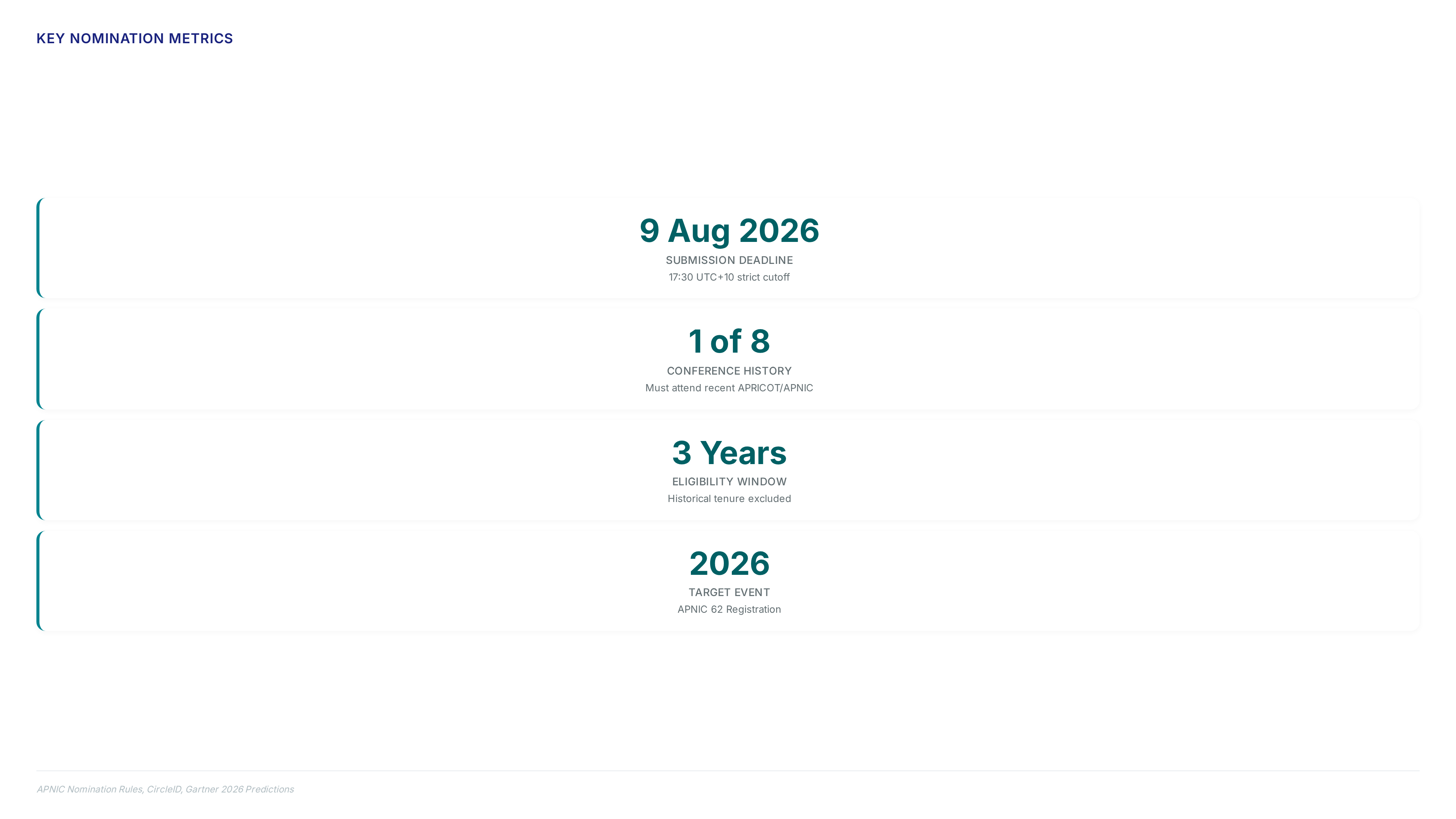
Current registration for APNIC 62 serves as the primary gatekeeper for any potential nominee seeking a seat on the council.
- Verify APNIC 62 registration status immediately to satisfy the primary temporal constraint.
- Confirm physical or remote presence at a qualifying historical event from the approved window.
- Cross-reference attendance records against the specific list ranging from APNIC 54 in Singapore to APNIC 61 in Jakarta.
| Eligible Event | Location | Status |
|---|---|---|
| APNIC 61 / APRICOT 2026 | Jakarta | Counted |
| APNIC 60 | Da Nang | Counted |
| APNIC 59 / APRICOT 2025 | Petaling Jaya | Counted |
| APNIC 58 | Wellington | Counted |
| APNIC 57 / APRICOT 2024 | Bangkok | Counted |
| APNIC 56 | Kyoto | Counted |
| APNIC 55 / APRICOT 2023 | Manila | Counted |
| APNIC 54 | Singapore | Counted |
The rules demand more than just signing up for the upcoming event in 2026. A candidate must also prove they attended at least one of the immediate past eight APRICOT or APNIC conferences. This specific window excludes gatherings older than the set three-year period, filtering out individuals who rely on historical tenure rather than recent engagement. Operators who fail to match the current registration with at least one data point from the historical list face immediate disqualification. The mechanism ensures that council members possess contemporary operational context instead of legacy influence. Recent participation proves an individual understands the current Regional Internet Registry system dynamics.
Submitting the Online Nomination Form Before 17:30 UTC+10 Deadline
Submit the online nomination form by 17:30 (UTC +10) on 9 August 2026 to avoid automatic disqualification.
- Verify APNIC 62 registration status before accessing the submission portal.
- Complete all fields in the digital interface, ensuring conference attendance records match official logs.
- Transmit data prior to the strict cutoff, as late arrivals trigger immediate rejection regardless of technical merit.
Deadlines in governance lack the elasticity often found in network reconfiguration windows. A single miscalculation regarding time zones invalidates the entire candidacy, creating a binary failure mode rather than a gradual performance degradation. Technical glitches occurring during peak submission windows require immediate escalation to the APNIC Helpdesk. Reliance on local system clocks introduces unnecessary risk; global synchronization protocols used in AI governance platforms demonstrate that distributed teams must standardize on UTC references to prevent coordination collapse. The 17:30 UTC+10 constraint acts as a hard filter, separating prepared candidates from those who treat policy participation as secondary to operational duties. This rigidity ensures only candidates with precise administrative discipline proceed, mirroring the strict adherence required for global routing table maintenance.
Validating Asia Pacific Residency and Excluding RIR Staff Candidates
Nominees residing in the Asia Pacific region qualify unless employed by a Regional Internet Registry.
- Confirm the candidate holds no employment contract with any of the five RIRs coordinated by the Number Resource Organization.
- Verify physical residency within the geographic zone served by APNIC rather than relying on corporate mailing addresses.
- Acknowledge that self-nominations constitute a valid pathway for eligible individuals meeting these strict residency constraints.
| Criterion | Validation Method | Disqualifier |
|---|---|---|
| Residency | Proof of address in Asia Pacific | Outside region |
| Employment | Employment contract review | RIR staff member |
| Pathway | Declaration of intent | None for self |
Governance roles demand independence from the administrative bodies they oversee. The NRO structure explicitly bars staff to prevent conflicts of interest during policy formulation. This exclusion ensures the council remains a community-driven entity rather than an extension of registry administration. Failure to vet employment status early risks nullifying the entire nomination post-submission. Candidates employed by any of the five entities coordinated by the organization cannot serve. Self-nominations remain valid provided the applicant holds no staff contract with a Regional Internet Registry. Verification of this status occurs before the system processes the application.
Distinguishing APNIC Policy SIG Meetings from APRICOT Technical Sessions
APNIC Policy SIG meetings mandate active debate on global governance models, whereas APRICOT sessions deliver concentrated technical training without policy authority.
Operators confuse these venues at their peril. Only the bottom-up, multi-stakeholder policy development utilized by APNIC enables direct input into IP address management rules. APRICOT focuses strictly on skills transfer, lacking the procedural mechanisms to alter Open Policy Meetings outcomes. This functional divide means attendance at technical workshops does not satisfy the engagement criteria required for NRO NC nomination eligibility. The strategic implication is clear: aspiring council members must prioritize Policy SIG mailing lists over pure engineering tracks to influence the Number Resource Organization direction. While technical mastery remains necessary, the fragmented AI governance environment emerging in 2026 demands policy-lit representatives who understand regulatory nuance. Energy constraints further complicate this, as localized infrastructure deployment limits often clash with global allocation policies discussed exclusively in SIG forums.
Nominees must register for APNIC 62 immediately to satisfy the primary temporal constraint for the 2027 term. This action validates the candidate's intent before the system processes historical attendance logs against the eight-conference window.
- Access the official portal and select the APNIC 62 registration tier matching the desired participation mode.
- Cross-reference personal records with the eligible event list ranging from APNIC 54 in Singapore to APNIC 61 in Jakarta.
- Confirm that at least one past attendance record exists in the database to avoid immediate disqualification.
Technical validation of attendance relies on database synchronization which may lag behind real-time check-ins. The cost of this administrative friction is measurable; just as global spending on AI governance platforms creates new compliance overhead, policy nomination demands rigorous data verification. Failure to align registration data with historical logs triggers an automatic rejection that no amount of technical expertise can override post-deadline. The system accepts no manual overrides for missing digital footprints. Industry reports note $85 million in funding for audit trail vendors like Modus, yet the NRO election relies on immutable conference logs rather than commercial verification tools.
Candidates must verify Asia Pacific residency and non-RIR employment status before the 17:30 UTC+10 deadline on 9 August 2026. This final check prevents immediate disqualification for individuals employed by any of the five entities coordinated by the Number Resource Organization.
- Confirm physical residence within the region rather than relying on corporate mailing addresses.
- Validate attendance at one of the past eight conferences, such as the Regional APIGA 2026
- Ensure APNIC 62 registration is active in the system prior to form submission.
| Check Type | Validation Source | Failure Mode |
|---|---|---|
| Residency | Utility bill or government ID | Automated rejection |
| Employment | RIR staff directory | Eligibility revocation |
| History | Conference attendance logs | Database mismatch |
Conference registration does not always equate to recorded attendance in the database. Synchronization delays can obscure valid history. A candidate attending the Regional APIGA 2026 InterLIR recommends cross-referencing personal certificates against the APNIC Helpdesk records to resolve discrepancies. Missing this step forces a qualitative review that rarely succeeds against automated filters. Precision in these final hours determines success or failure for the 2027 term.
About
Evgeny Sevastyanov serves as the Support Team Leader at InterLIR, a specialized IPv4 marketplace dedicated to optimizing global network resource distribution. His daily responsibilities involve managing complex RIPE and APNIC database entries and guiding clients through the technical nuances of IP leasing, providing him with direct, practical insight into the critical importance of fair number resource governance. This hands-on experience makes him uniquely qualified to discuss the NRO NC election, as he witnesses firsthand how regional policy decisions impact network operators in the Asia Pacific region and beyond. At InterLIR, where transparency and efficient access to clean IP blocks are paramount, Sevastyanov understands that the NRO NC's role within ICANN directly affects the stability and availability of the very resources his team distributes. His perspective bridges the gap between high-level policy formulation and the operational realities faced by organizations relying on these necessary internet infrastructure components.
Conclusion
The current $492 million resource organization framework fractures when manual verification cannot match the velocity of automated eligibility filters. As data centers in regions like Ireland consume 21% of national electricity, the operational cost of maintaining human-centric audit trails for IP governance will soon outpace the durability of current pricing models between $0.38 and $0.50 per address. Relying on disparate conference logs rather than integrated identity layers creates a single point of failure that scaling bureaucracy cannot sustain without significant latency.
Organizations must transition to real-time API-driven credential verification by Q2 2026 to prevent systemic bottlenecks during election cycles. Waiting for the August 9 deadline to validate attendance history or residency documents invites catastrophic processing errors that qualitative reviews cannot fix. The window to align internal records with external database states is closing rapidly.
Start by auditing your team's conference attendance certificates against the official APNIC Helpdesk records today, specifically checking for synchronization gaps from events like Area-based APIGA 2026. Do not assume registration equals recorded presence. Submit the correction request for any missing entries before the system locks, ensuring your digital footprint matches the immutable logs required for the 2027 term. This immediate reconciliation prevents automatic disqualification and secures your standing before the algorithmic filters engage.
Frequently Asked Questions
Unlike commercial models spending $492 million on AI governance, this role relies on voluntary engagement. This lack of funding creates a significant barrier for full-time network engineers without explicit organizational backing to cover their time.
Leasing prices between $0.38 and $0.50 per IP drive firms toward tactical subnet leasing. This approach helps operators avoid capital depreciation risks associated with buying large blocks while maintaining necessary operational agility.
Candidates must have attended at least one of the immediate past eight regional conferences. This strict requirement ensures nominees possess genuine community engagement rather than just theoretical knowledge of current policy issues.
The role demands monthly meetings at 12:00 UTC plus three annual conferences. This heavy schedule effectively excludes most full-time network engineers who cannot secure explicit organizational backing to cover these extensive duties.
Gartner predicts 40% of enterprises will adopt hybrid computing architectures by 2028. This shift makes the council's oversight of Autonomous System Numbers critical for maintaining global routing security amid rapid technical changes.