IPv4 2026: Why Small Blocks Cost
The 2022 IPv4 market saw block transactions drop 28% while total addresses transferred surged 35%, per IPv4.Global data. Volume consolidation now outweighs transaction frequency as the primary market driver.
Small blocks no longer offer the traditional volume discount. Price inversion has flipped the value proposition, forcing buyers to pay premiums for fragmentation. The average number of IPs per transfer jumped 89% to over 10K units, a shift documented by IPv4.Global. This mechanical change explains why 92% of global moves remained intra-RIR; operators simply cannot afford the policy friction of cross-regional deals when liquidity is this tight.
External factors like inflation and supply chain issues create cross-currents that make short-term forecasting unreliable. IPv4.Global notes that navigating these regional variances is now a prerequisite for survival. Entities looking to buy or sell must abandon false predictability and focus on the concrete mechanics of block size and transfer security.
The Role of Price Inversion and Regional Variance in the 2022 IPv4 Market
Defining IPv4 Price Inversion and Block Size Anomalies
Small blocks now command higher relative prices than large allocations. This price inversion defies standard economic logic where volume usually drives discounts. Scarcity for compact units overrides traditional valuation models. Historical records show compensated transfer prices have risen 300% during the past five calendar years, amplifying the cost of these anomalies.
Operators distinguish intra-RIR transfers occurring inside one registry from those crossing jurisdictional boundaries. In 2022, 92% of transfers worldwide were intra-RIR transfers, proving regional liquidity outweighs global arbitrage. Block consolidation aggregates fragmented holdings into efficient units, directly shaping valuations and availability metrics. Market dynamics now pivot on block size rather than total volume. InterLIR suggests reviewing block size anomalies prior to deal execution to prevent overpayment on fragmented stock.
Regional Variance: RIPE vs ARIN Transfer Size Trends
Registry policies ensure the average size of RIPE transfers was considerably smaller than those in ARIN. This structural divergence alters per-unit valuation, causing transfer sizes to fluctuate wildly by region. Global observers note that in 2022, the average number of IPs transferred per transfer increased by 89% to over 10K IPs/transfer, yet this trend appears uneven across jurisdictions. Buyers seeking immediate, small-scale deployment face steep premiums in regions favoring fragmentation. Data from the InterLIR marketplace confirms that grasping these regional nuances drives accurate asset valuation and strategic acquisition.
Most activity stays within specific regional boundaries despite growing global volume. Organizations optimizing existing IPv4 resources through InterLIR solutions gain advantage by navigating these constraints effectively. Ignoring variances risks overpaying for assets misaligned with long-term routing efficiency goals.
Transaction Volume vs Block Size: 2022 Market Shifts
Block consolidation drove a 35% rise in transferred addresses despite fewer deals. Fewer transactions moved notably larger volumes, fundamentally altering liquidity dynamics. Average block size has surged while transaction frequency drops. Historical volume metrics mislead buyers expecting uniform price stability.
Access to optimized blocks meeting modern routing efficiency standards remains available. Current infrastructure remains predominantly based on IPv4, making strategic acquisition of these consolidated assets vital for long-term network stability. Market participants must adapt to this new reality where deal count declines even as total address volume climbs. The divergence between transaction count and total volume defines the current market state.
Inside the Mechanics of Global IP Block Transactions and Volume Shifts
Defining the 2022 Volume Paradox: Fewer Deals, Larger Blocks
Total transaction counts dropped sharply while average block sizes surged. This statistical anomaly defines a shift toward block consolidation, where operators aggregate fragmented holdings rather than acquiring piecemeal resources. Such volume shifts indicate that organizations are prioritizing efficiency and scale over simple acquisition counts. Market analysis suggests this trend reflects smarter utilization strategies as entities optimize existing infrastructure. The dominance of large-block deals means liquidity for /24 or /22 segments remains constrained compared to historical norms.
Relying on historical growth trends is no longer viable. Strategic planning around these volume shifts is necessary for maintaining network expansion goals.
Applying April 2026 Liquidity Data to Current Valuation Models
April 2026 market analysis recorded exactly 110 distinct transactions, establishing a concrete baseline for assessing current market liquidity. Operators calculate fair value by anchoring negotiations to the weighted average price of $19.56 per IP address observed during this period. This specific data point allows buyers to distinguish between temporary volatility and genuine shifts in asset valuation.
- Identify the total transaction volume to gauge market activity levels.
| Metric Type | April 2026 Value | Strategic Implication |
|---|---|---|
| Transaction Count | 110 deals | Indicates moderate trading frequency |
Ignoring this nuance leads to overpayment for fragmented resources or failed acquisitions due to unrealistic seller expectations. Using these precise liquidity metrics helps align client acquisitions with actual market throughput rather than historical anomalies. This approach ensures that capital deployment matches the verified pace of address redistribution. Network planners must treat such snapshots as flexible indicators rather than static price tags. Accurate modeling prevents capital stagnation in an environment where supply constraints persist.
Routing Table Stagnation Risks Amidst Rising IP Per Transfer Metrics
Worldwide new entries in routing tables for both IPv4 and IPv6 versions decline, even while asset ownership changes hands rapidly. This divergence creates a deceptive signal where routing table growth appears flat while asset ownership changes hands rapidly. Operators relying solely on BGP update counts to gauge market activity may miss significant liquidity shifts occurring within existing prefixes.
| Metric Trend | 2022 Observation | Operational Risk |
|---|---|---|
| Transfer Volume | Increased significantly | Masks fragmentation |
| Routing Entries | Declined globally | Hides topology changes |
| Block Size | Grew substantially | Increases blast radius |
Consolidation introduces a critical trade-off: the market has shifted from a pure price-based negotiation model to one where costs are balanced against flexibility and timing. Networks optimizing for address efficiency must simultaneously upgrade filtering policies to handle these denser allocations safely. Ignoring this stagnation reduces visibility into actual path diversity and resource distribution.
Analyzing transaction logs alongside routing data helps detect these hidden shifts. Marketplace tools help buyers identify under-utilized blocks that offer genuine expansion without compounding fragmentation risks.
Strategic Decision Frameworks for Buying and Selling IP Assets Amid Volatility
Defining Cross-Currents in IPv4 Pricing Influences
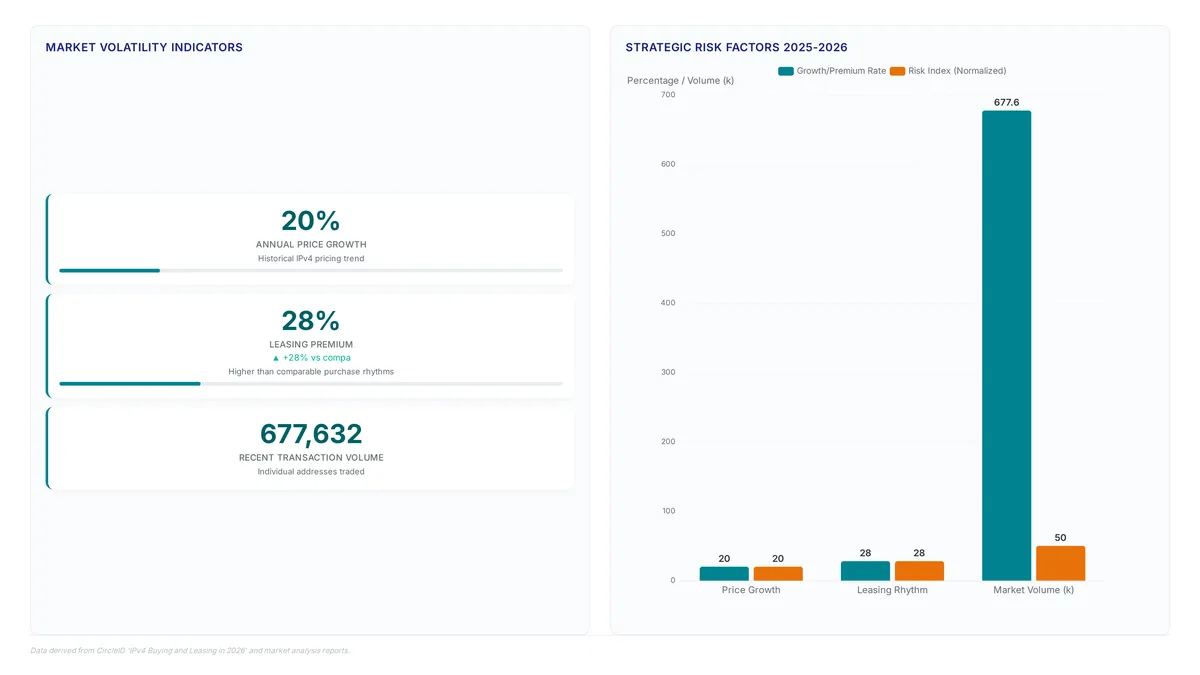
Conflicting macroeconomic forces render near-term IPv4 price prediction unreliable for current market participants. External pressures including war, supply chain disruptions, and rising inflation create cross-currents that temporarily slow infrastructure expansion despite a vibrant underlying marketplace. Even seasoned experts remain wary of guessing future values when such volatility defines the environment. This divergence suggests that operators are consolidating holdings rather than fragmenting them during uncertainty. The primary tension exists between immediate deployment needs and long-term asset strategy. Buyers must evaluate if current price inversion between small and large blocks impacts acquisition strategy.
War, supply chain issues, rising interest rates, inflation, and recession fears have combined to slow infrastructure expansion temporarily. These macroeconomic headwinds create a hazardous environment for timing IPv4 asset acquisition incorrectly. Operators delaying deployment due to cost concerns face a environment where infrastructure expansion has slowed, while those over-expanding now may lock in inefficient capital expenditure. The market remains vibrant, yet price inversion complicates traditional valuation models based on historical growth. Stakeholders must adopt rigorous IPv4 address shortage mitigation strategies that prioritize liquidity over static ownership. Treat address blocks as managed assets requiring active utilization monitoring rather than idle inventory. Evaluate leasing agreements to maintain operational flexibility during periods of economic uncertainty. Avoid speculative purchasing when external pressures distort standard pricing mechanisms. Monitor regional transfer data to identify localized supply constraints before they impact pricing. The cost of mistimed entry exceeds simple price variance; it includes opportunity costs from delayed service launches. Market participants are advised to focus on immediate network availability needs rather than attempting to predict volatile market bottoms. Strategic patience combined with data-driven execution protects capital while ensuring critical infrastructure projects proceed without interruption.
Executing Secure IPv4 Transfers Through Verified Brokerage Channels
Verified Brokerage Channels and RIR Compliance Requirements
Professional intermediaries assist organizations in evaluating acquisition options that align with specific Regional Internet Registry requirements. Asset holders selling IP blocks through these channels face rigorous documentation demands and strict buyer vetting. This protocol reduces the risk of creating fragmented blocks that later fail routing policy checks. Speed often conflicts with compliance depth in this sector. Direct peer-to-peer deals appear quicker on the surface. Professional mediation navigates the complex documentation regional registries demand for inter-RIR transfers effectively.
Market volatility means prices fluctuate, yet sustained demand for verified stock remains evident. The business is founded on the belief that the transaction that yields mutual satisfaction is worth pursuing, ensuring every transaction secures your infrastructure against future regulatory shifts.
Executing Intra-RIR Address Transfers via Broker Facilitation
Sellers engaging InterLIR adhere to a structured protocol designed to navigate market volatility while maximizing asset value. Precise coordination handles the complex documentation regional registries require during execution.
This structured approach balances rapid liquidity needs against regulatory compliance mandates. Some operators attempt direct sales to avoid fees, yet the process for intra-RIR address transfer frequently stalls without professional mediation to interpret evolving policy nuances. Self-service limitations manifest as delays caused by incomplete paperwork, directly impacting revenue realization. Market data indicates that average transaction sizes have grown notably, with blocks exceeding 10K IPs becoming more common. This shift necessitates rigorous due diligence that individual sellers often lack resources to perform. InterLIR centralizes the workflow so market trends do not erode final settlement value. The outcome is a simplified path to liquidity adhering strictly to global routing.
Validating Mutual Satisfaction and Transaction Security Protocols
Confirming liquidity metrics and mutual satisfaction terms defines the final validation step before executing secure IPv4 block sales.
The following table contrasts standard brokerage checks with InterLIR security enhancements.
| Validation Stage | Standard Broker Check | InterLIR Security Protocol |
|---|---|---|
| Price Benchmarking | Historical sale data | Real-time weighted average analysis |
| Title Search | Basic registry lookup | Deep lien and dispute audit |
| Buyer Vetting | Self-declared need | Rigorous RIR justification review |
| Final Execution | Email confirmation | Escrow-backed mutual satisfaction clause |
Thorough title audits prevent failed transfers. Transaction security operates on a binary logic where any single failure point halts the entire process. Transfer volumes have shown significant growth, yet verifying mutual satisfaction remains a manual bottleneck. InterLIR resolves this tension by automating compliance checks while maintaining human oversight for final agreement validation.
About
Nikita Sinitsyn, Customer Service Specialist at InterLIR, brings eight years of telecommunications support expertise to this analysis of the 2022 IPv4 marketplace. His daily work managing RIPE and ARIN database operations and executing strict KYC procedures provides a unique, ground-level perspective on market volatility. At InterLIR, a Berlin-based specialized IPv4 marketplace, Sinitsyn directly enables the secure redistribution of unused IP resources, witnessing firsthand how complex transfer regulations and shifting demand impact global clients. This practical experience allows him to interpret market statistics beyond simple numbers, understanding the operational hurdles businesses face when acquiring or leasing addresses. By connecting real-world transaction challenges with broader industry trends, Sinitsyn offers valuable insights into why the market remains unpredictable. His role ensures that InterLIR maintains transparency and efficiency, helping organizations navigate the scarcity of IPv4 addresses through reliable rental, leasing, and brokerage solutions tailored to current market realities.
Conclusion
Scaling IPv4 portfolios exposes a critical fragility: as transaction sizes swell, the operational cost of manual compliance grows disproportionately. A single oversight in title verification or RIR justification can stall a multi-block consolidation, locking capital in limbo while market liquidity shifts. The market is maturing into a stable asset class, meaning price volatility is decreasing, but the penalty for procedural failure remains absolute. Operators must stop treating address transfers as simple administrative tasks and start managing them as high-stakes financial settlements requiring institutional-grade security.
Any organization holding blocks larger than 5,000 addresses must mandate an independent, escrow-backed validation protocol before initiating contact with potential buyers. This shift from ad-hoc brokerage to structured security is necessary for preserving asset value in a consolidating market. Do not rely on self-declared buyer needs or basic registry lookups, as these methods fail to detect deep liens or complex jurisdictional disputes that emerge during cross-border transfers.
Start this week by auditing your current IPv4 inventory for any blocks lacking a recent, deep-lien title search and dispute audit. Identify which assets have unclear ownership chains or missing RIR justification documentation. Once you isolate these vulnerabilities, engage InterLIR to execute a thorough security review that ensures your next transfer meets the rigorous standards required for modern, large-scale block sales.
This means buyers now face a market focused on large, efficient blocks rather than frequent small transactions.
Q: How has the average size of IPv4 blocks changed during recent transfers?
A: The average number of IPs transferred per transfer increased by 89% to over 10K units. Operators must now prepare for acquiring larger contiguous blocks to match current liquidity trends.
Q: What percentage of global IPv4 transfers occurred within the same regional registry in 2022?
A: In 2022, 92% of transfers worldwide were intra-RIR transfers, avoiding cross-border complexity. This suggests buyers should prioritize regional availability over seeking global arbitrage opportunities for their assets.
Q: How much have compensated IPv4 transfer prices increased over the last five years?
A: Compensated transfer prices have risen 300% during the past five calendar years. This sharp increase requires buyers to budget significantly higher amounts compared to historical acquisition costs.
Q: What defines price inversion in the current IPv4 market environment?
A: Price inversion means small blocks now command higher relative prices than large allocations. This anomaly forces buyers to pay premiums for fragmented stock instead of receiving traditional volume discounts.
Frequently Asked Questions
Block consolidation drove a 35% rise in transferred addresses despite fewer deals. This means buyers now face a market focused on large, efficient blocks rather than frequent small transactions.
The average number of IPs transferred per transfer increased by 89% to over 10K units. Operators must now prepare for acquiring larger contiguous blocks to match current liquidity trends.
In 2022, 92% of transfers worldwide were intra-RIR transfers, avoiding cross-border complexity. This suggests buyers should prioritize regional availability over seeking global arbitrage opportunities for their assets.
Compensated transfer prices have risen 300% during the past five calendar years. This sharp increase requires buyers to budget significantly higher amounts compared to historical acquisition costs.
Price inversion means small blocks now command higher relative prices than large allocations. This anomaly forces buyers to pay premiums for fragmented stock instead of receiving traditional volume discounts.
References