High-Value Assets: Your 2030 Crypto Deadline
By December 31, 2030, federal agencies must transition their most sensitive systems to post-quantum encryption under Executive Order 14412. This mandate forces an immediate architectural overhaul of high-value Assets to survive the accelerated arrival of Q-Day. The order uses federal procurement power to drive industry-wide adoption, mirroring historical shifts toward IPv6 and DNSSEC.
Readers will learn why the timeline for RSA and Elliptic Curve Cryptography deprecation has tightened following breakthroughs by Google and Oratomic. We examine the mechanics of NIST-standardized algorithms that now replace classical public key methods. The analysis details how organizations can replicate the migration paths already deployed by Cloudflare to secure network traffic against future decryption.
The urgency stems from Cloudflare moving its own full security target to 2029, signaling that the window for hybrid encryption deployment is closing. Agencies face a hard deadline to protect network assets before current cryptographic standards become obsolete. This roadmap outlines the operational steps required to meet the 2030 compliance date for Federal Information Processing Standards.
The Strategic Imperative of Post-Quantum Cryptography for Federal high-value Assets
Defining Post-Quantum Cryptography and the Q-Day Threat
Post-quantum cryptography replaces vulnerable RSA and Elliptic Curve algorithms to secure data against future quantum decryption capabilities. This transition addresses the immediate risk of harvest-now-decrypt-later attacks where adversaries store encrypted traffic for later compromise. The urgency stems from an accelerated timeline for Q-Day, the theoretical point when quantum computers break current public-key encryption standards. In April 2026, Cloudflare moved its own target for full post-quantum security to 2029, following research breakthroughs from Google and Oratomic. Federal mandates now require deprecating classical cryptography by 2030 and disallowing it entirely by 2035 according to NIST guidance. The definition extends beyond simple algorithm swaps to include hybrid encryption architectures that maintain backward compatibility while introducing quantum resistance. Ignoring this shift leaves high-value Assets exposed to retrospective decryption even if current interception seems harmless. The window for orderly migration narrows as research progresses quicker than typical procurement cycles allow. Strategic planning today prevents emergency patching tomorrow when quantum threats materialize unexpectedly.
Executive Order 14412 Deadlines for Federal high-value Assets
Executive Order 14412 mandates immediate migration planning for all assigned high-value Assets (HVAs). On June 22, 2026, President Trump signed Executive Order 14412, titled 'Securing the Nation Against Advanced Cryptographic Attacks.' The order establishes a deadline of December 31, 2030, for federal agencies to transition their most sensitive systems to post-quantum encryption and a deadline of December 31, 2031, for post-quantum authentication implementation. The order also directs federal contractors to comply with post-quantum Federal Information Processing Standards (FIPS) by the end of 2030. HVAs represent the government's crown jewels, including databases holding millions of employee records or platforms managing critical financial transactions. Operators should initiate PQC migration strategies immediately, as agency heads must identify a PQC migration lead by July 2026. By September 2026, the Office of Management and Budget (OMB) will issue guidance requiring agencies to review HVA inventories and submit migration plans. While the order binds federal agencies, the supply chain ripple effect means private sector vendors must align with these FIPS requirements to maintain government eligibility. The distinction between key establishment and digital signature deadlines requires parallel but distinct engineering tracks.
Harvest-Now-Decrypt-Later Attacks and Timeline Acceleration
Harvest-now-decrypt-later attacks exploit current encryption weaknesses by storing ciphertext for future quantum decryption. Adversaries intercept and archive sensitive traffic today, waiting for sufficient computational power to break classical algorithms like RSA or Elliptic Curve Cryptography. This threat model renders data with long-term confidentiality requirements immediately vulnerable, regardless of current security postures. The urgency intensifies because the projected arrival of Q-Day has accelerated notably beyond earlier estimates. Industry data reflects this shift, as over two-thirds of browser traffic to Cloudflare's network now uses post-quantum encryption protocols. Such rapid adoption signals that the threat environment is evolving quicker than traditional procurement cycles accommodate. Federal high-value Assets containing classified intelligence or financial records face acute risk if migration delays persist. The cost of inaction exceeds the operational friction of early hybrid implementation strategies. Organizations must distinguish between HVAs and general systems to prioritize resources effectively against this asymmetric threat. Strategic planning must assume adversaries are already harvesting encrypted streams for later analysis.
Mechanics of NIST-Standardized Algorithms and Hybrid Encryption Architectures
Distinguishing ML-KEM Key Establishment from ML-DSA Authentication
ML-KEM secures session key exchange while ML-DSA validates server identity through digital signatures. Executive Order 14412 establishes distinct deadlines, requiring post-quantum key establishment by 2030 and post-quantum authentication by 2031. This sequencing prioritizes mitigation of "harvest-now-decrypt-later" attacks where adversaries archive encrypted traffic for future decryption. Post-quantum encryption is needed today to prevent such attacks.
| Feature | ML-KEM Role | ML-DSA Role |
|---|---|---|
| Primary Function | Key Encapsulation | Digital Signatures |
| TLS Implementation | Encrypts pre-master secret | Signs certificate chain |
| Migration Driver | Data confidentiality | Identity integrity |
| Threat Mitigation | Harvest-now-decrypt-later | Certificate forgery |
The mechanism relies on hybrid encryption architectures that combine classical elliptic curve cryptography with these new NIST-standardized algorithms to ensure backward compatibility during the transition. Operators implementing these standards within IETF TLS standards should note that the transition to post-quantum authentication has only just begun compared to the more mature deployment of key establishment protocols. Over two-thirds of browser traffic to substantial networks is already protected with post-quantum encryption. Full post-quantum security deployment is targeted for 2029 by industry leaders. A critical analytical insight for network architects involves the dependency chain. Unlike key establishment which functions bilaterally between client and server, authentication involves a broader system including certificate authorities and root stores.
Integrating Hybrid Encryption Architectures into TLS and IPsec Protocols
Hybrid encryption architectures deploy classical and post-quantum algorithms in parallel to secure the handshake against future quantum decryption. This approach ensures continuity while mitigating harvest-now-decrypt-later risks before a cryptographically-the quantum computer emerges. Operators implement ML-KEM alongside elliptic curve cryptography within the TLS handshake. Recent technical analysis highlights an emerging trend of integrating IPsec with PQ-crypto, indicating that migration scope extends beyond web traffic to include core network layer security protocols such as MASQUE and IPsec. Adherence to IETF TLS standards remains central to the federal roadmap for high-value Assets targeting the 2030 deadline.
The operational reality involves distinct performance considerations between protocol layers.
| Protocol | Primary Use Case | Hybrid Mechanism Constraint |
|---|---|---|
| TLS | Web Application Traffic | Integration with existing handshake flows |
| IPsec | Site-to-Site Tunnels | Extension to network layer security protocols |
The dependency chain for full validation remains complex, requiring coordinated updates across clients, servers, and certificate authorities. Network architects must prioritize key establishment immediately while planning for the subsequent authentication upgrades. Organizations are encouraged to audit current IP address inventories and system classifications to align with the requirement for agencies to review their inventory of HVAs and high impact systems by September 2026. Optimizing existing resources supports the broader transition to mandatory cryptographic upgrades. Failure to inventory assets now creates immediate compliance gaps.
Navigating Validation Bottlenecks in CMVP and FedRAMP Update Streams
Executive Order 14412 directs NIST to revise CMVP processes, accelerating validations to meet the 2030 federal mandate. Legacy validation timelines fail to match the urgency of post-quantum threats. Early deployments indicate that large ML-DSA signatures introduce new variables for authentication handshakes, necessitating careful planning for high-throughput gateways. This performance characteristic requires operators to balance strict compliance with network stability. The FedRAMP update stream now permits agencies to deploy updated modules before final validation completes. This provisional authorization model notably reduces the window of exposure to harvest-now-decrypt-later attacks.
The directive explicitly calls for similar allowances within the Cryptographic Module Validation Program to enable quicker adoption. The supply of approved modules may lag behind the deployment schedule required for high-value Assets without such procedural flexibility. Rigorous cryptographic assurance conflicts with the immediate need for quantum-resistant infrastructure. Organizations are advised to prototype hybrid configurations now, using provisional approvals where available. Delaying integration until full certification arrives risks missing the critical 2030 deadline entirely. Strategic planning must account for these validation bottlenecks as a primary constraint. The industry cannot afford a gap between algorithm standardization and operational availability. Immediate action on module testing is the only viable path forward for federal contractors.
Operational Roadmap for Migrating Federal Systems to Quantum-Safe Standards
Implementation: Defining Federal high-value Assets and High Impact Systems
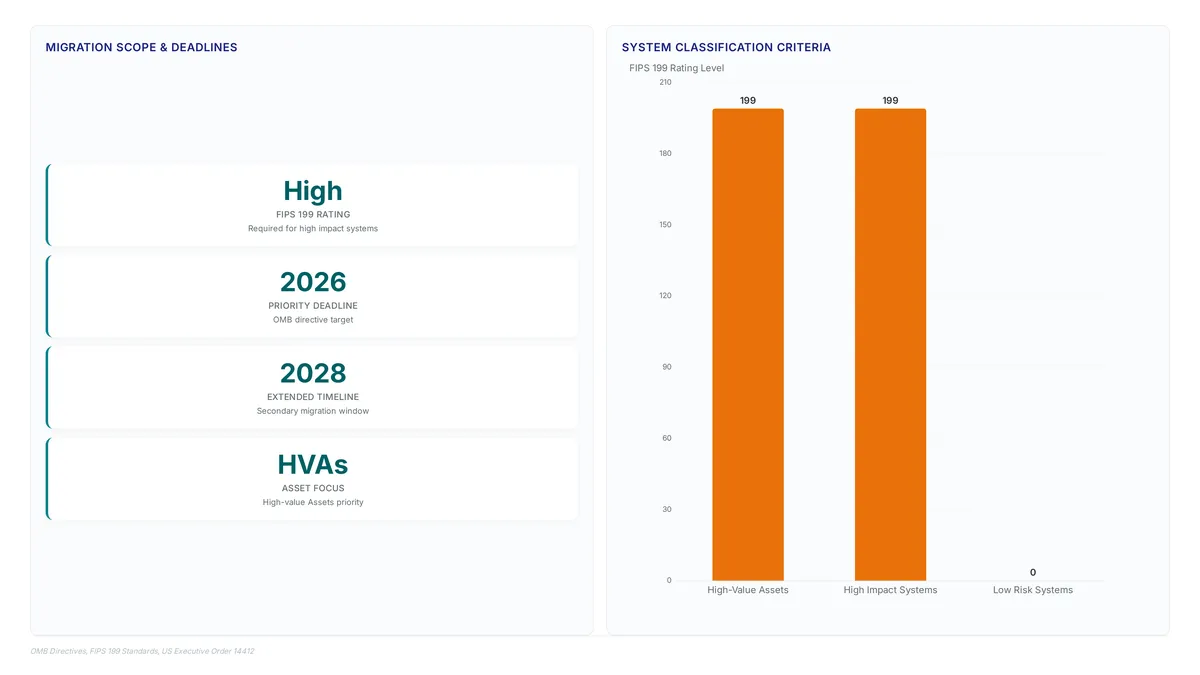
Agencies must first distinguish high-value Assets assigned by the Office of Management and Budget from systems rated under FIPS 199. The executive order targets these specific categories for mandatory migration. high-value Assets represent the government's crown jewels, encompassing databases holding millions of federal employee records, classified intelligence systems, and federal financial transaction platforms. In contrast, high impact systems are set as systems where confidentiality, integrity, or availability is rated 'high' under FIPS 199, where a breach could cause severe harm.
- Identify all systems assigned as HVAs by OMB guidance.
- Audit existing infrastructure against FIPS 199 "high" impact criteria.
- Tag assets requiring immediate post-quantum key establishment versus digital signatures.
A critical operational tension exists here: over-scoping inflates costs, while under-scoping leaves critical data vulnerable to harvest-now-decrypt-later attacks. Misidentifying a high impact system as low risk creates an irreversible security gap once quantum decryption capabilities mature. Precise definition drives effective resource allocation.
Executing the Quantum Impact Inventory and CBOM Strategy
Agencies must prioritize a targeted quantum impact inventory to meet immediate compliance deadlines, as operational guidance should prioritize this approach over an exhaustive Cryptographic Bill of Materials (CBOM). This focused approach isolates critical assets before expanding scope. Operators should execute the following workflow:
- Identify all high-value Assets assigned by federal guidance as priority targets.
- Filter systems rated "high" under FIPS 199 standards for severe breach consequences.
- Map current key establishment methods on these specific assets to flag quantum vulnerabilities.
- Submit the resulting migration plan to federal leadership by the September 2026 deadline.
While the executive order directs federal contractors to comply with post-quantum Federal Information Processing Standards (FIPS) by the end of 2030, waiting for additional documentation creates unacceptable risk exposure. Network leaders should begin asset discovery immediately rather than stalling on procedural completeness. This proactive stance ensures continuous protection against harvest-now-decrypt-later threats while the broader regulatory framework matures.
Procurement Checklist for PQC-Capable Product Categories
Procurement officers must distinguish between high-value Assets and high impact systems to satisfy federal mandates. The executive order establishes clear deadlines for transitioning these specific system categories, driving the urgency of vendor negotiations today. CISA released 'Product Categories for Technologies That Use Post-Quantum Cryptography Standards,' distinguishing between 'Widely available' categories like cloud services and other specialized sectors.
| Category | Examples | PQC Status |
|---|---|---|
| high-value Assets | Federal employee records, classified intelligence | Transition by Dec 2030 (Key Establishment) |
| High Impact Systems | FIPS 199 "high" rated systems | Transition by Dec 2031 (Digital Signatures) |
Follow this mandatory verification sequence for all new acquisitions:
- Demand written confirmation that covered contractors will meet NIST FIPS standards by December 31, 2030, as the FAR Council must publish proposed rules requiring this compliance.
- Ensure cloud platforms and networking gear support post-quantum key agreement protocols such as TLS and IPsec.
- Confirm identity systems include a documented roadmap for post-quantum authentication integration by 2031.4. Reject any vendor lacking a clear vulnerability disclosure program for cryptographic failures.
The Office of Management and Budget issues guidance requiring agencies to review inventories and submit plans, creating a binding timeline for action. Relying solely on future regulation creates immediate supply chain risk. Agencies waiting for the rulemaking may find their critical networking hardware obsolete before the deadline arrives. Treating the December 31, 2030 deadline as a hard stop for key establishment ensures compliance with the executive order's requirements for federal agencies. Proactive inventory separation prevents costly emergency replacements when the regulatory framework finalizes.
Supply Chain Mandates and Critical Infrastructure Compliance Requirements
FAR Council Rules for Covered Contractors and Vulnerability Disclosure

Executive Order 14412 mandates that federal contractors achieve compliance with post-quantum Federal Information Processing Standards (FIPS) by the end of 2030. This directive binds supply chain security directly to cryptographic agility, transforming federal procurement mechanics. Historical precedents exist where government purchasing power drove industry-wide technology adoption, specifically regarding IPv6, routing security, and DNSSEC. Compliance now extends past internal network upgrades to encompass rigorous vendor assessment protocols. Regulations distinguish between widely available cloud platforms and transitioning networking hardware, necessitating distinct migration strategies for each category.
Parallel regulatory actions by the FCC regarding BGP security establish a broader baseline for infrastructure protection. These concurrent measures signal a unified government approach to securing the digital supply chain against emerging threats. Verifying vendor claims against actual implementation status presents the primary operational tension. Many suppliers assert readiness without possessing valid FIPS validation certificates, creating hidden compliance risks for prime contractors. Network operators should prioritize inventory verification immediately rather than waiting for final rule publication. Optimizing current IPv4 resources remains necessary while upgrading underlying cryptographic layers, as address availability dictates expansion capacity regardless of encryption.
Application: Procurement Strategies for Widely Available and Transitioning Product Categories
Procurement teams must immediately distinguish between widely available cloud platforms requiring instant PQC capability and transitioning networking hardware needing phased upgrades. CISA and federal guidance categorize IaaS and PaaS environments as mature sectors where organizations should procure only PQC-capable products without delay. Routers, firewalls, and identity management systems remain in a transition phase where hybrid cryptographic support serves as the current operational baseline.
| Category | Examples | Procurement Action |
|---|---|---|
| Widely available | Cloud platforms, web browsers, endpoint security | Mandate immediate PQC capability |
| Transitioning | Routers, firewalls, HSMs, email servers | Require hybrid upgrade paths |
This dichotomy creates specific friction for federal agencies managing mixed-venue architectures. Cloud providers like Cloudflare have already shipped post-quantum encryption across most products. Legacy on-premise hardware often lacks the silicon-level throughput for full implementation without performance degradation. Strategic errors occur when operators apply uniform upgrade cycles to these distinct categories, potentially causing latency in stable clouds or leaving stagnant hardware vulnerable. Effective federal agency PQC migration demands parallel tracks: aggressive replacement schedules for widely available software and rigorous capacity testing for transitioning infrastructure. Network operators optimizing their IPv4 resources must ensure their addressing plans accommodate these dual-speed deployment models without fragmenting routing tables. Clients should audit current inventory against these specific definitions today. Delaying this categorization risks non-compliance with the December 31, 2030 deadline for high-value Assets. Secure your supply chain by aligning procurement language with these finalized product categories now.
Critical Infrastructure Sector Assistance and Federal Agency Support Protocols
Executive Order 14412 focuses its binding requirements on federal high-value Assets (HVAs) and high impact systems, while the U.S. Government uses federal leadership to encourage adoption across critical infrastructure owners in energy, finance, and healthcare. No hard deadlines exist for these owners, yet the EO directs federal agencies to assist them with PQC migration plans. The Federal Communications Commission simultaneously reinforces security obligations for broadband providers, creating a layered regulatory environment.
Operators must distinguish between immediate procurement requirements for widely available technologies and the transitional status of core networking hardware. This distinction creates a strategic tension: delaying upgrades for transitioning assets like routers risks future incompatibility, yet premature replacement may incur costs before standards fully stabilize. Network architects are advised to prioritize inventory audits that classify assets by their cryptographic agility.
| Sector Focus | Agency Role | Operator Action |
|---|---|---|
| Energy & Finance | Technical Assistance | Submit migration plans |
| Telecommunications | Regulatory Alignment | Upgrade edge encryption |
| Healthcare | Risk Assessment | Inventory HVA dependencies |
Relying on voluntary adoption timelines for non-federal entities exposes supply chain nodes to harvest-now-decrypt-later attacks for a longer duration than federal systems. Organizations should proactively engage with assigned agency leads to align their migration plans with emerging federal best practices. This collaborative model ensures that critical sectors maintain interoperability while preparing for the eventual 2030 compliance horizon.
About
Alexander Timokhin, CEO of InterLIR, brings critical strategic insight to the discussion on high-value Assets (HVAs) in the context of post-quantum mandates. As the leader of a specialized IPv4 marketplace, Timokhin manages some of the internet's most finite resources daily, understanding that digital infrastructure components are paramount national assets. His expertise in IT infrastructure and international policy allows him to recognize how Executive Order 14412 elevates the status of network resources. At InterLIR, his team ensures the security and reputation of IP blocks through rigorous BGP validation, a practice directly parallel to the cryptographic integrity demanded by new federal standards. With a background spanning public policy and technical database administration, Timokhin uniquely connects the dots between government procurement power and the protection of essential network layers. His perspective highlights that securing HVAs requires both advanced encryption and the steadfast management of the underlying addressing architecture that powers global connectivity.
Conclusion
Scaling post-quantum readiness reveals that static inventory lists fail when cryptographic standards evolve quicker than hardware refresh cycles. The operational cost of delaying action is not merely financial but structural, as legacy routers and switches become incompatible with hybrid encryption architectures required for strategic ip assets. Organizations must treat their network assets as flexible entities requiring continuous cryptographic agility rather than one-time upgrades. I recommend that non-federal operators in energy and finance immediately classify their infrastructure based on upgradability, distinguishing between devices capable of software-based PQC integration and those requiring physical replacement before the 2030 horizon. This targeted approach prevents unnecessary capital expenditure while securing the most vulnerable nodes against harvest-now-decrypt-later threats. This specific inventory step allows you to prioritize procurement for hardware that supports future algorithm updates, ensuring your organization aligns with the collaborative migration models emerging from federal assistance programs. By focusing on agility now, you secure the long-term viability of your digital infrastructure without waiting for mandatory enforcement mechanisms to activate across private sectors.
Frequently Asked Questions
Agencies must finish encryption by December 31, 2030, and authentication by December 31, 2031. Missing these dates leaves High Value Assets non-compliant with Executive Order 14412 mandates for federal security.
Agency heads must identify a migration lead by July 2026 and submit plans by September 2026. This early action ensures agencies meet the final 2030 deadline for securing sensitive government data systems.
Federal contractors must comply with post-quantum Federal Information Processing Standards by the end of 2030. Vendors failing this requirement risk losing eligibility for future government contracts and procurement opportunities entirely.
Harvest-now-decrypt-later attacks store current traffic for future quantum decryption attempts. This threat forces immediate action because data intercepted today remains vulnerable even after the 2030 compliance deadline passes.
Hybrid architectures maintain backward compatibility while introducing quantum resistance to existing networks.
References