InterRIR transfers: Move IPv4 across 5 regions
Five recognized RIRs currently govern the fragmented environment of global IP allocation. The Inter-RIR transfer process remains the only viable mechanism for moving IPv4 assets across these rigid regional borders, though bureaucratic friction often outweighs market efficiency. Readers will learn how the hierarchical distinction between Regional Internet Registries and Local Internet Registries dictates eligibility, noting that RIRs operate on a non-profit basis while LIRs bear the burden of membership fees. Finally, the text outlines the mandatory workflow from account creation to the final confidentiality agreement required for cross-border execution.
Navigating this terrain requires understanding that IANA designations are immutable and that organizations cannot simply become new RIRs. You will see why demonstrating a specific need for address space is a non-negotiable prerequisite before any negotiation begins. The guide details the exact steps buyers must take to satisfy auditors within their specific geographic region.
The Hierarchical Roles of RIRs and LIRs in Global IP Management
RIR and LIR Hierarchical Roles in Global IP Management
IANA designates exactly five non-profit entities as Regional Internet Registries to manage global address distribution. These organizations, including RIPE for Europe and ARIN for North America, handle statistics and dispute resolution without selling products. Operators seeking address space must engage Local Internet Registries, which act as the primary interface for resource allocation. Unlike RIRs, LIRs pay membership fees determined by their specific network size category.
The classification system divides LIRs into five distinct tiers: Extra Large, Large, Medium, Small, and Extra Small. Fee structures remain proportional to the assigned category, ensuring equitable cost distribution across the system. While RIRs maintain the master registry, LIRs possess the authority to allocate Sub-Allocated Number Resources to end users. This hierarchy enables the fluid movement of IPv4 blocks through inter-RIR transfer policies, all allowing buyers to expand their search scope beyond local boundaries. Currently, APNIC enables inter-RIR transfers with RIPE NCC, ARIN, and LACNIC, enabling cross-regional resource movement.
| Feature | RIR Function | LIR Function |
|---|---|---|
| Primary Role | Regional Policy & Statistics | Customer Allocation |
| Revenue Model | Membership Fees | Service Fees & Resale |
| User Access | No Direct End-User Sales | Direct Customer Interaction |
Strict regional needs-based validation clashes with the global necessity for address liquidity. Inter-RIR transfers are legally recognized and enable the movement of assets despite regional exhaustion. InterLIR enables these complex transfers, ensuring operators navigate divergent policies efficiently. Engage our marketplace to secure the IPv4 capacity your infrastructure requires today.
LIR Authority to Allocate Provider Independent and Sub-Allocated Number Resources
Local Internet Registries possess the exclusive operational mandate to distribute Sub-Allocated Number Resources and Provider Independent addresses directly to end-user networks. This authority transforms the LIR from a passive fee payer into an active distribution node capable of satisfying specific customer connectivity requirements without direct RIR intervention. Operators frequently require Provider Independent space to maintain routing stability during upstream provider changes, a capability distinct from provider-aggregated assignments. The LIR functions as the necessary intermediary between these technical entities and the RIPE NCC, particularly when registering new Autonomous Systems for customers needing direct peering capabilities.
Inter-RIR Transfer Policy Requirements for IPv4 Address Space Utilization
Cross-regional IPv4 mobility depends on strict adherence to divergent validation mechanisms that prevent speculative hoarding. Operators must navigate specific needs-based policies where ARIN mandates demonstrating a requirement for a 24-month supply before approval. This contrasts sharply with transfers targeting the RIPE NCC region from an RIR with needs-based policies, which demand a documented utilization plan covering at least 50% of resources within five years. Such asymmetry creates a complex compliance environment where inter-RIR transfers universally require the consent of both RIRs involved.
| Region | Validation Focus | Planning Horizon |
|---|---|---|
| ARIN | 24-month supply proof | 2 years |
| RIPE NCC | Utilization roadmap | 5 years |
The operational cost of this fragmentation is measurable capital commitment locked in upfront rather than deployed dynamically. While global liquidity improves through inter-RIR transfers, the restriction limits immediate resale potential for twenty-four months post-receipt in Europe. This policy tension forces buyers to choose between rapid deployment flexibility and long-term asset security. Most organizations underestimate the administrative burden required to satisfy these distinct regional auditors simultaneously. InterLIR guides network architects through these regulatory mazes to secure necessary addressing assets efficiently. Contact our team to validate your transfer eligibility today.
Divergent Regional Policies Governing Cross-Border IP Allocations
ARIN 24-Month Supply Rule vs RIPE NCC Five-Year Utilization Plan
Temporal validation metrics create distinct compliance barriers for cross-regional buyers. Applicants prove a specific requirement for a 24month supply, forcing operators to forecast growth with high precision over a shorter horizon. This divergence dictates that capital allocation strategies must align with the destination registry's specific definition of justified need. A buyer satisfying the 24-month supply justification in North America may still face rejection in Europe if their long-term roadmap lacks the granularity to satisfy the five-year utilization test. An address block valid for immediate deployment in one region becomes a stranded asset in another due to planning misalignment. The limitation is clear: global liquidity remains constrained not by address scarcity alone, but by the inability of operators to synchronize their network engineering timelines with divergent regulatory clocks. InterLIR solves these network availability problems by matching your specific utilization profile with compliant inventory. Contact our team to navigate these complex inter-RIR requirements efficiently.
Aligning Capital Commitment Strategies with Regional Regulatory Frameworks
Capital deployment timelines must strictly mirror the temporal validation metrics of the destination registry to avoid transaction rejection. Operators targeting North American inventory face a compressed planning window, as ARIN mandates proof of need for a 24month supply rather than indefinite holdings. Regulatory asymmetry forces buyers to segregate capital reserves based on geographic target rather than global aggregate demand. A single treasury strategy fails when one jurisdiction validates immediate deployment while another audits long-term roadmap adherence. This tension between liquidity and compliance volume dictates that organizations must diversify their acquisition timing rather than batching purchases. Failure to align financial planning with these divergent regulatory frameworks results in stranded assets or failed validation reviews.
Validating Transfer Feasibility Against Minimum Block Sizes and Lock-up Periods
Operational viability hinges on verifying that target inventory meets the minimum block size of a /24 block before negotiations commence. This technical floor, enforced by ARIN, prevents the fragmentation of address space into unrouteable units that degrade global routing tables. Buyers must also account for holding periods; for instance, in the RIPE NCC service region, IPv4 addresses are restricted from being transferred for 24 months after they have been received via allocation, transfer, or merger. APNIC maintains flexible policies to support market movement through active inter-RIR agreements with RIPE NCC, ARIN, and LACNIC. Other regions impose specific constraints such as the exclusion of AFRINIC from current inter-RIR transfer policies.
The cost of ignoring these structural constraints is immediate transaction failure rather than delayed approval. Operators must engage a qualified broker to navigate these divergent rules, as the transfer process involves complex steps including account creation, application for approval, and mutual confirmation between buyer and seller. Failure to align with these requirements results in wasted administrative effort and lost market opportunities.
Executing a Compliant Inter-RIR Transfer Request Workflow
Defining the Inter-RIR Transfer Workflow Steps

Successful Inter-RIR transfers begin when the buyer creates an account with the each Regional Internet Registry to legally acquire IPv4 address space. This core step establishes the necessary identity for all subsequent regulatory interactions. Once registered, the buyer submits an application for approval that provides detailed justification for the intended use of the requested resources. Administrators strictly review this documentation to verify legitimate operational requirements before authorizing any movement of assets.
Following initial validation, the parties enter negotiations to finalize transfer details, including specific IP blocks and associated costs. A broker often oversees these discussions to ensure a confidentiality agreement outlines fund timing and completion protocols. The seller then initiates the request with the Source RIR to formally start the handover procedure. Either party submits the formal transfer request through the online portal, providing thorough organizational data for the buyer.
Regions such as APNIC, LACNIC, and parts of ARIN may require payment of a transfer fee by the address owner. Both parties must sequentially confirm the request before the registry processes the final update to the Whois database. This sequence ensures that Inter-RIR transfers maintain global routing integrity while adhering to registry policies.
Executing Buyer-Seller Negotiations and Confidentiality Agreements.
Finalizing inter-RIR transactions demands a legally binding confidentiality agreement that dictates fund transfer timing and recipient verification before any asset movement occurs. This document serves as the primary control mechanism, ensuring that sensitive operational data remains protected while parties align on cost and initiation protocols. In high-value exchanges, participants frequently execute an Asset Purchase Agreement where the buyer funds a neutral escrow agent to mitigate counterparty risk. The seller initiates the technical transfer only after the escrow conditions are fully satisfied, creating a secure dependency between financial settlement and registry updates.
- Establish a confidentiality framework defining the exact sequence of fund releases and registry notifications.
- Engage a qualified broker to oversee negotiations and validate the identity of all funding recipients.
- Deposit purchase capital into an escrow account managed by a third-party agent rather than transferring directly to the seller.
- Confirm the desire to receive the block via the RIR portal once financial conditions are met.
Operators must recognize that Regional Internet Registries do not manage these private funds, leaving financial dispute resolution entirely to the contractual terms established between buyer and seller.
Validating Needs-Based Justification and Utilization Plans.
Regulatory compliance demands that operators align their documentation with the specific temporal metrics of the destination RIR before submitting an application.
- Account creation establishes the legal identity required to hold resources within a specific registry jurisdiction.
- Submit an application for approval that quantifies need using the precise horizon mandated by local policy.
3.
| Region | Temporal Metric | Validation Focus |
|---|---|---|
| ARIN | 24-month supply | Immediate deployment capacity |
| RIPE NCC | 5-year horizon | Long-term utilization plan |
Operators frequently underestimate how rigid utilization plans become once approved, effectively locking capital into slow-deployment architectures that may not match agile network scaling. This divergence creates a strategic tension between acquiring assets quickly and maintaining the flexibility to pivot infrastructure plans without regulatory penalty. The divergent needs-assessment methodologies mean that procurement strategies must account for specific regional constraints. Teams must separate their inventory planning by region to avoid rejection during the application for approval phase. InterLIR recommends validating these temporal constraints against your actual deployment velocity before entering negotiations. Secure your global address strategy by aligning your justification documents with these distinct regional clocks today.
Resolving Common Rejections and Approval Delays in IP Transfers
Defining Transfer Rejection Triggers in Needs-Based RIR Policies
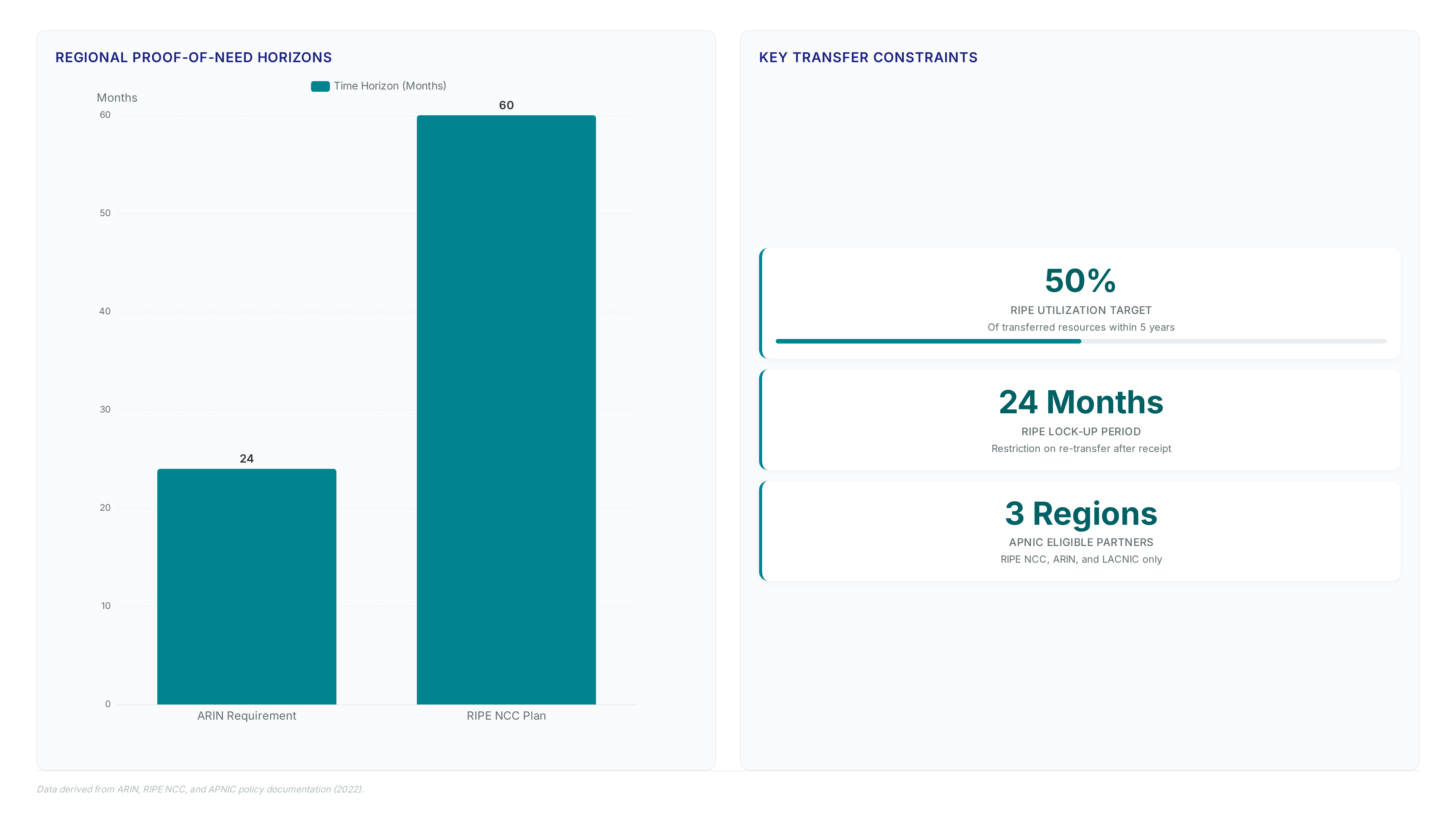
Rejection triggers frequently originate from temporal misalignments regarding resource necessity. ARIN mandates that recipients prove a specific need for a 24-month supply of addresses, a strict horizon that disqualifies speculative hoarding. Conversely, transfers entering the RIPE NCC region from needs-based jurisdictions require a utilization plan covering a significant portion of resources within a set future period. This divergence creates a compliance trap where a buyer satisfying ARIN's short-term operational metrics may fail RIPE's long-term deployment threshold. The utilization plan serves as the primary audit target, and vague projections can result in application denial.
Assuming Account creation alone satisfies the deeper Application for approval scrutiny required for cross-border deals is a costly error. Operators often mistake these policies for bureaucratic noise, yet they function as rigid gatekeepers against market inefficiency. Justification narratives must tailor themselves to the destination registry's specific definition of "need" before file submission. Validating utilization math against both regional standards simultaneously helps prevent avoidable delays. Precision in defining a growth window remains the only viable path through these conflicting regulatory landscapes.
Resolving Application Delays Through Precise Justification Documentation
Approval delays stem primarily from temporal misalignment between buyer justifications and regional policy mandates. Operators frequently submit generic deployment schedules that fail to satisfy the rigid time-horizon requirements of the destination registry. ARIN strictly evaluates whether requested blocks cover a specific future supply period, rejecting applications that imply speculation rather than immediate infrastructure rollout. Conversely, transfers into the RIPE NCC region demand a long-term utilization strategy proving significant resource consumption over an extended horizon. This divergence creates a critical friction point where a technically sound request fails due to improper narrative framing.
Overlooking the requirement for dual-RIR consent extends the validation window unnecessarily. The cost of vague documentation is measurable in lost opportunity and frozen capital. Buyers must tailor their justification documentation to explicitly mirror the regulatory language of the receiving authority. It is necessary to demonstrate the need for obtaining these addresses by auditing internal network capacity plans against specific temporal metrics before filing. Precise alignment between projected usage and policy definitions converts a potential rejection into a routine administrative update.
Risks: Capital Commitment Risks from Divergent Regional Regulatory Frameworks
Misaligned justification horizons change liquid IPv4 assets into stranded capital when regional policies conflict. Operators purchasing address space often overlook how divergent needs-assessment methodologies mechanically lock funds in escrow during prolonged regulatory review. While ARIN demands proof of a 24-month supply, the RIPE NCC enforces a utilization plan covering a substantial percentage of resources within five years for specific inter-regional moves. This policy friction creates a hidden cost structure where delayed approvals inflate the effective price per address through opportunity cost and administrative overhead.
Extended escrow periods tie up operational cash flow while awaiting dual-RIR consent. Incompatible deployment timelines force buyers to purchase excess inventory just to satisfy the stricter jurisdiction. Lost market velocity prevents rapid network expansion when regulatory validation lags behind technical requirements. The requirement to demonstrate need implies a significant upfront capital commitment that affects total cost of ownership beyond the initial purchase price. Sellers showing willingness to consider a wider geographic range of transfers still face these structural bottlenecks that delay settlement. The limitation is clear: without precise alignment to the destination registry's temporal metrics, capital remains immobilized regardless of market demand. Network planners must treat regulatory divergence as a primary financial risk factor rather than a mere administrative hurdle. Engaging expert guidance helps navigate these complex jurisdictional variances and secure IPv4 investments efficiently.
About
Alexander Timokhin, CEO of InterLIR, brings authoritative expertise to the complex subject of Inter-RIR transfers. As the leader of a specialized IPv4 marketplace founded in Berlin, Timokhin manages daily operations that navigate the precise regulatory frameworks of APNIC, ARIN, LACNIC, and RIPE. His direct experience facilitating cross-border IP transactions provides unique insight into the logistical and policy challenges discussed in this article. At InterLIR, his team executes the very mechanisms of inter-regional redistribution, ensuring clean BGP routes and strict compliance with varying regional policies. This practical, hands-on involvement in global IP resource management allows Timokhin to explain not just the theory, but the real-world application of transfer policies. By bridging the gap between technical registry rules and market demand, he offers a perspective grounded in the operational reality of maximizing IPv4 efficiency across different geographic jurisdictions.
Conclusion
Scaling inter-RIR transfers exposes a critical fracture where divergent temporal mandates stall deployment. The operational cost here is not merely administrative delay but the tangible erosion of capital velocity as assets sit frozen in regulatory limbo. Operators attempting to bridge ARIN's strict 24-month proof of need with RIPE NCC's five-year utilization roadmap often purchase excess inventory solely to satisfy the stricter jurisdiction, inflating the effective price per address. This fragmentation forces organizations to treat policy alignment as a primary financial constraint rather than a backend checkbox.
Organizations must synchronize internal network capacity plans with destination registry metrics before initiating any transfer negotiation. Do not file applications until your projected usage data explicitly satisfies the specific horizon of the target region, whether that requires demonstrating a two-year supply or a five-year roadmap. This alignment converts a potential rejection into a routine update and prevents funds from becoming stranded in escrow.
Start this week by auditing your current IPv4 inventory against the specific temporal requirements of your target RIR to identify gaps in your justification documentation. Only proceed with acquisition talks once your internal forecasts mathematically satisfy the destination's distinct proof-of-need window. This disciplined approach ensures that liquidity remains available for actual infrastructure growth rather than being locked away by preventable regulatory friction.
Frequently Asked Questions
The minimum transferable unit in the ARIN region is strictly a [/24 block](https://interlir.com/2022/10/18/what-is-arin-transfer-process/). Operators cannot request smaller fragments, so buyers must ensure their technical requirements align with this specific [minimum block size](https://interlir.com/2022/10/18/what-is-arin-transfer-process/) before starting negotiations.
Applicants must demonstrate a specific requirement for a [24-month supply](https://interlir.com/2022/10/18/what-is-arin-transfer-process/) of addresses to qualify. This rule forces operators to forecast growth accurately, as indefinite holdings are not permitted under the current needs-based validation policies.
Recipients must submit a utilization plan covering at least [50%](https://www.ripe.net/manage-ips-and-asns/resource-transfers-and-mergers/inter-rir-transfers/) of resources within five years. This long-term projection ensures that transferred assets are deployed efficiently rather than held speculators within the European service region.
This waiting period prevents rapid flipping of resources and ensures stability within the regional registry database.
Local Internet Registries pay membership fees based on their network size category, not the end users. These fees support the non-profit RIR operations, while LIRs recover costs by charging service fees directly to their customers.
References