IPv4 acquisition costs rise: skip the tag
With only 3.9 million unallocated addresses remaining globally, the era of free IPv4 expansion is dead. Network architects now face a binary choice: commit to costly permanent acquisition or pivot to flexible leasing agreements. The operational mechanics of leasing bypass the strict justification processes once mandated by the American Registry for Internet Numbers. Meanwhile, prices in the ARIN region have climbed to roughly $45, $50 per IP, rendering upfront investment prohibitive for many projects. Organizations avoid these purchase prices by utilizing short-term contracts that align with actual deployment cycles.
This guide covers managing address utilization to ensure compliance without the burden of permanent ownership. By understanding these regional price variations, operators can optimize network budgets effectively.
The Critical Impact of IPv4 Exhaustion on Modern Network Infrastructure
IPv4 Exhaustion Mechanics and the 4.3 Billion Address Limit
The theoretical became absolute in 2015. That year, the 4.3 billion available addresses vanished, marking the start of a constrained environment where the protocol's finite ceiling became a hard barrier to global network expansion. No amount of demand can override this limit. The Regional Internet Registries now manage only the tiny remainder of unallocated space. Current data indicates the global unallocated pool sits at approximately 3.9 million addresses as of early 2026. These remaining resources are concentrated heavily within specific jurisdictions like APNIC and AFRINIC.
New direct allocations from bodies such as ARIN are effectively impossible for most organizations today. Operators must navigate a secondary market where scarcity dictates value rather than administrative policy. Networks cannot rely on organic growth through registry requests anymore.
| Registry Region | Allocation Status |
|---|---|
| ARIN | Exhausted |
| RIPE NCC | Exhausted |
| APNIC | Critical |
| AFRINIC | Critical |
This reality forces a strategic shift toward optimizing existing assets rather than seeking new blocks. InterLIR addresses this by redistributing unused IPv4 resources to where they generate immediate utility. The cost of holding inefficient blocks rises as acquisition prices climb toward $50 per unit. As new allocations vanish, competitors increasingly secure necessary connectivity through the secondary market and leasing models.
Regional IPv4 Price Variations from APNIC to AFRINIC
Geographic registry policies dictate IPv4 acquisition costs, creating distinct price tiers across global markets. The AFRINIC zone presents a lower entry point, though liquidity constraints often limit available block sizes. This disparity forces network architects to align deployment geography with budget realities rather than purely technical latency requirements. While buying remains viable for permanent infrastructure, IPv4 leasing offers a strategic alternative for organizations needing to bypass these regional purchase ceilings without long-term asset commitment. InterLIR enables access to these distributed resources, allowing operators to lease blocks in specific regions to match local pricing structures.
Short-term agreements suit a majority of cases requiring flexibility under two years. Long-term holdings exceeding seven years favor buying in the vast majority of scenarios due to cumulative cost efficiency. Lessees never build an equity asset, whereas buyers own the resource permanently. Align the choice strictly with project duration to optimize financial efficiency.
Operational Mechanics of Leasing Versus Buying IPv4 Address Blocks
BGP Routing Implications for Leased IPv4 Address Blocks
Leased IPv4 blocks route via BGP under lessor-set policies, restricting autonomous system path control compared to owned infrastructure. Operators using rental models accept that the AS path originates from the provider's upstream peers rather than their own autonomous system number. This architectural constraint means the lessee cannot independently assert origin authority without explicit coordination.
Buying grants full control over routing announcements. Leasing transfers technical governance responsibilities to the lessor. The mechanism relies on the lessor advertising the specific prefix and setting a next hop toward the customer's edge router. Consequently, traffic engineering options like local preference manipulation remain limited to the lessor's discretion. Operational simplicity conflicts with routing sovereignty; lessees gain immediate connectivity but lose the ability to implement complex multi-homed strategies independently. Cost is reduced while administrative overhead drops, though ultimate BGP protocol authority cedes to the landlord.
| Feature | Owned Block | Leased Block |
|---|---|---|
| Origin Control | Full ASN ownership | Provider-dependent |
| RIR Compliance | Operator burden | Lessor managed |
| Routing Policy | Customizable | Restricted by contract |
Short-Term Testing and Seasonal Traffic Use Cases for IPv4 Leasing
Operators deploy IPv4 address rental for temporary advertising campaigns lasting only a few months. Such Flexibility enables networks to scale resources up during high-traffic seasons and down immediately after, optimizing operational expenditure without long-term debt. Testing environments for new applications also benefit notably from this model compared to permanent acquisition. Developers launch apps without long-term commitment, using blocks for validation before committing capital to permanent assets. This statistic highlights a clear tension between capital efficiency and asset ownership that depends entirely on project duration.
Executing IPv4 Lease Agreements and Managing Address Utilization
IPv4 Lease Agreement Mechanics and RIR Registration
The lessor assigns a block (e.g. /24, 256 IPs), handles DNS delegation, registers space with a Regional Internet Registry (RIR), and manages global routing via BGP. This workflow lets organizations bypass high upfront buying prices while securing immediate connectivity. The vendor retains technical governance responsibilities, reducing the administrative burden on the lessee's IT team regarding RIR compliance. Operators gain instant deployment capabilities without navigating complex transfer policies or justifying utilization plans to registry officials.

| Component | Provider Responsibility | Lessee Responsibility |
|---|---|---|
| Registry Record | Maintains WHOIS accuracy | Provides contact data |
| Routing | Manages BGP announcements | Configures local peers |
| Abuse Handling | Initial triage and filtering | Application layer logs |
Speed trades off against permanence; leasing offers rapid provisioning but delegates ultimate control of the AS path origin to the vendor. This model transfers the risk of market volatility and regulatory overhead to the lessor. Networks requiring temporary scale or those testing new geographic regions without long-term capital commitment benefit from this arrangement. The primary limitation remains the lack of asset accumulation on the balance sheet compared to traditional acquisition.
Calculating IPv4 Lease Costs by Prefix Size and Term
Multiplying the per-IP rate by the subnet count yields the exact monthly obligation for any leased block. Operators calculating expenses must apply volume discounts where larger prefixes reduce the unit cost notably. These tiers illustrate how bulk acquisition lowers the marginal cost of connectivity infrastructure.
Commitment duration serves as the second variable influencing total expenditure profiles across different regions. Selecting an annual payment cycle trims these recurring costs by a modest portion to 15% compared to standard monthly billing increments. Clients are advised to model these geographic differentials before finalizing contract terms to avoid budget overruns. Operational risk lies in assuming uniform global pricing, which rarely reflects actual market conditions. Operators must align their prefix size selection with specific regional availability to optimize cash flow efficiency effectively.
Operational Checklist for IPAM Utilization and Reputation Management
Contact records must match current operational teams to ensure consistent communication channels.
Deploy IPAM tools to track utilization metrics across the entire leased block in real-time. Detailed logs of IP assignments and usage patterns allow networks to right-size future leases rather than over-provisioning based on estimates. This granular visibility ensures every assigned address generates value, directly countering the inefficiency of dormant subnets.
Modern platforms apply advanced automation to handle the majority of abuse cases, yet manual verification remains necessary for immediate mitigation of deliverability issues. A single flagged range can alter email services and customer access globally.
| Action | Frequency | Risk Mitigated |
|---|---|---|
| Update Whois Records | Quarterly | Administrative Issues |
Proactive management allows organizations to secure favorable long-term rates, whereas reactive leasing often results in higher short-term costs. The cost of reactive leasing notably exceeds the marginal effort of proactive management.
Strategic Decision Framework for IPv4 Acquisition Models
Defining the IPv4 Leasing vs Buying Decision Boundary
The boundary between leasing and buying IPv4 addresses depends on whether infrastructure needs remain under five years or extend beyond that horizon. Financial modeling indicates leasing delivers superior outcomes for temporary requirements compared to the capital lock-up of buying, particularly when organizations seek to preserve liquidity for other operational priorities. This approach bypasses the significant upfront expenditure associated with permanent acquisition while maintaining access to necessary routing resources. Al Expense Duration Fit short-term Under 5 Years long-term Stability Asset Control Contra. Companies weighing these factors must calculate total cost of ownership rather than focusing solely on monthly fees.
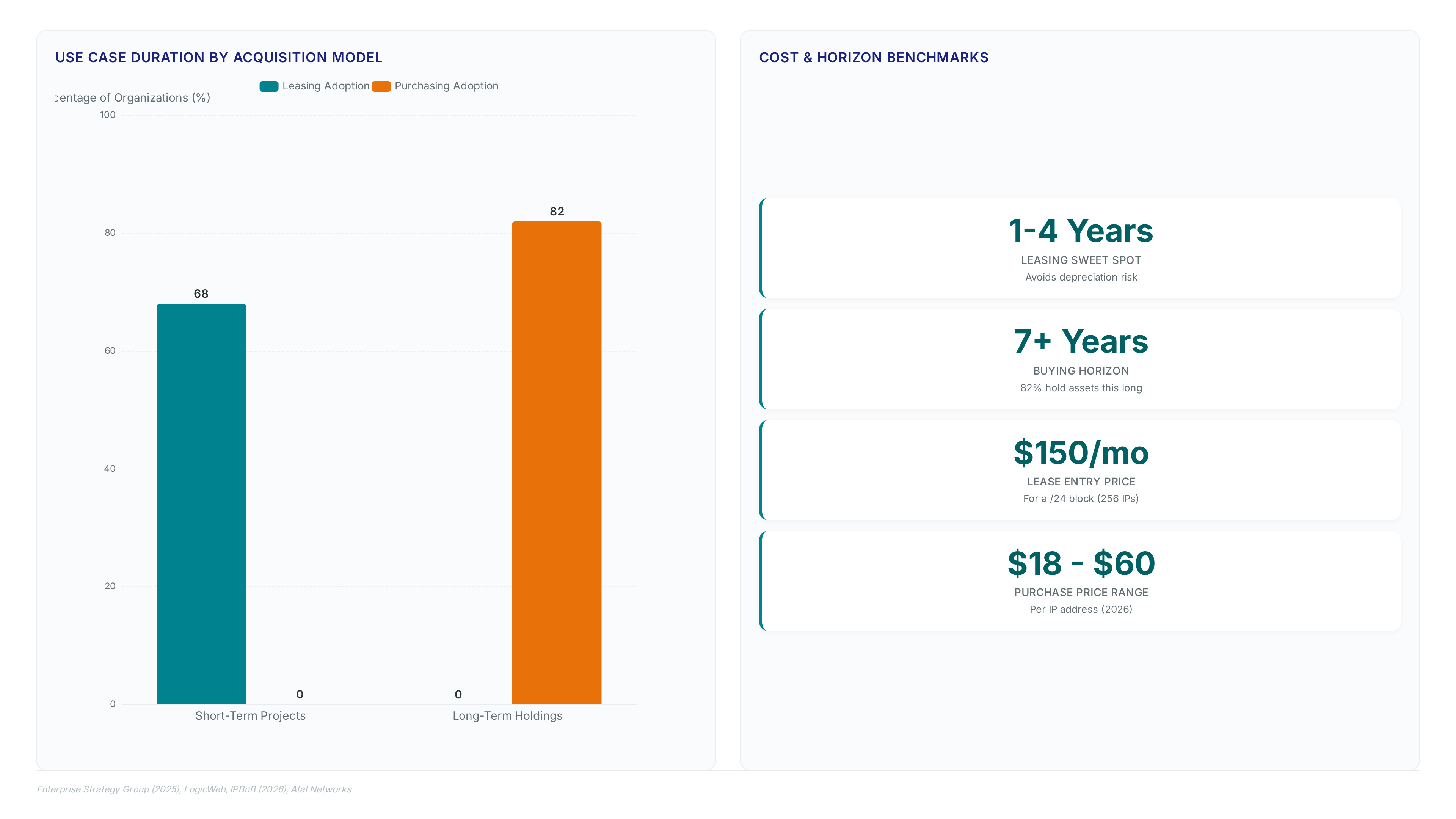
Organizations intending to hold assets for seven years or longer typically favor purchasing to secure balance sheet stability, whereas those facing fluctuating demand prefer the flexibility of rental contracts. The strategic tension lies in balancing immediate cash flow efficiency against the desire for permanent infrastructure control without provider restrictions. Operators must determine if their use case aligns with short-term flexibility or requires the full control inherent in ownership. A misalignment here often results in either wasted capital on unused permanent assets or excessive cumulative costs from extended rental agreements.
Applying Lease Models to Seasonal Traffic and Temporary Projects
Seasonal traffic surges demand immediate IPv4 capacity that purchasing cannot match without wasting capital on dormant assets. Operators facing temporary advertising campaigns or application testing phases avoid locking funds into permanent inventory when needs fluctuate. Leasing serves as the strategic mechanism for these variable workloads, allowing networks to scale address space up or down without long-term liability. Organizations using this model for temporary tasks report avoiding the high upfront expenditure associated with buying addresses outright. This approach keeps organizational budgets available for critical development rather than static infrastructure. Evidence suggests leasing is the preferred choice for a majority of projects lasting under 24 months due to this efficiency. Networks must align lease expirations with project timelines to mitigate the risk of sudden connectivity loss. For those navigating these variable demands, short-term agreements bypass permanent purchase hurdles. The operational benefit lies in converting fixed capital expenses into manageable operational costs.
Comparison: Leasing vs Buying IPv4: Monthly Fees Versus Permanent Infrastructure Investment
Capital expenditure for permanent IPv4 acquisition locks liquidity that could otherwise support immediate network expansion. Financial modeling indicates the break-even point for purchasing versus leasing extends to approximately 11–12 years when including operational overheads like platform fees. This timeline exceeds the typical refresh cycle for many cloud-native applications, rendering permanent ownership inefficient for flexible workloads. Conversely, a significant majority of organizations choosing to purchase intend to hold assets for seven years or longer, highlighting the rigid long-term nature of buying decisions. Sus leasing extends to approximately 11–12 years when including operational overheads li.
The primary tension lies between balance sheet stability and operational agility. Buying secures asset control but exposes the operator to potential technology obsolescence before ROI realization. Leasing bypasses massive initial investments, allowing firms to redirect funds toward revenue-generating infrastructure rather than dormant registry entries. Operators must recognize that leasing is identified as the more cost-effective strategy for businesses operating on a 1 to 4 year horizon, avoiding the depreciation risks and liquidity constraints of ownership. InterLIR enables this optimization by redistributing unused IPv4 resources to networks requiring immediate, flexible connectivity without the burden of permanent asset management. Tegy for businesses operating on a 1 to 4 year horizon, avoiding the depreciation risk.
About
Evgeny Sevastyanov serves as the Customer Support Team Leader and Account Manager at InterLIR, a specialized IPv4 marketplace based in Berlin. His daily work directly addresses the complexities of IPv4 address acquisition, making him uniquely qualified to analyze the leasing versus buying debate. Through managing customer inquiries and overseeing technical database entries in RIPE and APNIC, Evgeny navigates the precise challenges organizations face regarding rising costs and supply exhaustion. He routinely assists clients in securing clean BGP routes and verifying IP reputation, ensuring that businesses avoid the pitfalls of spam-listed resources. This hands-on experience with global clients across telecommunications and hosting sectors allows him to offer practical, data-driven advice on optimizing network infrastructure investments without unnecessary overhead.
Conclusion
The IPv4 market has fundamentally shifted from a speculative land grab to a discipline of capital efficiency, where holding assets without immediate yield becomes a liability rather than a hedge. The breaking point occurs when organizations treat address space as a permanent fixture despite having workloads that evolve on much shorter cycles. You must align your procurement strategy strictly with your projected infrastructure lifespan to avoid stranded assets.
Adopt a hybrid approach immediately: mandate leasing for any project with a horizon under seven years, reserving permanent purchases only for core, stable backbone requirements that guarantee long-term utility. This specific threshold ensures you capture flexibility while minimizing exposure to technology obsolescence. Do not let legacy thinking force a buy decision when operational agility provides superior financial returns.
Start by auditing your current IPv4 portfolio this week to identify any blocks held for projects with less than a seven-year lifespan. Tag these assets for potential transition to a leasing model to free up liquidity for revenue-generating innovations rather than dormant registry entries.
Frequently Asked Questions
Only 3.9 million unallocated addresses remain globally, severely limiting organic network growth. This scarcity forces operators to rely on secondary markets rather than expecting free allocations from regional registries for expansion.
Short-term fees range from $1 to $2 per IP, exceeding the stable $0.40 to $0.50 monthly rate. This premium costs more but provides essential flexibility for temporary projects without long commitments.
Buying becomes favorable for holdings exceeding seven years in most scenarios due to cumulative savings. Shorter needs under two years suit leasing better to avoid high upfront capital expenditure locks.
Prices in regions like ARIN climb toward $50 per unit, making direct purchase prohibitive for many. Leasing bypasses this steep cost, allowing access to necessary addresses without massive initial liquidity.
The hard cap of 4.3 billion addresses means no new blocks will ever be created. Planners must now optimize existing assets and utilize leasing to navigate this absolute barrier to expansion.
References
- IPv4 Leasing vs. Buying: Cost Comparison Guide | ServerMania
- Leasing vs. Buying IPv4 Addresses: Buying IPv4 addresses is
- IPv4 Lease Price Guide 2026: /24, /23, /22 &
- IPv4 Address Price History & Market Trends to 2026
- IPXO - Leasing vs. Buying IP Addresses: Undeniably, leasing
- Buy vs. Lease IPv4 Blocks: A Practical Playbook for