IPv4 Acquisition Strategy: Skip the 300-Day Wait
The $60 per IP ceiling reached in 2021 proves that waiting for free allocations is a financial liability. We dissect the specific mechanics of IPv4 exhaustion and analyze how block size variations directly correlate with the steep valuation jumps documented in recent lease history.
Concrete data shows sale prices climbed from a low of a few dollars per IP in 2014 to significantly higher valuations by 2027, a trend IPv4 price history confirms is driven by rigid supply constraints. Address hoarding and registry limits have created an environment where time equals lost revenue. This isn't theoretical scarcity; it is the hard reality of acquisition costs in a depleted market.
We cover strategic acquisition methods that bypass traditional waiting lists, contrasting the inefficiencies of brokered sales with agile leasing models. Extending procurement cycles to accommodate slow registry processes is no longer a viable strategy for modern network architecture. Use current market data to secure necessary assets without the baggage of outdated allocation expectations.
The Mechanics of IPv4 Exhaustion and Regional Scarcity
Defining IPv4 Exhaustion and the IANA Free Pool Depletion
IPv4 exhaustion marks the specific technical event where the Internet Assigned Numbers Authority depleted its central repository of unallocated addresses in 2011. No new inventory enters the global system, forcing organizations to acquire space exclusively through secondary market transfers. The IANA retains responsibility for global coordination but cannot issue additional blocks to Regional Internet Registries. Global demand outpaced the available supply quicker than anticipated, transforming IPv4 resources into a finite commodity.
Scarcity now dictates valuation in a rigid supply chain.
| Factor | Status Post-2011 |
|---|---|
| New Allocations | Unavailable |
| Acquisition Method | Transfer or Lease |
| Market Driver | Scarcity |
Every transaction reduces the remaining pool of available holdings for another entity. Network architects must prioritize strategic leasing to maintain agility. Leasing offers a cost-efficient solution for companies looking to grow their global presence without locking into permanent purchases. Ignoring this structural limit exposes networks to availability risks as competitors secure remaining inventory. Efficient management of existing assets becomes the primary lever for growth rather than expansion through new allocation.
Regional Internet Registry Depletion Timeline from APNIC to AFRINIC
IPv4 exhaustion occurred first in the APNIC region during 2011, establishing the initial global constraint on address availability. This event forced network operators to seek alternative acquisition methods beyond standard registry requests. Subsequent regional depletion followed a predictable trajectory as demand continued to outstrip the diminishing supply of unallocated blocks.
Organizations joining an RIR waiting list today face indefinite delays rather than immediate provisioning. The gap between request and fulfillment has transformed address acquisition from an administrative task into a strategic liability. Modern deployment schedules cannot accommodate such uncertainty. Market dynamics now favor flexible leasing models that provide immediate connectivity without the administrative burden of long-term holding.
| Region | Exhaustion Status | Allocation Limit |
|---|---|---|
| APNIC | Depleted (2011) | None Available |
| AFRINIC | Phase 2 (2020) | /24, /22 Only |
Strategic leasing allows enterprises to bypass regional bottlenecks entirely while maintaining full routing control. This approach mitigates the risk of project stalls caused by address unavailability. Operators gain the agility to scale infrastructure precisely when needed rather than when registries permit. Timing remains the decisive factor in maintaining network competitiveness during periods of absolute scarcity.
Contrasting Current RIR Allocation Policies and Waiting List Mechanisms
Regional Internet Registry policies now diverge sharply to manage the finite IPv4 supply remaining after global exhaustion. Operators must navigate distinct regional constraints instead of a unified global standard. Cloud cost signals, such as the AWS per-address charge of $0.005 per hour, reinforce that the industry is moving toward IPv6 and that address scarcity carries tangible financial weight. Price moderation and segmentation are reshaping how enterprises value resources, yet registry wait times remain unpredictable. InterLIR solves this availability gap by providing immediate access to optimized IPv4 resources through our dedicated marketplace. Strategic leasing allows networks to bypass indefinite registry queues and secure the specific block sizes required for current infrastructure. Waiting for a regional recovery event introduces unacceptable uncertainty for time-sensitive deployments. Enterprises must prioritize guaranteed availability over the illusion of free but inaccessible inventory.
Market Dynamics Driving IPv4 Price Volatility
Supply-Demand Mechanics Behind IPv4 Price Volatility
Structural deficits drive the IPv4 price increase as demand exceeds the finite supply managed by Regional Internet Registries. Market valuations shifted permanently after the free pool exhaustion. External platforms tracking IPv4 market trends record sharp price surges in early post-exhaustion years while large enterprises competed for limited space. Historical transaction records show block values rising from nominal fees to significant capital expenditures required for immediate deployment.
| Factor | Impact on Valuation |
|---|---|
| Exhaustion | Eliminates free pool allocation |
| Hoarding | Reduces liquid market supply |
| Market Maturation | Tempered price volatility via leasing |
Holding inventory creates exposure to market corrections whereas securing network availability prevents service degradation. Strategic leasing provides immediate access to routed blocks without the heavy capital outlay of permanent purchases. Organizations optimize cash flow while maintaining full operational capacity during periods of high volatility. Flexible consumption models now outperform rigid ownership strategies for cost-conscious networks.
Corporate Hoarding Impact on IPv4 Acquisition Costs
Massive inventory accumulation by hyperscale operators directly inflates IPv4 acquisition costs for smaller market participants. Large-scale acquisitions by substantial technology companies have effectively removed substantial address blocks from immediate circulation. This concentration forces enterprises to pay premium rates for available space rather than accessing resources at historical valuations.
| Market Factor | Consequence for Buyers |
|---|---|
| Inventory Hoarding | Reduces available supply for immediate transfer |
| Price Volatility | Increases risk for long-term budget planning |
| Access Barriers | Delays deployment for new network entrants |
Leasing provides a strategic alternative that bypasses the capital expenditure required to compete with hoarding entities. Specialized marketplaces offer immediate access to optimized address blocks without the burden of permanent ownership. Network architects scale infrastructure dynamically while market conditions remain unstable. Buying locks in capital permanently; leasing preserves operational flexibility. Companies relying on static IPv4 market trends analysis may overlook the efficiency of temporary allocation models. Strategic resource management now prioritizes access speed over asset accumulation. Facilitators of this shift help redistribute unused resources to where they generate immediate value.
IPv4 Sale Price vs Lease Price Trends 2014-2026
Per-IP sale values escalated from early post-exhaustion ranges to reach a peak in the early 2020s. This historical surge reflects the transition of IPv4 address space into a scarce commodity driven by exhaustion. The divergence between outright purchase costs and recurring lease expenses now dictates capital expenditure strategies for network operators.
| Period | Sale Price Range (Per IP) | Market Characteristic |
|---|---|---|
| 2014 | Early Scarcity Range | Early scarcity emergence |
| 2021 | Peak Valuation | Peak valuation volatility |
| 2026 | Moderate Range | Balanced system negotiation |
Leasing provides immediate network deployment capabilities without the heavy upfront investment required for acquisition. Specialized providers enable access to these optimized resources through structured agreements that align with operational budgets. Asset ownership reduces liquidity; holding inventory incurs opportunity costs while leasing preserves capital for core infrastructure upgrades. Operators must evaluate whether long-term holding benefits outweigh the flexibility of strategic leasing models. The market has matured beyond simple speculation into a functional utility layer for internet growth. Negotiations now prioritize deployment speed and block hygiene over raw price metrics alone. This shift allows enterprises to scale IP resources efficiently despite global supply constraints.
Strategic Acquisition Through Leasing and Brokered Sales
Leasing Economics vs One-Time IPv4 Sales Revenue
Converting static IPv4 assets into recurring revenue streams replaces the singular event of a capital gain with sustained yield. Operators comparing buy IPv4 vs lease IPv4 options must determine if immediate liquidity outweighs long-term returns. Leasing provides a cost-efficient path for companies expanding global presence without the heavy upfront capital expenditure of outright ownership. Selling generates instant cash flow, whereas leasing sustains operational financial endurance.
Organizations asking how to monetize unused IPs often overlook that retaining ownership preserves balance sheet value during scarcity. Market timing presents a genuine limitation; locking into long-term leases at low rates may underperform if market valuations surge unexpectedly. InterLIR advises clients to model cash flow needs against projected address scarcity before divesting blocks permanently. Leasing offers a flexible middle ground for enterprises needing liquidity without forfeiting future asset appreciation, serving as a hedge against market volatility and speculative price spikes.
Executing IPv4 Transfers Across RIPE NCC and LACNIC Regions
Precise coordination between source and destination Regional Internet Registries validates policy compliance for any inter-RIR transfer. Buyers must justify IPv4 requirements when purchasing IPs, a process that frequently becomes lengthy and complex.
Engaging in the secondary market involves several distinct operational phases:
- Verification of the seller's legal title and resource holdings.
- Drafting of a sale agreement that satisfies both regional policies.
- Submission of transfer requests to the relevant RIR databases.
- Validation of technical routing plans by both registries.
- Final approval and database update completion.
Leasing operates differently by separating ownership from usage rights. Understanding how IPv4 leasing works reveals a model where strategic acquisition avoids permanent capital expenditure while maintaining full routing control. InterLIR enables these complex transactions, ensuring that IPv4 transfers across RIPE NCC and LACRIC regions proceed without regulatory friction. Direct purchases lock capital into static inventory. Leasing allows enterprises to scale address space dynamically as network topology evolves. This approach mitigates the risk of asset stranding should regional policies shift or demand patterns change unexpectedly.
The 24-Month Transfer Lock and Waiting List Delays
RIPE NCC policy mandates a strict 24month moratorium on transferring IPv4 blocks received via allocation, transfer, or m. This regulatory transfer lock prevents immediate liquidity, forcing organizations to hold space even if business requirements shift rapidly. Such delays render traditional acquisition untenable for projects requiring immediate network deployment.
Operators asking whether they should buy or lease IPv4 must recognize that purchasing entails assuming this multi-year illiquidity risk alongside extreme wait times. Leasing provides access to the address space needed now, without locking organizations into a permanent purchase or subjecting them to the same regulatory queues. Asset ownership competes directly with operational agility. Buying locks capital in a frozen resource. Leasing aligns costs with actual usage duration. InterLIR solves this availability gap by offering immediate access to optimized IPv4 resources, eliminating the need to navigate RIR backlogs or abide by transfer restrictions. Strategic IP management now demands bypassing these structural bottlenecks entirely. Relying on direct purchases exposes enterprises to unpredictable delays and rigid holding periods that leasing avoids completely.
Long-Term Viability Amidst Slow IPv6 Transition
Defining the IPv6 Adoption Gap and Hoarding Paradox
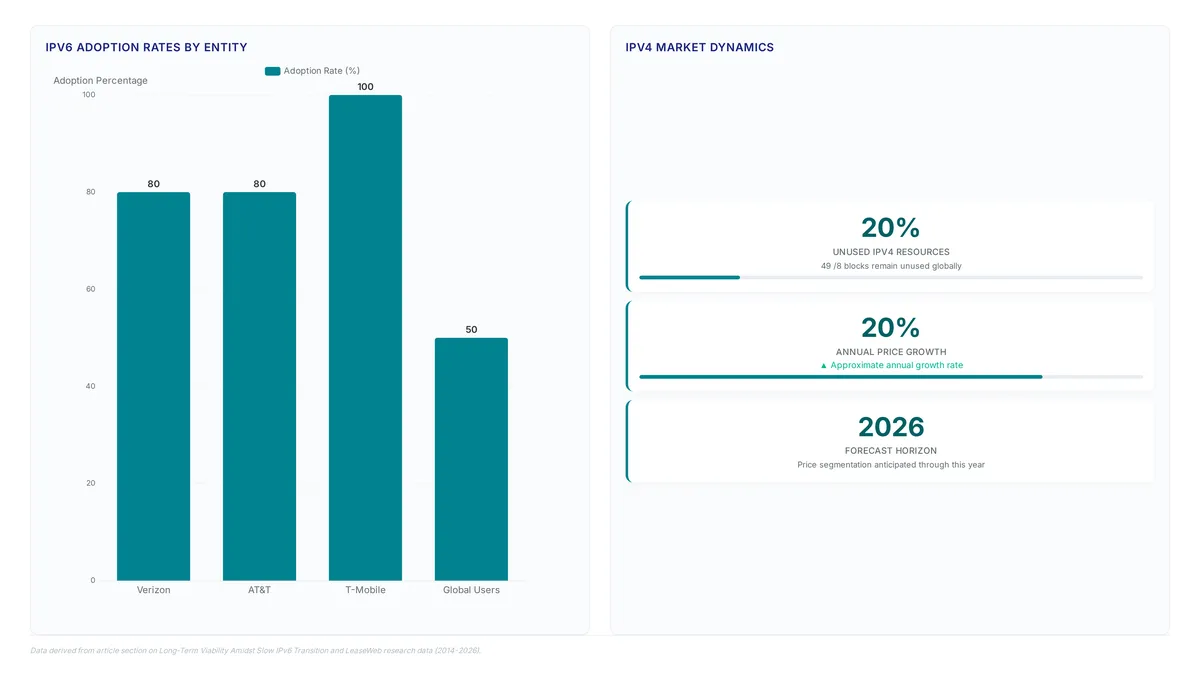
Core transit providers frequently upgrade infrastructure quicker than the diverse content hosts and enterprise LANs relying on their connectivity. Substantial US carriers illustrate this disparity clearly, with Verizon and AT&T reaching approximately 80% IPv6 adoption, while T-Mobile is nearing full adoption. In contrast, global IPv6 connectivity among Google users barely crossed the 50% mark, reaching this milestone in June 2026.
A paradoxical hoarding phenomenon constrains available supply despite widespread claims of total exhaustion. Corporations retain vast legacy allocations due to uncertainty or speculation, effectively removing functional addresses from immediate circulation even though the free pool exhausted years ago. New IP addresses are exhausted, yet approximately 20% (49 /8 blocks) of global IPv4 resources remain unused. Industry estimates suggest hundreds of millions of IP addresses sit underutilized globally. Block size, acquisition year, and buyer strategy influence value as increased availability and leasing solutions temper price volatility.
| Metric | Status | Implication |
|---|---|---|
| Carrier Adoption | Increasing | Core transport is ready |
| Global Connectivity | Evolving | Edge content lags behind |
| Unused IPv4 Space | Significant | Artificial scarcity exists |
Final mile connectivity often depends on legacy application compatibility, forcing continued reliance on IPv4 infrastructure. Operators cannot force end-user upgrades when critical services remain IPv4-dependent. The market must optimize existing resources rather than waiting for a total protocol shift. Strategic leasing allows businesses to bypass acquisition delays while maintaining operational continuity during the extended transition period. Leasing provides flexibility and cost-efficiency, serving as a hedge against market volatility and speculative price spikes.
Strategic Risks of Delaying IPv6 Transition Plans
Holding underutilized IPv4 assets creates immediate balance sheet exposure as market volatility intensifies. Companies sitting on unused IP resources often fail to monetize or sell them, trapping capital in static inventory rather than funding network modernization. This represents a massive inefficiency in current infrastructure deployment. Organizations delaying IPv6 adoption face compounding operational costs while competitors optimize their address portfolios. Financial risk extends beyond acquisition to include the opportunity cost of failing to lease excess space during peak demand cycles.
| Risk Factor | Operational Impact | Financial Consequence |
|---|---|---|
| Asset Stagnation | Blocked network expansion | Lost revenue from idle inventory |
| Market Volatility | Unpredictable budgeting | Increased capital expenditure requirements |
| Technology Lag | Compatibility issues with modern services | Higher long-term migration costs |
Relying on legacy addressing without a transition roadmap exposes enterprises to supply shocks that leasing models effectively mitigate. Tension exists between holding for speculative value versus generating cash flow through strategic redistribution. Failure to address this gap leaves networks vulnerable to sudden price spikes and availability shortages. Proactive management converts dormant assets into operational liquidity. Falling prices reflect a recalibration where hyperscaler demand wanes and leasing expands, turning scarce addresses into managed assets shaped by liquidity and infrastructure-driven needs.
Checklist for Auditing Unused IPv4 Assets Before Migration
Map every assigned block against active traffic flows to identify silent inventory. Many organizations retain legacy allocations for servers and smart devices without verifying current utilization. This validation step isolates hoarded resources that incur holding costs while generating zero operational value.
Categorize identified blocks by utilization status to determine the optimal disposal method. Operators must decide between immediate monetization or reallocating space for dual-stack integration. Leasing provides necessary flexibility compared to permanent ownership models, allowing access to address space without locking into a permanent purchase when the long-term trajectory of pricing is uncertain. The following matrix outlines the decision criteria for asset optimization:
| Asset Status | Action Required | Strategic Outcome |
|---|---|---|
| Active Traffic | Retain and Monitor | Maintains Service Continuity |
| Silent / Unused | Audit and Lease | Generates Immediate Revenue |
| Partially Used | Subnet and Reassign | Maximizes Resource Efficiency |
Execute the transfer of verified unused blocks through established market mechanisms to secure liquidity. This approach converts dormant technical debt into working capital for infrastructure upgrades. Delaying this assessment exposes the organization to unnecessary market volatility. Efficient IP management ensures that every address serves a set business purpose or generates income. Organizations ignoring this step risk falling behind competitors who actively optimize their address portfolios.
About
Alexei Krylov, Head of Sales at InterLIR, brings a unique combination of B2B sales expertise and legal acumen to the analysis of volatile IPv4 market shifts. With a background in civil law and direct experience managing complex IP resource transactions, Krylov is uniquely qualified to dissect why a 300-day waiting period for addresses is increasingly untenable for modern enterprises. His daily work at InterLIR involves navigating the precise legal and logistical challenges of IPv4 exhaustion, giving him front-line insight into how scarcity drives lease costs and influences hoarding behaviors. Unlike theoretical observers, Krylov actively structures deals that bypass prolonged RIR waiting lists, directly addressing the urgency highlighted in current market trends. At InterLIR, a specialized marketplace founded to redistribute unused IPv4 resources, he uses this practical experience to help organizations secure clean, verified IP assets efficiently. This article reflects his deep understanding of the intersection between legal ownership, market velocity, and the critical need for immediate network availability in a constrained global environment.
Conclusion
Scaling IPv4 inventories without active governance creates a hidden operational tax where dormant blocks drain budgets while offering zero utility. The market has shifted from simple scarcity to a liquidity-driven model where holding costs outweigh speculative value, especially as substantial carriers approach near-total IPv6 adoption. Organizations clinging to legacy allocations face a critical inflection point: continue paying to store unused assets or convert them into immediate capital for modernization. The window for maximizing return on these finite resources is narrowing as pricing recalibrates around actual infrastructure demand rather than hoarding.
Executives must mandate a thorough audit of all assigned blocks within the next 30 days to separate active traffic from silent inventory. Do not assume historical allocation equals current necessity; verify every subnet against live flow data. If a block shows no active traffic, classify it immediately for leasing or reassignment rather than letting it sit idle. This specific action transforms technical debt into working capital that funds necessary dual-stack integration. InterLIR's marketplace solutions provide the necessary framework to execute these transfers securely and efficiently, ensuring your organization captures value from assets that currently generate only expense. Start by mapping your largest unused /24 block this week to establish a baseline for monetization.
Frequently Asked Questions
This sharp increase means waiting for free allocations is now a financial liability for network operators.
The market hit a $60 per IP ceiling in 2021, proving that relying on free allocations is costly. Operators must now pivot toward immediate market engagement to avoid lost revenue.
Waiting lists create indefinite delays that stall modern deployment schedules entirely. Organizations can no longer accommodate such uncertainty when competitors are securing remaining inventory through agile leasing models.
Regional scarcity forces operators to navigate distinct policies where new allocations are unavailable. This reality makes strategic leasing essential to bypass bottlenecks and maintain full routing control.
The depletion of central repositories means no new inventory enters the global system. Consequently, every transaction reduces the remaining pool, forcing acquisition exclusively through secondary market transfers.
References