IPv4 Marketplace: Lease Clean Blocks in 24h
InterLIR Global data shows over a million IPv4 addresses ready for instant delivery. The modern IPv4 marketplace has evolved from a chaotic gray market into a regulated utility where leasing frequently outperforms selling for ROI. InterLIR Global operates as a RIPE NCC–registered broker, enabling secure transactions across ARIN, LACNIC, and APNIC regions. The operational mechanics of transferring these resources now include guarantees that networks are served in less than 24 hours.
Leasing unused IPs versus selling IPv4 blocks outright delivers measurable return on investment when evaluated correctly. Abuse management systems and 99.9%+ uptime SLAs directly impact the long-term value proposition for network owners. Understanding these transfer mechanics allows businesses to monetize idle assets or acquire new space without the friction typical of legacy brokers.
The Role of InterLIR Global in Modern IP Resource Management
InterLIR Global as a RIPE NCC–Registered IPv4 Broker
InterLIR Global functions as a RIPE NCC–registered IPv4 marketplace that simplifies how operators buy IPv4 addresses. This designation ensures every transaction adheres to the specific regulatory framework governing European IP resources while maintaining global interoperability. Operations fully comply with European law, and the platform conducts rigorous due diligence on all counterparties. The marketplace enables secure transfers, offering buyers access to verified stock ranging from /24 to /16 blocks, while sellers monetize unused assets through flexible lease or sale options. A critical operational differentiator is the guarantee that network resources are served in less than 24 hours after a request, providing a layer of trust often missing in unregulated peer-to-peer dealings.
| Feature | Benefit |
|---|---|
| Regulatory Compliance | Fully aligned with RIPE NCC policies and European law |
| Global Reach | Active facilitation of transfers involving diverse geographic regions |
| Verification | Complete beneficiary analysis and counterparty due diligence |
Navigating distinct RIR requirements remains a complex variable even when using a compliant broker. InterLIR Global mitigates this by handling administrative burdens and providing free consultation for complex deals. This structure allows businesses to secure essential IPv4 broker services without compromising on legal security or resource availability.
Defining Clean IP Blocks Through 24+ Blacklist Scans
A clean IP block earns its status only after passing scans against 24+ email blacklists and a deep investigation of routing history. This rigorous process filters out addresses with prior spam associations or malicious BGP announcements that could sink your delivery rates instantly. Abuse management means constant monitoring of complaints from official channels rather than reactive firefighting after an outage occurs. InterLIR Global integrates this oversight directly into the transaction flow, ensuring full due diligence verifies quality before any transfer completes. Without such vetting, operators risk inheriting reputational damage that no amount of configuration can quickly fix.
| Risk Factor | Consequence Without Scanning |
|---|---|
| Email Blacklists | Immediate rejection by substantial providers |
| Routing History | Persistent BGP filtering by peers |
| Abuse Reports | Rapid termination of service contracts |
Understanding risks before you buy turns potential liability into reliable infrastructure. The real value lies in proactive abuse management that prevents incidents rather than merely responding to them. This approach protects your network's standing in the global IPv4 marketplace.
IPv4 Transfer Timelines: RIPE NCC vs ARIN and APNIC Regions
Administrative processing defines the speed at which operators can lease IP addresses across different regions. Transfers within the RIPE NCC region frequently conclude in just one to two weeks when documentation aligns perfectly. In contrast, moving blocks through ARIN or APNIC often extends to one or two months because these registries enforce stricter verification protocols. This disparity creates a tangible urgency for networks needing immediate capacity expansion without waiting for bureaucratic approval cycles.
| Registry Region | Typical Duration | Documentation Complexity |
|---|---|---|
| RIPE NCC | 1–2 weeks | Moderate |
| ARIN / APNIC | 1–2 months | High |
The bottleneck lies not in technical routing but in the manual review of legal entitlement papers required by policy. Operators facing tight deployment windows often find that standard regional timelines conflict with their service launch dates. This rapid delivery model allows businesses to buy IPv4 addresses and activate them before competitors finalize their paperwork. Strategic planning now requires accounting for these regional variances to avoid costly idle time.
Inside IPv4 Pricing Models and Transfer Mechanics Across RIRs
Supply and Demand Dynamics in IPv4 Pricing Models
Market rates for IPv4 blocks fluctuate based on the fundamental economic tension between limited supply and persistent operator demand. Unlike fixed-fee utility models, pricing here responds directly to asset scarcity, where locating a willing seller often proves more difficult than finding a buyer. This imbalance drives costs upward as available inventory shrinks across substantial regions. The market-driven pricing mechanism allows owners to set offers that reflect current scarcity rather than static valuations. Buyers increasingly observe that affordable prices become rarer as the pool of unallocated addresses diminishes.
| Factor | Impact on Cost |
|---|---|
| Seller Scarcity | Drives prices upward |
| High Demand | Increases competition |
| Fixed Supply | Prevents new minting |
Organizations ranging from startups to global enterprises now compete for the same finite resources, creating a flexible environment where market conditions dictate entry prices more than administrative fees. While some seek stable long-term leases, the underlying asset value remains tied to availability. Transparent pricing reveals these real-time shifts instead of hiding them behind opaque brokerage fees. Operators must recognize that waiting for prices to drop contradicts the reality of a resource that cannot be manufactured. The cost of delay often exceeds the expense of immediate acquisition when suitable blocks vanish quickly. Strategic planning requires evaluating portfolio needs against this volatile backdrop rather than assuming stable rates.
Executing Rent vs Buy IPv4 Strategies with Automated LOA
Deploying new edge nodes often stalls when capital expenditure limits block acquisition of permanent IPv4 assets. Operators can bypass this constraint by leasing space, a model that preserves cash flow while securing immediate connectivity. Renting IPv4 addresses starts from €99 monthly for a /24 block. This approach contrasts with purchasing, where stock ranges from /24 to /16 blocks sourced directly from real network owners. The deciding factor frequently involves the Letter of Authority (LOA), which grants routing rights without transferring ownership registry records. Services include automated LOA assignment, delivering credentials rapidly to ensure networks are served in less than 24 hours after a request. This speed allows networks to scale horizontally without waiting for complex processes to finalize.
| Feature | Leasing Model | Buying Model |
|---|---|---|
| Upfront Cost | Low monthly fee | High capital outlay |
| Stock Range | /24 to /16 | /24 to /16 |
| Delivery Speed | Under 24 hours | Varies by region |
| Ownership | Rental rights only | Full asset title |
Leasing converts a fixed capital expense into an operational one, offering flexibility that buying cannot match during market volatility. However, long-term holders may still prefer purchasing to build an equity portfolio. Networks must weigh immediate deployment needs against long-term balance sheet goals before committing. Both paths are facilitated with equal technical rigor.
Validating Clean IP Blocks and Transfer Readiness
Start your verification by scanning potential blocks against 24+ email blacklists to confirm reputation safety. This technical diligence prevents routing failures caused by previously compromised IP history. Full due diligence protocols verify block quality before any transaction occurs. Buyers should note that transfer timelines vary by region, with RIPE NCC transfers often completing within 1 to 2 weeks, while other regions may involve stricter documentation requirements.
- Inspect routing history for past abuse signals.
- Confirm inventory availability across specific geographic regions.
- Validate transfer readiness with regional policy checks.
| Region | Typical Delay | Constraint |
|---|---|---|
| RIPE NCC | 1-2 weeks | Standard docs |
| ARIN | 1-2 months | Strict review |
Affordable prices are becoming rarer as scarcity intensifies market competition. You can find IPv4 address sales offers starting from a low price per IP address on the marketplace platform. Operators must prioritize blocks with verified provenance over marginally cheaper options lacking transparent history.
Measurable ROI from Leasing Unused IPs versus Selling IPv4 Blocks
Defining IPv4 Leasing Terms and Selling Payout Structures
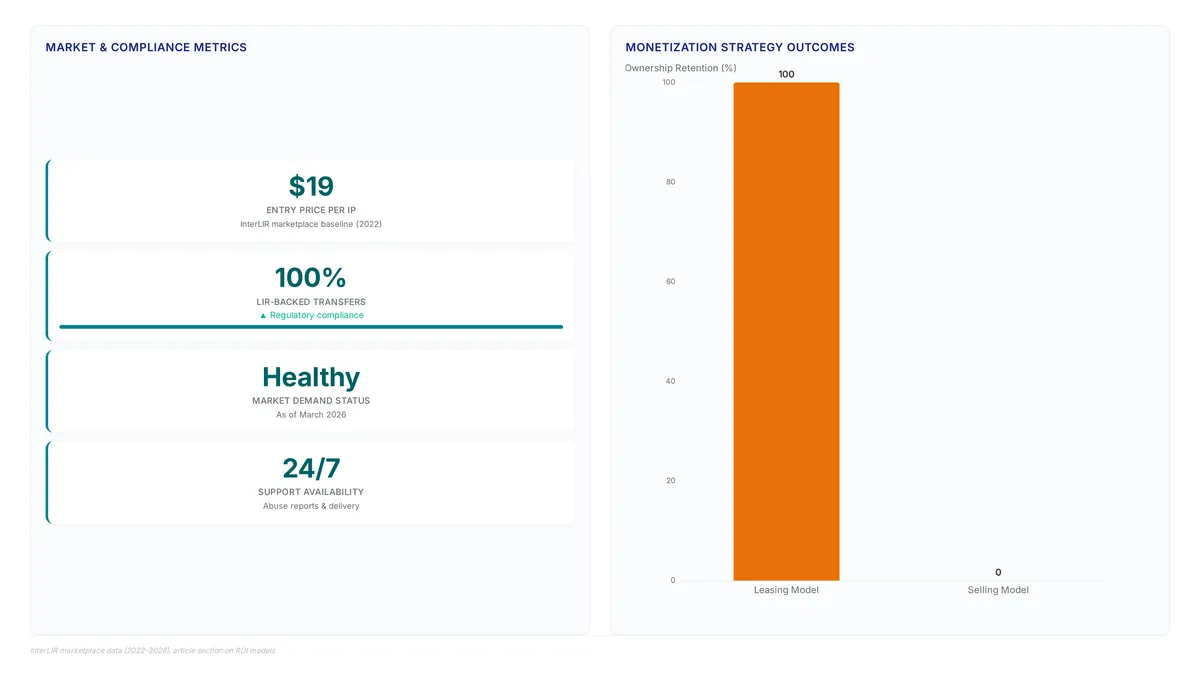
Setting a specific lease term lets owners keep full control while an external team handles the daily operational grind. This approach turns dormant assets into steady income without relinquishing long-term ownership of the IPv4 block. Owners maintain full control over duration, matching revenue directly to budget cycles instead of chasing volatile market prices. Selling operates on a completely different rhythm built for immediate cash. Payouts happen fast once client funds arrive, offering a quick liquidity boost at the cost of permanent asset loss. Network operators face a real choice between keeping property rights for future needs or taking cash now.
Distinct differences separate these two monetization paths:
- Term Flexibility: Lessors pick exact start and end dates for usage rights.
- Payment Velocity: Sellers get paid immediately after funds clear from buyers.
- Asset Retention: Leasing keeps underlying property rights intact for later use.
- Administrative Load: The platform manages abuse reports and technical routing details.
- Revenue Type: Choices range from recurring yield to one-time capital injections.
Scarce available networks push many toward flexible monetization models. Deciding to rent IP space or execute a sale depends entirely on whether sustained yield or a single capital injection fits the current goal. Both paths demand rigorous validation to ensure clean BGP objects and strict regulatory compliance. Benefits like flexible terms, timely payments, and zero abuse reports make the decision clearer for many.
Applying Lease-to-Budget Strategies for University CIOs and IP Owners
Matching IPv4 monetization to fiscal years helps institutions stabilize operations without liquidating valuable assets. Otto, a University CIO, discovered that leasing unused addresses solved specific budgeting needs while avoiding the permanence of a sale. This strategy transforms dormant technical resources into predictable revenue streams that support ongoing educational missions year after year.
- Set flexible lease terms to match academic funding cycles perfectly.
- Receive timely payments through automated marketplace mechanisms.
- Preserve asset value for future appreciation as scarcity grows.
- Avoid the hassle of permanent divestment during budget shortfalls.
Immediate capital from selling contrasts sharply with the sustained income leasing provides. Selling offers a one-time cash boost, yet leasing preserves the asset for future appreciation as scarcity increases. Alex, an IP owner, confirmed this strategy offers a hassle-free way to monetize resources without losing control. Operators asking whether to lease or sell IPv4 must weigh long-term infrastructure goals against short-term cash requirements. The market shift toward leasing reflects a broader trend where businesses treat IP space as a strategic portfolio item rather than a commodity to discard. Facilitation includes handling abuse management and ensuring clean route objects for all participants. Choosing to lease maintains flexibility, allowing owners to adapt to changing network demands quickly.
Checklist for Escrow Support and Clean BGP Route Objects
Secure high-value transactions with escrow support when selling large IPv4 blocks to unknown buyers. This mechanism protects both parties during the RIR transfer window, ensuring funds are held safely until the registry confirms the change. Complex deals often apply this support structure to proceed smoothly across different regions without risk. Verify that your route objects are clean before listing assets for lease or sale. The platform performs full due diligence to check history and prevent future abuse reports that could devalue your portfolio.
- Confirm clean BGP route objects before listing.
- Apply escrow for transactions with unknown counterparties.
- Check history for any past abuse reports or compliance issues.
- Ensure all RIR transfer requirements are met beforehand.
- Engage broker guidance for complex multi-region deals.
Deciding when to use escrow or whether to lease depends on your need for immediate capital versus long-term revenue. Leasing allows owners to set desired terms while maintaining asset ownership. Selling provides a lump sum and includes broker guidance to navigate these choices effectively. Use 24/7 support to validate your network status today.
Executing IPv4 Transactions and Resolving Abuse Complaints
Automated LOA Assignment and Flexible Payment Methods
Securing IPv4 space begins with the delivery of your allocated block after payment confirmation. This process simplifies traditional brokerage by generating your Letter of Authorization automatically upon transaction completion.
- Select your desired prefix size, ranging from a single /24 subnet to larger /16 aggregates available globally.
- Complete your purchase using secure card payments or initiate a direct bank transfer for processing.
- Receive your automated LOA, allowing you to announce routes via BGP.
Operators purchasing through this RIPE NCC–registered marketplace gain access to IP resources while navigating transfer requirements. The platform emphasizes speed, but users must maintain strict abuse management discipline to prevent listing on email blacklists. As the platform conducts full due diligence and analyzes beneficiaries to ensure compliance, the burden of initial configuration accuracy rests on your engineering team to avoid routing leaks. Precise BGP configuration is necessary before enabling announcements to ensure network stability.
Instant Delivery of 1M+ IPv4 Addresses Across Global Regions
Accessing over 1M+ IPv4 addresses begins with a simplified request designed to reduce brokerage delays. Unlike legacy transfers that can take weeks of paperwork, this platform enables operators to secure space through mechanisms designed for modern deployment speeds.
- Select your required prefix size, ranging from a single /24 subnet to larger /16 aggregates available across any GEO/RIR.
- Finalize the transaction using flexible payment methods such as secure cards or direct bank transfers.
- Receive your allocated block within a 24-hour window, allowing for BGP announcement and service activation.
The technical advantage lies in the automated LOA assignment that occurs upon payment confirmation. This automation reduces manual bottlenecks where human error might introduce routing latency or configuration mismatches.
| Feature | Traditional Broker | InterLIR Marketplace |
|---|---|---|
| Delivery Time | Weeks to Months | < 24 Hours |
| LOA Process | Manual Email Exchange | Automated System |
| Stock Visibility | Opaque/Inquired | Real-time Dashboard |
While the platform supports resource acquisition, the responsibility for abuse management integration rests with the deploying engineer.
Preventive Monitoring and Official Channel Abuse Management
Protecting your IP reputation starts with constant surveillance of official abuse channels. InterLIR Global performs this abuse management by constantly monitoring complaints while running preventive selective checks on active networks. This dual approach aims to catch issues before they escalate into blacklisting events that alter service availability.
Operators should verify their setup against these critical maintenance steps:
- Confirm 24/7 support access for incident response.
- Validate systems maintain 99.9%+ uptime.
- The platform conducts full due diligence to support compliance with European law and RIR policies.
About
Vladislava Shadrina serves as a Customer Account Manager at InterLIR Global, where she specializes in guiding clients through the complexities of the IPv4 marketplace. Her daily work involves directly assisting businesses in renting, buying, or leasing IP addresses, giving her unique insight into the urgent demand for network resources. Unlike theoretical analysts, Shadrina navigates real-time transactions daily, ensuring clients secure clean BGP routes and reliable IP reputation within hours. This hands-on experience allows her to explain how InterLIR Global simplifies access to over one million IPv4 addresses through fully automated processes. Her role bridges the gap between technical scarcity and business continuity, making her uniquely qualified to discuss efficient IP acquisition strategies. By managing diverse client needs across global sectors like hosting and cybersecurity, she understands the critical nature of speed and transparency. Consequently, her perspective reflects the practical realities of solving network availability problems in a resource-constrained digital environment.
Conclusion
Scaling network infrastructure exposes the fragility of relying on legacy transfer timelines when competitors activate capacity in under a day. The operational cost here is not merely financial but temporal, as weeks of paperwork directly translate to lost market opportunities while waiting for manual LOA assignments. Operators must shift from viewing IP acquisition as a periodic procurement task to treating it as an immediate utility function. Migrating critical expansion projects to automated marketplace models before your next substantial deployment cycle begins is essential, specifically when uptime guarantees and rapid BGP announcement are non-negotiable for service level agreements. This approach mitigates the risk of supply chain delays inherent in traditional brokerage. Start by auditing your current project pipeline this week to identify any upcoming IPv4 requirements that currently rely on multi-week transfer windows. Replace those projected timelines with a strategy using sub-24-hour delivery slots to secure your routing table presence immediately. The scarcity of available blocks means hesitation locks out access, so using verified stock with instant activation ensures your infrastructure scales without administrative friction. Prioritizing speed in acquisition allows your engineering teams to focus on abuse management and performance tuning rather than chasing documentation.
Frequently Asked Questions
You receive network resources in less than 24 hours after making a request. This speed ensures your business avoids delays while accessing over a large number available addresses for immediate deployment.
The systems operate with 99.9% uptime to ensure constant access for users. This high availability supports critical abuse management and allows companies to lease or buy addresses without service interruption.
Over a large number IPv4 addresses are available for instant delivery according to current data. This large inventory allows operators to find specific block sizes ranging from small /24s to large /16s quickly.
They constantly monitor complaints from official channels to prevent network issues. This proactive approach maintains the 99.9% service reliability needed for businesses that rent or buy IP space securely.
References