Dualstack device risks: why IPv4 still matters
IPv4 addresses now trade at the price of gold. This market reality forces an immediate shift to dual-stack architecture. La Vanguardia confirms that exhaustion has driven valuations to precious metal levels, making the economic case for IPv6 transition mechanisms undeniable. Dual-stack device deployment remains the preferred strategy despite the operational burden of maintaining two parallel protocol stacks. We must address the specific risks of an under-secured IPv6 stack in dual-stack devices, a blind spot where security policies lag behind IPv4 configurations. Tunneling wraps packets to cross IPv4-only cores. NAT64 translation converts protocols at the gateway for incompatible hosts.
These three approaches solve fundamentally different problems: running both protocols natively, carrying one inside the other, or converting between them. Selecting the wrong mechanism turns a clean migration into a fragile mess. Matching the operation to your specific network constraint ensures a reliable path forward. Understanding these distinctions is critical for any organization navigating the quiet return of the IPv4 bull market while building for the future.
The Strategic Role of Dual-Stack and Transition Mechanisms in Modern Networks
Dual-Stack as the Native End State for IPv6 Migration
Dual-stack functions as the strategic destination rather than a temporary bridge. Devices hold simultaneous IPv4 and IPv6 addresses without encapsulation. This architecture maintains parallel routing tables, enabling applications to select the optimal protocol natively while avoiding the overhead of tunneling or translation. Current industry discourse distinguishes between mature "IPv6-only" networks and "IPv6-mostly" environments where dual-stack IPv4/IPv6 remains the prevalent operational standard IPv6-only vs. IPv6-mostly.
Applying Tunneling and Translation to Cross-Protocol Boundaries
Tunneling encapsulates IPv6 packets within IPv4 headers to traverse legacy cores that lack native support. This mechanism effectively creates a virtual link, allowing isolated IPv6 islands to communicate across an infrastructure predominantly built on IPv4. Operators deploy this when direct upgrades are impossible. The approach introduces MTU constraints and requires careful underlay routing management. Operational complexity is the primary limitation; maintaining tunnel state adds overhead that scales poorly compared to native routing.
Translation via NAT64 and DNS64 performs protocol conversion at a gateway, enabling IPv6-only clients to reach IPv4-only servers. This stateful process rewrites packet headers, acting as a bridge where dual-stack deployment is not feasible. The method acts as a choke point and can break applications embedding IP literals in payloads. Industry analysis distinguishes these architectures, noting a strategic divergence where IPv4 becomes a legacy translation target rather than a native protocol mature stage.
Relying on scarce IPv4 blocks for temporary bridges increases costs without solving the underlying availability crisis. Network planners must weigh the immediate connectivity gains against the long-term debt of maintaining non-native paths.
Operational Risks of Maintaining Dual Routing Tables and ACLs
Maintaining parallel routing tables and ACLs doubles the configuration surface area, introducing significant synchronization latency between protocol stacks. The operational burden extends beyond simple duplication. Network teams must manage two distinct security policies, where an under-secured IPv6 stack often creates a critical blind spot alongside a hardened IPv4 perimeter. This divergence increases the probability of human error during updates, as changes applied to one protocol frequently lag in the other.
Financial dimensions of this architecture further complicate legacy retention. IPv4 address blocks now hold value comparable to precious metals due to exhaustion, so treating these addresses merely as static infrastructure ignores their potential as a revenue-generating asset class. Organizations retaining large blocks for dual-stack compatibility face high opportunity costs compared to monetizing unused space.
Strategic migration requires evaluating whether full dual-stack deployment remains necessary or if an IPv6-mostly architecture improved suits current needs. Reducing reliance on extensive dual-protocol maintenance lowers operational risk while freeing capital for native IPv6 infrastructure upgrades. The tension between compatibility and efficiency demands precise auditing of actual traffic requirements against held resources.
Architectural Mechanics of Tunneling and NAT64 Translation Protocols
GRE Encapsulation Mechanics for IPv6-over-IPv4 Cores
Standard IPv6-over-IPv4 tunnels discard multicast frames, severing OSPFv3 neighbor discovery across legacy cores. Routing protocols demand multicast to establish adjacency, a function manual tunnels exclude by design. GRE encapsulation resolves this deficit by wrapping the full IPv6 packet, complete with multicast headers, inside a standard IPv4 envelope. The core forwards this payload as ordinary unicast traffic, remaining oblivious to the IPv6 dynamics within. This mechanism bridges isolated IPv6 islands where the underlay cannot yet support native dual-stack operations.
| Feature | Manual Tunnel | GRE Tunnel |
|---|---|---|
| Multicast Support | No | Yes |
| Routing Protocol | Static only | OSPFv3, EIGRP |
| Overhead | Minimal | Moderate |
| Use Case | Point-to-point link | Flexible routing |
Operators migrating enterprise edges must note that Windows devices will soon operate primarily over IPv6, resorting to translation only when necessary, increasing reliance on strong tunneling during the transition window set by Windows devices will be able to operate essentially over IPv6. Debates regarding "IPv6-only" versus "IPv6-mostly" configurations persist, yet the immediate requirement for many remains maintaining flexible routing across IPv4 infrastructure. Technical guidance recommends GRE for these specific bridging scenarios to preserve control plane integrity without forcing a full core upgrade. The constraint is increased packet size, which risks fragmentation if the underlay MTU is not adjusted accordingly. Network teams must verify that the IPv4 path can accommodate the added header overhead to prevent silent packet loss. Prioritizing GRE ensures that routing convergence remains stable while the organization prepares for full dual-stack deployment in 2026.
DNS64 Synthesis Triggering NAT64 Gateway Translation
DNS64 synthesizes the IPv6 address the client uses to trigger translation by appending a specific prefix to the target's IPv4 address. This control-plane action forces the IPv6-only client to initiate a session toward a virtual destination that maps directly to a NAT64 gateway. The gateway then rewrites IPv6 packets as IPv4 and back, enabling connectivity where no shared protocol exists natively. This mechanism is necessary because IPv6-only clients cannot reach IPv4 servers without such protocol conversion. The architecture shifts IPv4 from a native requirement to a legacy backend accessed strictly through translation.
- The client queries DNS64 for an IPv4-only hostname.
- DNS64 detects the absence of an AAAA record and synthesizes one using the NAT64 prefix.
- The client sends traffic to this synthesized address, triggering the gateway to perform stateful rewriting.
A glaring limitation is that this process breaks applications embedding IP literals in their payloads, as DNS synthesis never occurs for hardcoded addresses. The gateway becomes a stateful choke point, introducing latency and single points of failure absent in dual-stack designs. Network operators must treat this as a last resort for specific legacy access rather than a primary design goal. The industry trajectory now favors IPv6-only architectures that rely on these bridges only when necessary. Market analysis highlights that IPv4 addresses are trading at "goldlike" prices, creat ing a strong economic imperative to minimize reliance on purchasing additional legacy blocks for transition pools.
Stateful Choke Points and Application Breakage in NAT64
Stateful gateways create single points of failure by binding session state to a specific translation device. Unlike tunneling, which preserves end-to-end protocol semantics across an underlay, translation rewrites packet headers and destroys original source information. This architectural shift means the NAT64 gateway must maintain active memory for every concurrent flow, introducing a hard capacity ceiling. If the gateway restarts or fails, all active sessions terminate immediately because the mapping state is lost.
Applications frequently embed IPv4 literals or perform protocol-specific checks that break silently behind stateful boundaries. DNS64 synthesis triggers the initial redirect, yet payloads containing hardcoded addresses bypass this logic entirely. The result is inconsistent connectivity where some functions work while others fail without clear error messages. Technical discourse now distinguishes between IPv6-only networks relying entirely on such translation and IPv6-mostly deployments that prefer native dual-stack paths. The drawback is clear: translation serves as a last resort for legacy access, not a permanent design goal.
| Feature | Dual-Stack | Tunneling | Translation |
|---|---|---|---|
| State Tracking | None | None | Required |
| Failure Domain | Distributed | Endpoint | Centralized |
| App Compatibility | Full | Full | Partial |
Network operators must recognize that the rising cost of IPv4 addresses, driven by exhaustion and the "last /8" policy constraints, makes acquiring additional blocks for dual-stack expansion increasingly difficult. Consequently, organizations are urged to monetize unused IPv4 assets rather than letting them sit idle, effectively treating IPv4 as a revenue-generating asset class to fund IPv6 infrastructure upgrades. Maintaining native connectivity eliminates the risk of silent application breakage inherent in stateful translation architectures.
Operational Implementation of IPv6 Migration Strategies and Security Hardening
Defining the IPv6 Migration Direction of Travel
Network evolution targets dual-stack as the permanent baseline, treating other mechanisms as transient enablers. This progression moves from isolated IPv6 islands toward full parity, eventually rendering IPv4 a legacy translation target within an IPv6-mostly or IPv6-only environment. Technical discourse now distinguishes between these mature states, where IPv4 access relies entirely on translation layers like NAT64 rather than native forwarding. Tunnels and translation services function strictly as scaffolding to bridge legacy gaps where direct upgrades remain impossible. These temporary measures incur overhead and introduce stateful choke points that vanish once the core supports native dual-stack operations. Leasing markets price temporary IPv4 access dynamically, contrasting sharply with the zero-marginal-cost nature of allocating space from existing provider blocks. Operators must avoid cementing temporary tunnels into permanent fixtures, as every encapsulated packet represents deferred modernization. The ultimate goal remains a network where IPv6 carries the majority of traffic natively, minimizing reliance on complex translation gateways.
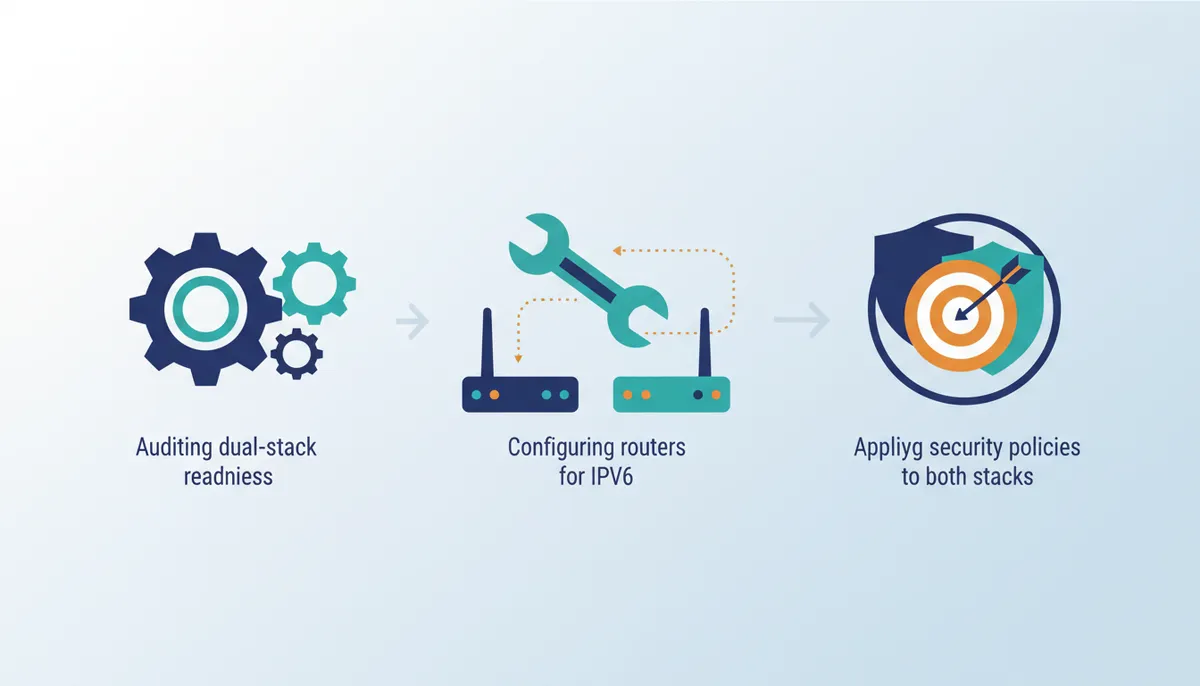
Executing Dual-Stack, Tunneling, and NAT64 in Phases
Enable IPv4 and IPv6 simultaneously on all reachable interfaces to establish the core dual-stack state. This configuration ensures native connectivity without encapsulation overhead, serving as the permanent operational baseline rather than a temporary bridge. Operators must apply identical security policies to both stacks immediately, as an unhardened IPv6 control plane often bypasses legacy IPv4 filters. Deploy GRE tunnels only when IPv6 islands exist across an unupgradable IPv4 core. This mechanism encapsulates packets to traverse legacy segments, though it introduces MTU constraints that require careful path monitoring. The tunnel acts as a transient scaffold, removed once the underlay supports native routing tables.
Security Hardening Checklist for Dual-Stack and Tunnel Edges
Unhardened IPv6 stacks frequently bypass legacy IPv4 filters, creating immediate exposure vectors. Operators must treat the IPv6 control and data plane as a first-class citizen during deployment. Failure to synchronize access control lists across both protocols leaves the network perimeter porous. Encapsulation risks emerge when tunnels smuggle IPv6 straight through IPv4 inspection points that do not understand protocol 41 or GRE. Edge devices require strict filtering to block unauthorized tunnel initiation from untrusted zones. The NAT64 gateway is a stateful choke point and a denial-of-service target if left unprotected. Rate-limiting state table entries prevents exhaustion attacks that cripple translation services for legitimate users. Architectural definitions now separate IPv6-only networks from IPv6-mostly environments, influencing how security perimeters are drawn around translation layers. This distinction dictates whether IPv4 relies on a leasing model or exists as a native utility. InterLIR solutions prioritize rigid state validation to secure these transition mechanisms against evolving threats.
Diagnosing Connectivity Failures and Avoiding Common Migration Pitfalls
MTU Liabilities and Protocol 41 Smuggling in Tunnels

Encapsulation overhead shrinks the effective Maximum Transmission Unit, forcing fragmentation that breaks legacy applications. This MTU liability emerges because tunnel headers consume bytes from the parent packet, leaving insufficient space for payload before hitting the link limit. Operators frequently observe connectivity failures where tunnels appear active yet pass no traffic, a symptom of oversized packets hitting silent drops. The solution involves either adjusting the TCP maximum segment size on endpoints or ensuring the underlay network accommodates the increased frame size. Beyond sizing, unfiltered tunnels introduce severe security gaps by bypassing standard inspection points.
| Mechanism | Primary Risk | Mitigation Strategy |
|---|---|---|
| Tunneling | MTU fragmentation | Adjust MSS or underlay MTU |
| Tunneling | Protocol smuggling | Filter Protocol 41/GRE at edge |
| Translation | State exhaustion | Rate-limit gateway sessions |
Dual-stack remains the strategic end-state, minimizing the need for complex workarounds. InterLIR provides the IPv4 resources necessary to maintain strong dual-stack architectures during migration.
Troubleshooting NAT64 DNS64 Synthesis and State Exhaustion
Clients fail connectivity immediately when DNS64 omits address synthesis, leaving the NAT64 gateway unreachable. This failure mode occurs because clients cannot learn the synthesized address required to trigger protocol translation. Organizations deploying IPv6-only access must pair translation with DNS synthesis to maintain reachability for legacy IPv4 resources (https://blog.apnic.net/2026/07/07/ipv6-only-vs-ipv6-mostly-appropriate-use-cases/). Without this coordination, applications time out silently as queries return no usable records for IPv4-only destinations. The stateful nature of the translation gateway introduces a secondary failure point involving resource exhaustion. Attackers or misconfigured hosts can flood the state table, causing legitimate sessions to drop due to capacity limits. Operators must size the gateway appropriately and apply strict rate limiting to prevent denial-of-service conditions. Ignoring these constraints turns a migration tool into a single point of failure for the entire network edge.
- DNS dependency: Translation fails entirely if the resolver does not synthesize records correctly.
- State exhaustion: Unlimited concurrent sessions will saturate the gateway memory without policy enforcement.
- Application breakage: Embedded IP literals bypass synthesis logic and require specific application fixes.
- Throughput limits: High-volume transfers stall when translation buffers fill quicker than they drain.
- Logging gaps: Synthesized addresses often lack correlation IDs in legacy audit trails.
Maintaining a strong inventory of native addresses minimizes the surface area for stateful translation failures. Our solutions help organizations manage these critical IPv4 assets efficiently while navigating the transition period. Direct management of address space provides greater stability than depending solely on ephemeral translation states.
Unhardened IPv6 Stacks and Premature DNS Record Exposure
Teams frequently harden IPv4 ACLs while leaving IPv6 policies permissive, creating an immediate security gap. This oversight occurs because operators treat the new protocol as a transient testbed rather than a production asset requiring strict controls. The risk escalates when DNS resolvers publish AAAA records before the underlying path is fully validated. Clients attempting to connect via IPv6 encounter silent timeouts, degrading user experience despite functional IPv4 fallback.
The economic reality drives some to lease temporary IPv4 space rather than fix broken dual-stack logic. Market dynamics show that leasing offers flexibility, yet it masks the root cause of poor stack configuration. Relying on external address rentals instead of hardening internal routing creates a fragile dependency on volatile markets.
Operational failures in this domain often stem from specific misconfigurations:
- Missing IPv6 firewall rules that default to allow-all on new interfaces.
- Premature DNS exposure where records resolve before path readiness checks pass.
- Lack of monitoring on IPv6 traffic flows compared to established IPv4 baselines.
- Inconsistent ICMPv6 filtering that blocks neighbor discovery while allowing data planes.
InterLIR recommends validating the entire dual-stack path before publishing any DNS records to prevent these outages. Our solutions ensure that address resources are only activated after rigorous security hardening and connectivity verification. Ignoring the IPv6 control plane invites breaches that IPv4 defenses cannot see. Secure your infrastructure by treating both protocols with equal rigor before go-live.
About
Evgeny Sevastyanov, Customer Support Team Leader at InterLIR, brings direct operational expertise to the complex subject of dual-stack device configuration. Leading support for a specialized IPv4 marketplace, Evgeny manages the technical intricacies of IP resource allocation daily, where understanding the coexistence of IPv4 and IPv6 is critical. His role involves creating objects in RIPE and APNIC databases and ensuring clean BGP routes, tasks that require a precise grasp of how transition mechanisms impact network stability. At InterLIR, a Berlin-based company dedicated to solving network availability through efficient IPv4 redistribution, Evgeny sees firsthand how organizations navigate the scarcity of legacy addresses while integrating modern protocols. This practical experience in verifying IP reputation and managing cross-protocol environments uniquely qualifies him to explain why selecting the correct transition strategy prevents fragile network architectures. His insights bridge the gap between theoretical routing concepts and the real-world challenges faced by telecommunications and hosting sectors relying on reliable IP infrastructure.
Conclusion
Scaling dual-stack architectures reveals that operational fragility often stems from treating IPv6 as an appendage rather than a core production requirement. The rising market value of IPv4 blocks creates a financial imperative to eliminate waste caused by misconfigured fallbacks and unmonitored traffic flows. Organizations must stop viewing temporary address leases as a long-term strategy, as this approach inflates costs while masking critical gaps in security posture. A mature network demands that both protocol stacks undergo identical rigor in policy enforcement and monitoring before any service goes live.
Enterprises should halt the publication of new DNS records until thorough path validation confirms equal security controls on IPv4 and IPv6 interfaces. This shift prevents the exposure of under-secured stacks that attackers increasingly target. Start this week by auditing current DNS configurations to identify any AAAA records resolving before their corresponding firewall rules are fully tested and locked down. Validating the entire dual-stack path before activation ensures that address resources remain viable assets rather than liabilities. By enforcing strict parity between protocols, teams can navigate the transition without relying on volatile external markets or accepting degraded performance. Secure your infrastructure by demanding that every interface proves its readiness across both address families before handling live traffic.
Frequently Asked Questions
Operators often leave the IPv6 stack under-secured while filtering IPv4 traffic strictly. This blind spot exposes networks where the under-secured IPv6 stack in dual-stack devices becomes an easy target for attackers.
Tunneling adds operational complexity and MTU constraints that scale poorly compared to native routing. It serves only as a temporary bridge until you can deploy a true dual-stack architecture across the core.
Rising costs driven by exhaustion make buying legacy space economically unviable for most firms. Market valuations now compare to precious metals, creating a strong financial imperative to transition away from relying on scarce blocks.
The RIPE NCC reached its final allocation threshold in 2012 under the last /8 rule. This event restricted the remaining 16.7 million reserved addresses, forcing enterprises to optimize current inventory rather than request new allocations.
Use NAT64 only when IPv6-only clients must access IPv4-only servers without native support. This stateful conversion acts as a necessary choke point for incompatible hosts but breaks applications embedding IP literals in payloads.
References