IPv4 Prices Dropped: What $19.56 Means for You
IPv4.Global reports /16 block prices fell below $20 in June 2025. Buying addresses now means navigating a strict secondary market; free allocations are history. With regional internet registry pools empty, organizations must execute compliant transfers within the ARIN region to secure network infrastructure. This guide details acquiring IPv4 addresses under the regulatory frameworks governing the United States, Canada, and parts of the Caribbean.
You need to understand how Regional Internet Registries enable this market and why AFRINIC remains incompatible with ARIN transfers as of June 2026. We examine specific NRPM sections dictating eligibility, including the /24 minimum transfer size and the requirement to justify need for a 24-month supply. Recent data from IPv4Center recorded 677,632 addresses traded in April 2026 at a weighted average of $19.56 per IP.
Skipping due diligence invites routing failures and email deliverability nightmares. Carrier-grade NAT and dual-stack operations keep legacy IPv4 demand high despite IPv6 adoption. Ignoring ARIN documentation or utilization thresholds stalls deployments and wastes capital on unusable assets.
The Role of Regional Internet Registries in the Secondary IPv4 Market
How RIR Exhaustion Created the IPv4 Secondary Market
The free pool is gone. Regional Internet Registries distributed their final general allocations years ago, leaving zero supply for new requests. This exhaustion forced the creation of a secondary market where organizations acquire space strictly through transfers. The global pool of freely available addresses no longer exists, making secondary discovery the sole path for blocks larger than minimal exceptions. Area-based Internet Registries hold no available supply, so businesses rely entirely on moving existing resources between parties.
Acquisition timelines now combine market search duration with regulatory approval windows. ARIN governs this process for the United States, Canada, and parts of the Caribbean and North Atlantic. Its policies dictate valid transfer sizes and eligibility criteria. Direct allocation involves only a nominal fee, yet secondary purchases require budgeting for market rates and processing costs. Operators cannot bypass the transfer mechanism to access unallocated space because none remains. InterLIR assists networks in navigating these regulated transfers to secure necessary IPv4 resources efficiently. A transaction fails validation without adherence to these regional policies, wasting administrative effort. Sustainable network growth depends on mastering this redistribution framework rather than waiting for new inventory that will not appear.
Executing Inter-RIR and Intra-RIR IPv4 Transfers
Validate registry compatibility before moving any IPv4 resources block between organizations. Operators distinguish between intra-RIR moves within a single region and inter-RIR transfers crossing jurisdictional boundaries. ARIN recognizes APNIC, RIPE NCC, and LACNIC as compatible partners for cross-regional transactions, while AFRINIC remains incompatible as of June 2026. This distinction dictates the approval workflow and documentation required for valid title transfer.
Every transaction mandates proof of operational necessity for a 24month supply window. The minimum transfer size is a /24. Pricing dynamics shift constantly; pricing for /16 blocks dropped below $20 per address in June 2025. More recent analysis by IPv4Center in April 2026 recorded a weighted average of $19.56 across 110 transactions. Policy divergence between regions can stall deals if compatibility is assumed incorrectly. ARIN covers the United States, Canada, and parts of the Caribbean and North Atlantic. Sourcing addresses inherently includes time for secondary market discovery rather than direct application. Rushing a deal without verifying registry approval risks nullifying the entire acquisition. InterLIR advises verifying all regional constraints before signing purchase agreements to avoid costly delays.
IPv4 Block Pricing Dynamics: Large /16 vs Small Blocks
Economies of scale dictate that smaller blocks carry a higher unit cost than large contiguous allocations. Volume notably reduces the capital expenditure required per usable IP. Direct allocation from registries offers a nominal fee alternative, yet strict scarcity limits this to minimal sizes, forcing reliance on the secondary market for substantial growth.
Preserving cash flow via leasing contrasts with building equity through purchasing. Leasing avoids large upfront sums but yields no residual asset value upon contract termination. Organizations with temporary spikes in demand or uncertain IPv6 migration timelines may find leasing more fiscally prudent. The decision rests on balancing immediate liquidity constraints against the strategic advantage of owning finite digital real estate.
Executing a Compliant IPv4 Transfer Within the ARIN Region
ARIN Account Setup and Pre-Approval Mechanics
Establishing a verified ARIN Online account creates the mandatory digital identity required before any address transaction proceeds. This core step involves registering an organization identifier and defining specific points of contact within the registry database. Operators can request pre-approval of their documented need before identifying a specific seller, a strategy that accelerates the final transfer window. Recipients within the region must demonstrate a justified requirement for up to a 24-month supply of IPv4 addresses to satisfy policy constraints. The administrative process validates the organization's status, preventing delays often caused by incomplete documentation during active negotiations.
Securing pre-clearance helps mitigate the risk of failed deals after due diligence costs are incurred. While some entities attempt to source blocks first, establishing need early simplifies the subsequent agreement execution. The operational distinction lies in the timing of the justification review:
| Timing Approach | Risk Profile | Processing Speed |
|---|---|---|
| Pre-Approval First | Low | High |
| Source Then Verify | High | Variable |
Securing approval early isolates the regulatory hurdle from the commercial negotiation phase. This separation ensures that the $500 processing fee is committed only when the transfer request is ready for evaluation.
Executing Compliant Sourcing and Escrow Workflows
Selecting a verified sourcing path prevents transaction failure before the registry step begins. The acquisition process follows five specific steps starting with setting up an ARIN presence. Operators locate sellers through ARIN's list of qualified facilitators, public exchanges, or direct private channels. Buyers should apply escrow services so funds release only upon successful transfer completion. This mechanism mitigates the risk of non-delivery after payment. The acquisition process involves time and potential coordination efforts to verify the seller's status before a deal proceeds.
- Identify a seller via qualified facilitators or marketplaces.
- Engage an escrow agent to hold purchase funds.
- Submit the signed Registration Services Agreement to the registry.
- Release funds once the registry confirms the resource update.
The interplay between sourcing speed and security creates a tension where rushing due diligence often leads to purchasing tainted address space. Unlike simple commodity trading, IP transfers carry historical routing baggage that escrow alone cannot fix. A compliant workflow ensures that financial settlement aligns precisely with registry validation.
| Feature | Private Channel | Qualified Facilitator |
|---|---|---|
| Vetting | Buyer responsibility | Pre-screened by facilitator |
| Speed | Variable | Accelerated |
| Cost | Lower fees | Brokerage commission |
Coordinating pre-approval, escrow, and paperwork through experienced advisory firms can help navigate these variables efficiently. This structured approach secures the asset while satisfying strict regulatory requirements for network growth.
Due Diligence Checklist and Fee Breakdown
Validating registration history prevents acquiring tainted assets that alter routing stability. A clean routing history ensures immediate usability without legacy filtering penalties. Smaller blocks generally command higher per-address costs than large allocations, impacting total budget planning.
| Cost Component | Description | Payment Timing |
|---|---|---|
| Asset Price | Market rate per IP address | Via Escrow |
| Registry Fee | Non-refundable processing charge | Before evaluation |
| Service Fees | Broker or legal coordination | Contract dependent |
The full acquisition cycle often spans several weeks, requiring patience during the escrow phase. It is necessary to confirm that space is not from a reserved pool, as such addresses remain ineligible for transfer. Verifying seller authority helps ensure a smooth transaction. Checking reputation reports is necessary to avoid inheriting blacklisted ranges that degrade email deliverability. The registry step takes two business days after ARIN receives the signed RSA and fees. The trade-off between speed and safety favors thorough checks, as cleaning a contaminated block costs far more than the initial purchase.
Securing Network Integrity Through Due Diligence and Post-Transfer Configuration
ROA and RPKI: Defining Route Origin Validation
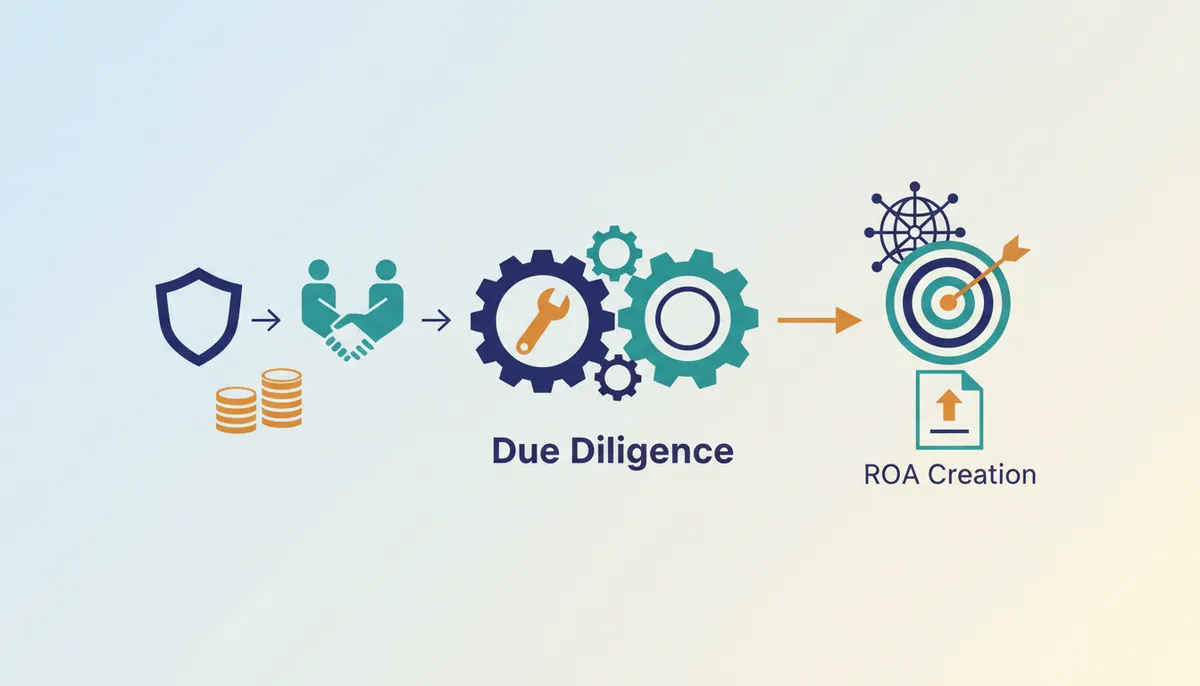
Route Origin Authorizations (ROA) function as the cryptographic permits that define which Autonomous System numbers can legitimately announce specific IP prefixes. These digital certificates prevent route hijacking by allowing peer networks to validate the origin AS against a trusted database. The underlying Resource Public Key Infrastructure (RPKI) provides the necessary framework for this verification, replacing informal trust with mathematical proof of ownership. Operators implementing hosted RPKI gain an immediate advantage by using registry-managed keys rather than building local infrastructure. Creating or updating ROAs ensures other networks can validate the legitimate origin for routes before accepting traffic.
This process is distinct from the administrative transfer process required to change ownership records at the registry level. While RPKI prevents unauthorized announcements, it does not sanitize historical reputation data associated with the address block. A clean transfer of registration rights does not automatically erase prior abuse listings or geolocation errors. Network teams must therefore separate the cryptographic validation of routing rights from the operational hygiene of the address space itself.
Immediate replacement of stale IRR objects prevents route rejection by peers enforcing strict origin validation policies. Operators must delete legacy route entries and publish new assertions matching the transferred prefix and originating AS number. This mechanical update ensures the global routing table reflects current ownership rather than historical data. However, propagating these changes across all global repositories requires time, during which some traffic may follow stale paths.
Coordination of reverse DNS pointers must occur simultaneously to maintain service continuity for email and logging systems.
- Submit geolocation correction requests to MaxMind, which aims to apply approved updates within about a week.
- Monitor abuse queues and blocklist status for the first 30 to 60 days to detect residual reputation issues.
- Validate that new ROA signatures align with the updated registry records to prevent validation failures.
A critical tension exists between rapid deployment and the patience required for global database convergence. Rushing traffic engineering before databases synchronize risks packet loss for users relying on updated geofeeds. This caution addresses the lag between registry approval and worldwide enforcement of new routing policies.
Critical Red Flags: Escrow Refusals and Reserved-Pool Risks
Terminate transactions immediately when sellers refuse escrow protection. This exposes buyers to total capital loss without resource delivery.
- Sellers rejecting third-party holding accounts often lack clear title to the assets they claim to own.
- Attempts to sell reserved-pool space violate registry policy and result in automatic transfer rejection.
- Promises of instant inter-RIR transfers involving AFRINIC and ARIN ignore current incompatibility rules.
Operators must verify that address blocks do not originate from restricted pools set in NRPM sections 4.4 and 4.10. The risk extends beyond financial loss; acquiring tainted space triggers Spamhaus SBL listings that cripple email deliverability for months. Cleaning a blocklist entry requires the current operator to prove remediation, a process impossible if the seller disappears after payment.
| Risk Indicator | Consequence | Action |
|---|---|---|
| No Escrow | Fund Loss | Halt Deal |
| Reserved Space | Policy Rejection | Verify Eligibility |
| Invalid Region | Transfer Fail | Check Compatibility |
The hidden trap involves reputation damage that persists long after the financial dispute resolves. Even if funds are recovered, the IP reputation stains the acquiring organization's network, causing peers to filter traffic selectively. InterLIR advises treating any offer bypassing standard due diligence as fraudulent by default. Network stability depends on acquiring clean assets through verified channels rather than chasing discounted but compromised inventory.
Strategic Financial Models for IPv4 Asset Acquisition
Defining IPv4 Asset Control Versus Monthly Lease Obligations

Permanent ownership transfers full registration rights, while leasing leaves title with the lessor. This distinction determines whether an organization builds equity or incurs recurring operational expenses. Lease options suit short-term projects by covering temporary needs without long-term commitment. Buying serves long-term strategies where treating address space as a liquid asset enables capital appreciation. Upfront capital eliminates exposure to monthly rate fluctuations and provides full authority over routing hygiene. Strategic acquisition ensures the network operator retains the option to monetize unused sub-blocks later, turning a connectivity requirement into a balance sheet advantage. Fixed unit costs create financial tension between acquiring large blocks versus small subnets.
Regulatory approval delays represent a hidden cost in any IPv4 address transfer. The registry step takes two business days after ARIN receives the signed RSA and fees, yet the full process often takes several weeks. This latency creates an operational gap where purchased addresses generate no revenue yet incur holding costs. Organizations should treat address space as a real asset and document abuse-prevention controls early to protect reputation value. Firms actively selling unused sub-blocks monetize their holdings, driven by the realization that these addresses hold tangible financial value. Immediate availability conflicts with long-term unit economics when buying small blocks. Large block buyers gain efficiency but face stricter justification hurdles regarding 80% utilization of prior allocations. Strategic planning must balance immediate technical needs against the appreciating nature of this finite resource.
Buy vs Lease IPv4: Decision Framework Based on Duration and Control
Projected duration of need and readiness for IPv6 acceleration dictate the choice between buying and leasing IPv4. Businesses must weigh the duration of need, desired control, and team readiness when choosing between buying, leasing, or accelerating IPv6. Organizations treating address space as a liquid asset often prefer purchasing to build equity rather than incurring recurring operational expenses.
| Dimension | Asset Purchase | Monthly Lease |
|---|---|---|
| Capital Impact | Upfront CAPEX expenditure | Recurring OPEX liability |
| Asset Value | Retains residual market value | Zero equity accumulation |
| Control Level | Full routing and policy authority | Restricted by lessor terms |
| Duration Fit | Ideal for multi-year horizons | Suited for short-term gaps |
Purchasing requires immediate capital deployment that leasing avoids, creating a cash-flow tension for expanding networks. Buying locks capital into IPv4 while Accelerate IPv6 initiatives might reduce long-term demand. Current guidance suggests lease rates commonly range around $0.40 to $0.50 per IP per month for ARIN-registered blocks. The decision ultimately balances immediate liquidity against the strategic advantage of owning critical infrastructure outright. Utilization Risk Requires 50% use within 24 months Easier to fully deploy quickly. The hidden cost in any IPv4 address transfer involves the temporal delay of regulatory approval. Th gests lease rates commonly range around $0.40 to $0.50 per IP per month for ARINregis se rates commonly range around $0.40 to $0.50 per IP per month for ARINregistered blocks. Th
About
Nikita Sinitsyn serves as a Customer Service Specialist at InterLIR, where he manages critical RIPE and ARIN database operations daily. With eight years of telecommunications experience, Nikita is uniquely qualified to guide businesses through the complex IPv4 transfer market. His routine work involves verifying IP reputation, managing KYC procedures, and troubleshooting routing issues, giving him direct insight into the due diligence required for safe address acquisition. At InterLIR, a Berlin-based marketplace specializing in IPv4 redistribution, Nikita helps clients navigate the scarcity of free allocations by facilitating secure transactions. This practical, hands-on exposure to the technical and administrative hurdles of buying IPv4 space allows him to offer actionable advice on protecting email deliverability and ensuring clean BGP routes. His expertise ensures that the guidance provided reflects real-world challenges faced by organizations seeking reliable network resources in 2026.
Conclusion
Scaling network infrastructure exposes the operational friction of treating IPv4 address assets as temporary fixes rather than permanent holdings. While leasing offers immediate liquidity, it creates a recurring liability that accumulates no equity and restricts routing policy authority. The real break point occurs when organizations face the strict 24-month utilization window mandated by regional registries. Companies must stop viewing address acquisition as a simple procurement task and start treating it as a capacity planning discipline that requires rigorous forecasting.
Organizations should commit to purchasing address blocks only when they can demonstrably justify a 24-month supply need through documented growth projections. If your team cannot guarantee half deployment within two years, leasing remains the pragmatic choice to avoid regulatory penalties. This approach balances the desire for asset ownership against the reality of operational readiness. Do not lock capital into static inventory if your engineering pipeline cannot absorb it quickly enough to satisfy policy constraints.
Start by auditing your current block utilization rates against your projected hiring and device onboarding schedules for the next quarter. This data will reveal whether you truly need to buy more space or if optimizing existing assignments solves the immediate shortage.
Frequently Asked Questions
The minimum transferable unit is strictly a /24 prefix to prevent routing table fragmentation. This rule ensures that organizations cannot acquire tiny, inefficient fragments of the global address space.
You must demonstrate a justified need for up to a 24-month supply of addresses. Additionally, policies often require showing 50% use of current holdings within that same two-year window.
Regulators enforce stricter justification hurdles if you have not achieved 80% utilization of prior allocations. This high bar ensures existing resources are fully deployed before granting access to more scarce inventory.
AFRINIC remains incompatible with ARIN transfers as of June 2026, blocking cross-regional deals. Attempting such a transaction will fail validation because the registries do not recognize each other for this purpose.
Poor due diligence can lead to acquiring blocks with bad reputations, causing email delivery failures. Operators should monitor blocklist status for the first 30 to 60 days post-transfer.
References