Route origin rules: enforce crypto route checks
RFC 6483 defines 3 validation states to filter bad routes. InterLIR ensures clean BGP objects for secure IPv4 infrastructure.

Comcast integrated RPKI in early 2022, ending fragile manual trust. Learn how cryptographic validation secures route origins against hijacks.
Recent studies confirm ROA objects are rapidly increasing as operators prioritize BGP security to stop hijacks before traffic drops.
NIST SP 800-189 Rev. 1 cuts through the noise: prefix hijacking and route leaks are the primary engines of denial of service.
Stop duplicate ROAs that break validation. Learn how cryptographically signed objects bind a prefix to one Origin AS for secure routing.
Stop manual crypto renewals by using the RIPE NCC web interface to secure your BGP route origins without local software deployment.
A significant majority of global IP prefixes now possess cryptographic attestation, proving that ROA adoption has reached a critical majority.
Over 400 registrants attended ThaiNOG 8, proving local engagement drives routing security adoption better than distant mandates for networks.
RPKI uses cryptographic certificates to bind IP prefixes, stopping hijacks before they spread across global networks in 2026.
Rising ROA adoption still causes outages. Learn how 90-day autorenewal windows eliminate validity gaps and secure BGP routing for operators.
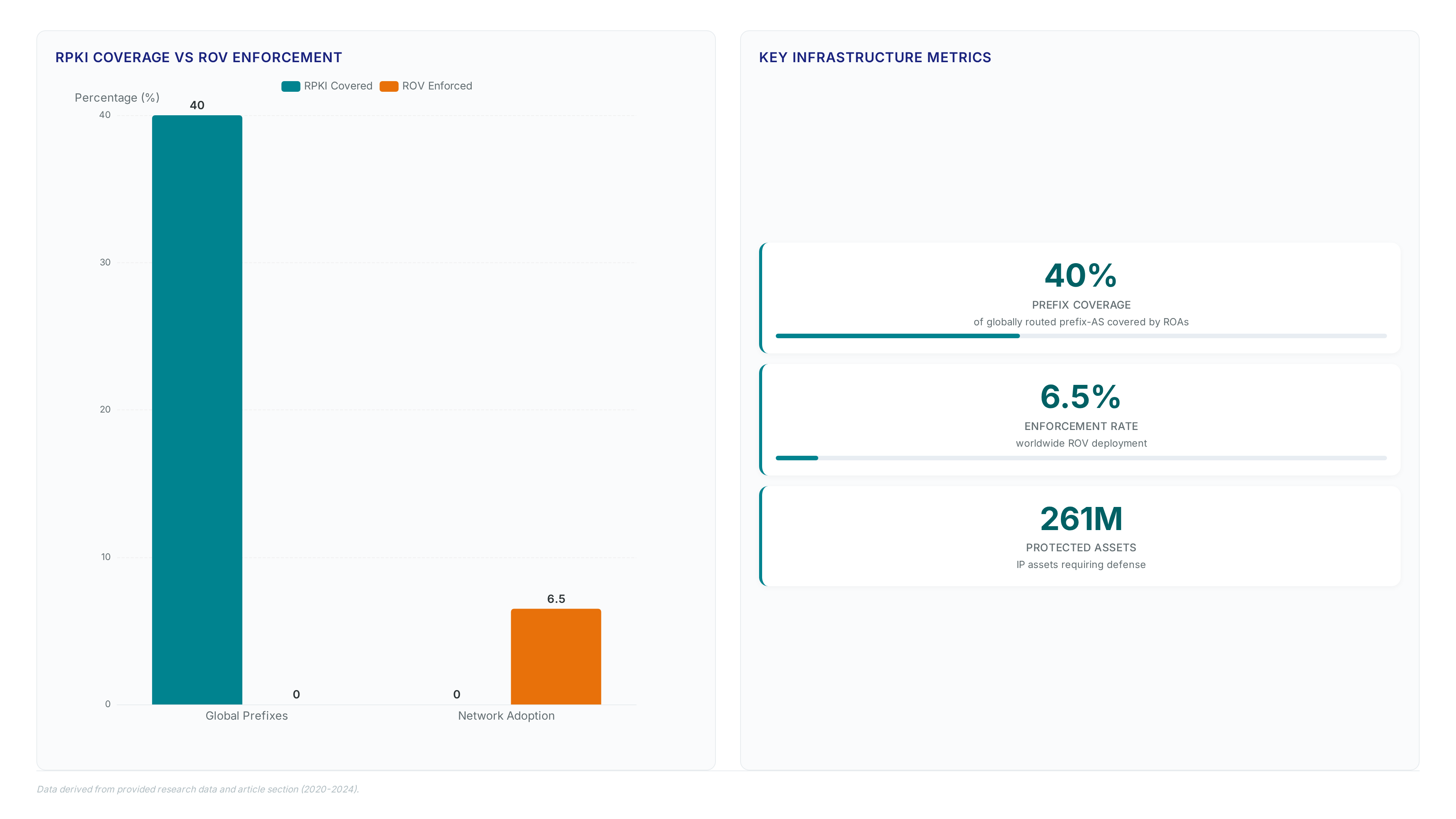
Only 6.5% of users have Route Origin Validation. InterLIR helps secure your IPv4 assets against hijacks by optimizing prefix ownership and routing policies.
With only 6.5% of users protected, learn to validate origins and block invalid routes before a hijack compromises your clean IPv4 reputation.
Resource Public Key Infrastructure (RPKI) stops BGP routing from guessing. It lets IP block holders cryptographically authorize specific AS numbers to...
Learn how RFC6480 defines the architecture to secure BGP routing. InterLIR provides verified IPv4 blocks that integrate smoothly into these validated...
Stop route leaks by validating origin against five regional registries. Secure your specific IP prefixes with cryptographic proof today.
Misconfigured ROA maxLength values create severe vulnerabilities when specific prefixes lack BGP announcements, inviting subprefix hijacks.
With only 34% of networks using ROAs, max length errors cause invalid routes. InterLIR audits your IP resources to prevent these costly BGP outages.
Prevent forged origins by aligning ROA maxLength values with BGP announcements, replacing trust-based filtering with cryptographic proofs today.
Over 375,000 Route Origin Authorizations exist, yet zero valid router certificates were published by June 2026, leaving BGP security incomplete.
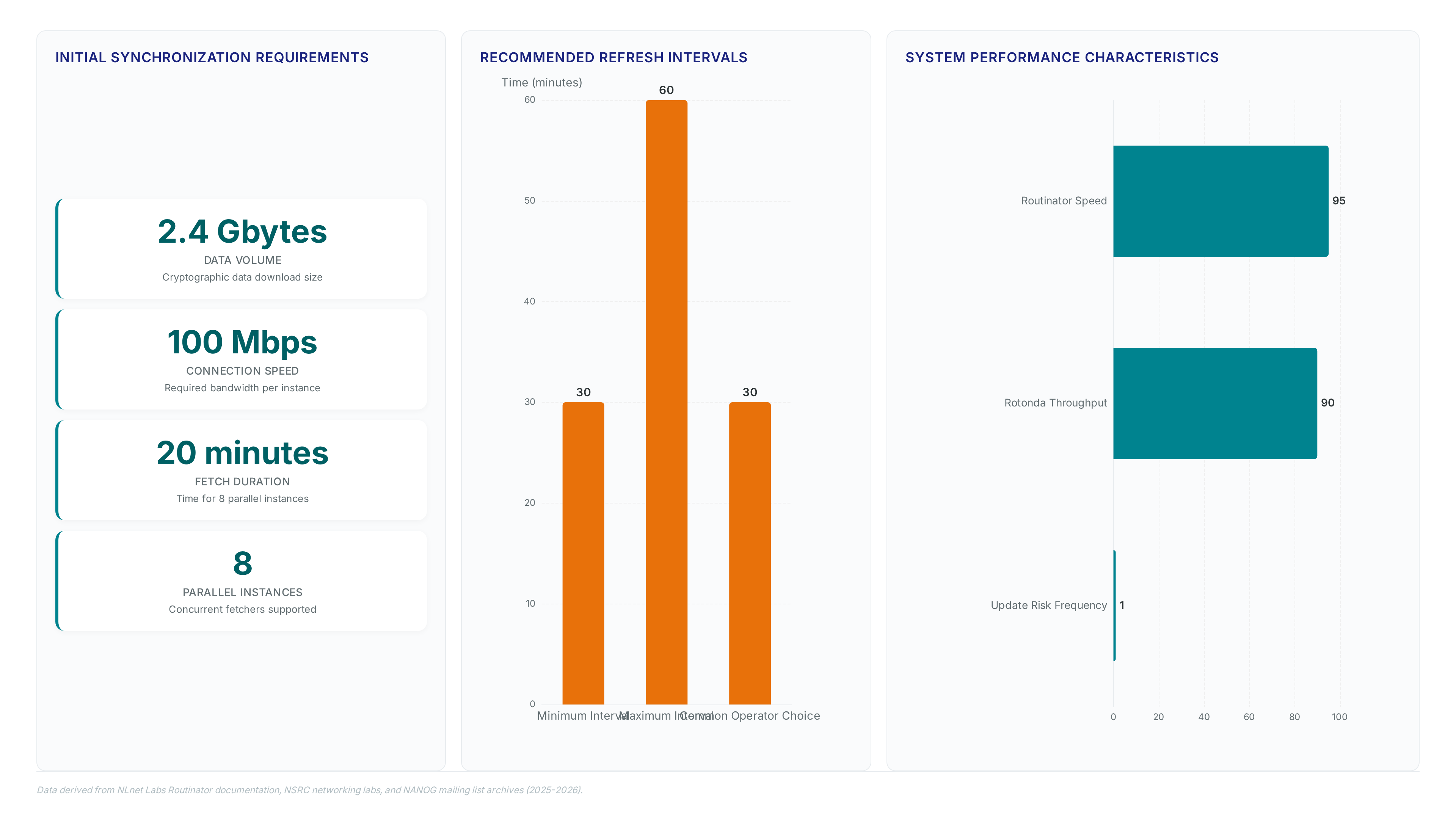
RPKI syncs every 10 minutes to validate BGP origins against signed records, yet single unsecured paths remain vulnerable to hijacking risks.
Over 60% of IPv4 routes now use RPKI. Learn to configure Junos OS routers to validate prefixes and block accidental leaks today.
X.509 certificates anchor RFC 6480 to prove IP ownership. Learn how strict validation stops origin spoofing without causing outages.
With 60% of routes covered, the remaining 40% face accidental misorigination risks. Learn how strict ROA policies enforce cryptographic validity.
Stop blind acceptance of ASNs. Learn to enforce RFC 6480 standards and filter invalid routes using cryptographic signed objects in minutes.
Over 68 million BGP announcements lack validation. Learn how RPKI ROV filters unknown routes to prevent hijacks and secure global routing tables today.
Cloudflare activated RPKI filtering on 19 Sep 2018 to block invalid BGP announcements. Learn how ROAs bind prefixes to ASNs for safer routing.
By Q4 2026, general availability brings private origin services, allowing WAF rules on internal APIs without inbound firewall exceptions.
As of June 2026, the global count of valid router certificates for BGPsec sits at exactly zero. Path validation remains theoretical.
BGP accepts advertised routes by default without verifying the owner, creating a critical security gap that RPKI solves.
Over 375,000 ROAs exist with zero enforcement. Learn to configure routers to drop Invalid routes and secure BGP announcements today.
With global IP prefix coverage reaching a tipping point, operators must move beyond tools to master X.509 certificate management for true routing security.
With 393,344 IPv4 ROA objects published, route origin validation replaces blind trust with cryptographic proof to stop prefix hijacks effectively.
The 2018 MyEtherWallet hack stole $150,000 due to missing route checks. Learn why Pacific operators must deploy RPKI filtering immediately.
New data reveals only 2% of ASes use BGP-based scrubbing. Most networks remain dangerously exposed to attacks despite marketed claims.
With IPv4 validity at 65.5%, ignoring RPKI risks traffic rejection. Learn how to deploy ROA and ASPA objects before enforcement deadlines hit.
East Asia IPv4 valid routes hit only 31.0%. I analyze why regional averages mask critical security failures and ASN mismatches.
RPKI validation stops 820k daily IoT attacks by 2027. Learn why three security invariants prevent 65% of routing breaches today.
Only 25% of systems enforce Route Origin Validation. See how predictive intelligence scores ASN risk before malicious routes propagate globally.
See how Jakarta turned 1% adoption into near-total coverage. Learn why 84% of networks still skip RPKI enforcement despite clear ROI.
Stop using 700 policy terms for single ASN matches. Switch to asset tree lookups to fix your BGP scaling collapse today.
Secure your routes with strict originASonly checks. PAM 2024 research shows IXP servers stay vulnerable without proper ROV ordering.
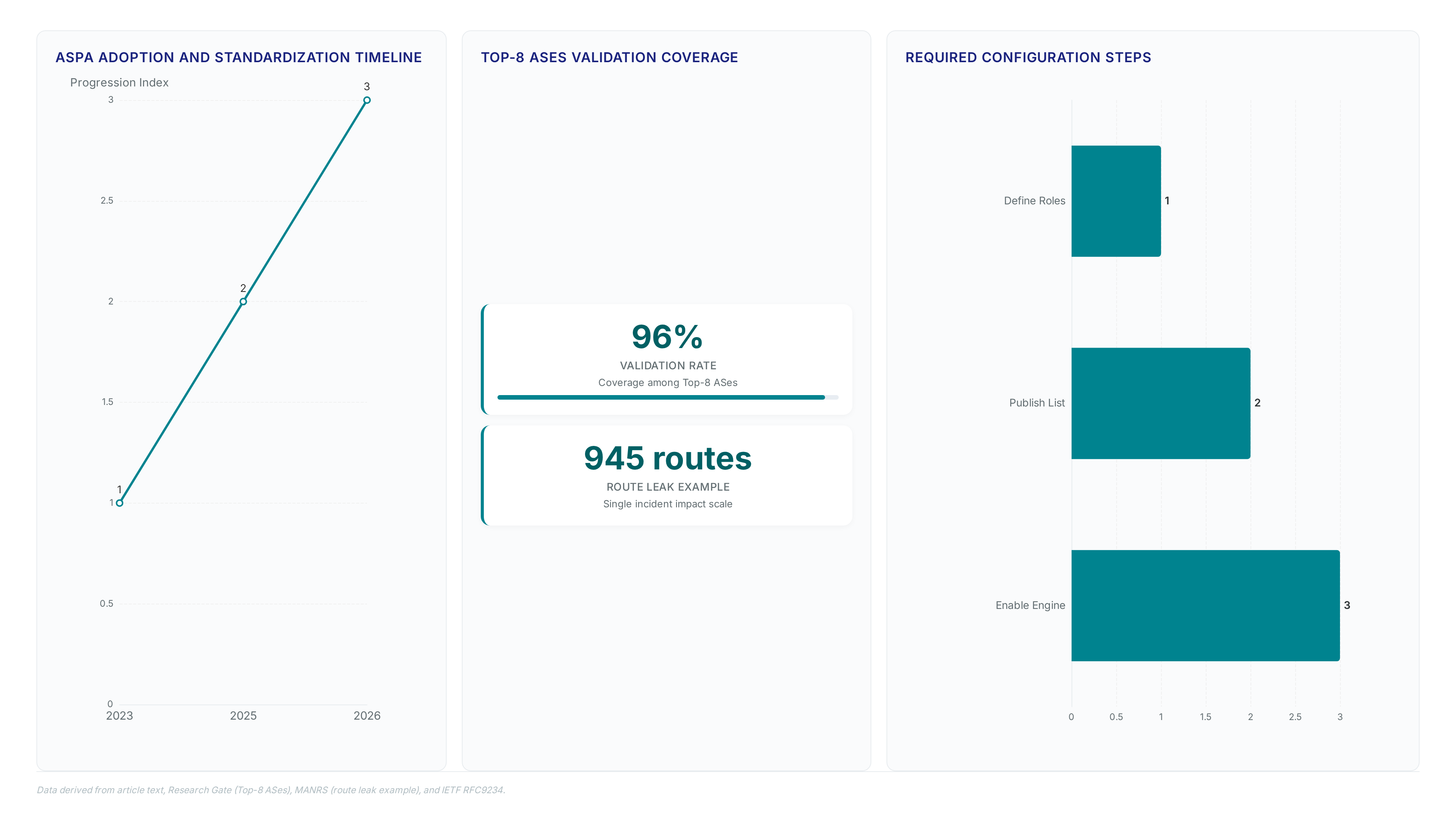
Securing just the top eight ASes with ASPA records stops 96% of route leak victims. Learn how to verify your transit path today.
Client support hit 60% in two years, yet origin servers lag. See how hybrid handshakes close this critical security gap today.
With ASPA Customer ASIDs up 539%, we see a real shift from origin checks to path security, though fragmented signing strains the system.
ASPA records surged 539% in 2025, yet route coverage lags. Learn why fragmenting ROAs slows validation and hurts your network security today.
Only 4% of routes tag origins, yet new clustering methods achieve 93% recall for mapping physical handoff points without vendor docs.