RPKI Certificates: How Five RIRs Secure Routing
RPKI replaces blind faith with cryptographic proof across five regional roots. Learn how this 2011 shift secures global IP allocation chains today.

Five regional bodies now manage IP space after the original IANA list collapsed under scale. Learn how this 1992 shift supports modern networks.
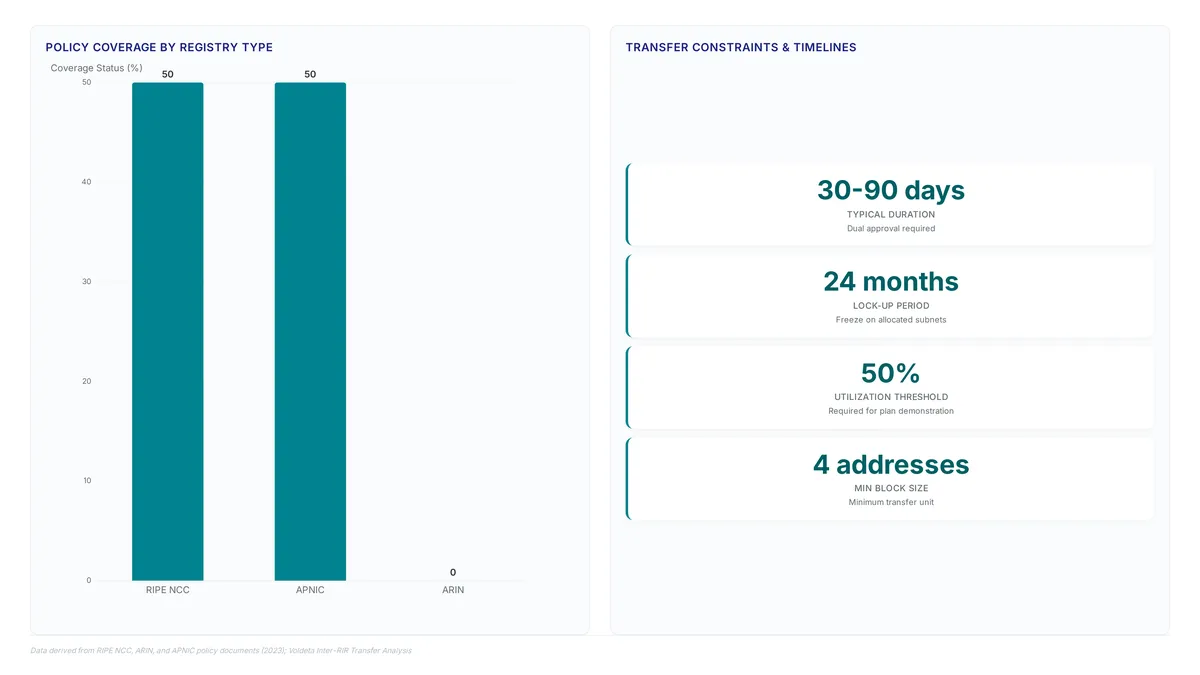
ARIN requires proving operational need for 24 months. InterLIR verifies blocks against 100+ blacklists to ensure your transfer clears RIR scrutiny.
Five Regional Internet Registries sit between IANA and your network. That gap is where Local Internet Registries (LIRs) operate.
RIRs enforce strict rules like ARIN's 12-month lock on new resources. Learn how these policies shape global IPv4 transfers in 2026.
Five Regional Internet Registries manage global IP allocation. Direct registry data offers the only verifiable path for accurate security analysis.
Five Regional Internet Registries coordinate global IP allocation to prevent routing chaos. Learn how this hierarchy secures unique address distribution.
IRINN imposes fees on transferred IPv4 resources, while APNIC routes InterRIR requests across 56 economies. Learn the specific costs.
LACNIC policy 2.21 mandates the original Spanish text overrides translations. Learn how this strict hierarchy impacts your regional IP address allocation...
Exactly four registries support global IPv4 moves. Learn the specific fee structures and documentation needed to prevent transaction stalls.
Only 4 regional registries enable interRIR transfers today. Learn the dual-consent rules and legacy status outcomes for global IPv4 moves.
Explore how five organizations manage global IP space, from APNIC's 26,067 members to AFRINIC's 2,492, defining strict regional boundaries.
Scarcity has birthed a liquid secondary market for IPv4 blocks where unused sub-blocks are sold rather than allocated.
Inter-RIR transfers take between 4 weeks and 10 months to complete depending on the registries involved.
Seven regional bodies now enforce routing integrity. With TWNIC reaching 98% IPv6 validity, I analyze how NIRs secure our infrastructure.
Five regional registries govern global IPv4 blocks, verifying each LIR before allocation to prevent routing conflicts and ensure network stability.
Navigate InterRIR transfers across 5 global regions. Learn how LIR fee tiers and strict needs-based validation impact your IPv4 acquisition strategy.
Five Regional Internet Registries manage global IP allocation, acting as the sole gatekeepers between IANA and the wider network infrastructure today.
Five Regional Internet Registries govern global IPv4 scarcity. Learn how InterLIR automates compliance for complex IntraRIR and InterRIR transfers.
Move IPv4 addresses across the five regional registries. Learn the strict LIR rules and justified need required for a legal InterRIR transfer today.
Since IANA's 2011 pool exhaustion, free IPv4 blocks are gone. Learn why leasing is the strategic fix for network expansion today.
Five distinct zones manage global IP policy under ICANN. Learn how strict governance impacts your network's access to finite IPv4 resources today.