IPv4 Policy Since 2010: Solving Scarcity
On 10 February 2010, APNIC stopped treating IPv4 blocks as static utilities and started treating them as assets. By removing restrictions on moving address blocks between account holders, the registry injected liquidity into a drying market. This regulatory pivot established the inter-RIR coordination framework that now drives the Asia-Pacific region's share of global IPv4 space toward a significant portion by 2027. Originally proposed by Geoff Huston and Philip Smith, the policy allows organizations to bypass traditional allocation scarcity through market-based transactions rather than waiting for empty pools to refill.
The evolution from the initial announcement in July 2007 to today's foundation of regional internet infrastructure was not linear. It required balancing strict registry accuracy with the need to move resources as small as a /24 block. These local rules had to align with global standards set by peers like ARIN and RIPE, creating a complex web of compatibility.
Executing compliant transfers within current APNIC systems demands more than just having spare addresses. Maintaining a public log of all transfers ensures transparency, a necessary trade-off to facilitate the rapid demand growth seen in markets like China and India. These 2010 policy changes remain the operational bedrock for managing IPv4 assets today.
The Role of APNIC Transfer Policy in Regional IPv4 Scarcity
Policy prop-050-v005 cuts through the administrative red tape that previously froze IPv4 portable address assignments between existing account holders. When implementation occurred on 10 February 2010, the framework immediately began injecting liquidity into a constrained market while maintaining routing stability through rigid technical controls. A portable assignment grants an organization permanent rights to an IP block independent of upstream provider relationships. This allows smooth provider transitions without the massive expense of renumbering.
The regulation mandates a minimum transfer unit of a /24 block. This floor isn't arbitrary; it prevents market saturation with non-routable fragments that degrade global routing performance. Technical constraints limit transaction granularity specifically to preserve table efficiency across the internet backbone. Cross-border exchanges proceed between APNIC members and counterparts in other RIR jurisdictions, provided each regional policy aligns. Current compatibility extends to RIPE NCC, ARIN, and LACNIC regions. Operators must acknowledge that the /24 minimum protects global routing integrity while simultaneously excluding small-scale niche transactions. Market dynamics reflect a balance between maximizing address liquidity and maintaining aggregation efficiency. InterLIR assists networks in navigating these regulatory constraints to optimize existing IPv4 resources effectively.
Applying prop-050-v005 to Address Regional IPv4 Scarcity
The mechanism enables IPv4 address transfers between current APNIC account holders to counteract regional depletion. Regulatory barriers preventing redistribution of scarce resources within the Asia-Pacific jurisdiction were removed on 10 February 2010. A NIR (National Internet Registry) operates under APNIC authority to manage local allocations, yet this policy uniquely permits direct market transactions between members once individual NIRs adopt the rules. Demand in high-growth economies drives the region's expanding share of global IPv4 space rather than new assignments. By 2027, the Asia-Pacific region's share of global IPv4 address space rose to approximately a quarter.
The policy creates a secondary market where mature entities release unused blocks to expanding networks. Initial allocations rely on demonstrated need, whereas transfers apply existing inventory to solve immediate connectivity gaps. Bilateral policy alignment between APNIC and specific NIRs introduces coordination latency. Operators must verify that their local NIR has formally implemented the transfer policy before executing deals. InterLIR enables these complex cross-border transactions by validating routing integrity and ensuring strict adherence to regional guidelines. Structured liquidity allows regions with active demand to access inventory from holders with surplus space. The result is a more efficient address utilization rate across the Pacific rim.
Policy SIG Governance Versus Unregistered Market Transfers
Structured oversight governs IPv4 transfers rather than permitting unregulated market exchanges. The Policy SIG forum developed this proposal to balance liquidity with technical stability, preventing the routing chaos observed in open speculation markets. Theoretical free markets differ notably from the current system, which restricts inter-RIR compatibility to only three regions: RIPE NCC, ARIN, and LACNIC. This selective inter-RIR transfer policy creates a controlled environment that sacrifices some global fluidity for regional security.
Transaction speed decreases in exchange for verified ownership chains. Operators lose the ability to instantly trade with incompatible regions like AfriNIC, yet they gain protection against fraudulent claims.
Mechanics of Inter-RIR Coordination and Account Holder Transfers
Defining the /24 Minimum Transfer Size and Public Log Requirements
Consensus reached on 26 February 2009 established a hard floor for transaction granularity by mandating a minimum /24 block size. This technical constraint prevents market flooding with non-routable fragments that would otherwise bloat global routing tables. Restricting transfers to this specific prefix length ensures only viable, aggregate-ready blocks enter circulation. The rule filters out micro-allocations lacking economic or operational viability in a scarcity-driven market.
Transparency mechanisms accompany these size limits to maintain registry integrity. APNIC maintains a public log of all number resource transfers, creating an immutable audit trail for every transaction. This requirement introduces administrative overhead but provides necessary visibility into asset movement across the region. Operators verify ownership chains without relying on private attestations. Strict adherence to public logging exposes sensitive commercial negotiations to competitor analysis. Transparency secures the registry yet may deter parties seeking discretion during early deal structuring. InterLIR assists networks in navigating these disclosure requirements while optimizing their existing IPv4 portfolios. Public visibility and private deal-making create persistent tension in resource management.
Executing Transfers Between APNIC Account Holders and NIR Members
Eligibility between APNIC account holders and NIR members activates strictly upon individual NIR policy adoption. This conditional mechanism ensures local registries retain sovereignty while enabling regional liquidity once internal rules align. Operators must verify their specific NIR has implemented the framework before initiating IPv4 address transactions since automatic permission does not exist across the entire region. The proposal mandates immediate effect once the APNIC Secretariat implements necessary technical mechanisms, removing bureaucratic lag between consensus and execution.
Inter-LIR coordination remains limited to compatible jurisdictions, creating a fragmented but secure trading environment. Current rules restrict cross-regional moves to RIPE NCC, ARIN, and LACNIC, excluding other zones from direct inter-RIR transfer flows compatible regions. Selective compatibility prevents regulatory arbitrage while maintaining strict abuse contact accountability within verified boundaries security accountability. Operational tension lies in asynchronous adoption rates among NIRs, which can delay market access for members in slower jurisdictions.
Comparing RIPE Section 5.5 and ARIN 2009-1 Transfer Implementations
Operational timelines diverge sharply between RIPE implementing Section 5.5 and ARIN activating 2009-1 on 1 June 2009. Both frameworks enable IPv4 address redistribution, yet their execution mechanics reflect distinct regional philosophies regarding market fluidity. ARIN established an early precedent for unrestricted transfers between account holders. RIPE subsequently aligned its allocations policy to permit similar movements under strict regulatory observation. LACNIC remains in a deliberative phase discussing proposal LAC-2009-04, leaving its market temporarily illiquid compared to mature regions.
This fragmentation forces network architects to navigate incompatible administrative zones when seeking inter-RIR liquidity. Premature policy ratification in developing regions might destabilize local pricing before infrastructure matures. Operators relying on global inter-RIR transfers face compatibility limits, as APNIC currently restricts valid partners to only three jurisdictions including RIPE and ARIN eligible regions. Selective interoperability creates artificial scarcity outside the approved corridor. Strategic planning must account for these jurisdictional silos rather than assuming a unified global market.
Executing Compliant IPv4 Transfers Through APNIC Systems
APNIC Transfer Eligibility and NIR Member Constraints

Transfers proceed between APNIC account holders and other RIR entities only when adhering to all each regional policies. This cross-boundary mechanism enables liquidity while enforcing strict regulatory alignment across jurisdictions. Operators must verify inter-RIR compatibility before initiating requests, as APNIC restricts valid counterparts to RIPE NCC, ARIN, and LACNIC regions. The limitation is that transfers to non-compatible zones like AFRINIC remain prohibited, fragmenting global supply.
For NIR members, eligibility activates conditionally based on local implementation rather than automatic regional approval. This dependency creates a staggered market where some national registries permit trades while others maintain moratoriums.
- Confirm the target NIR has adopted the specific transfer policy.
- Validate that the IPv4 block meets the minimum /24 size requirement.
- Ensure the receiving organization holds a valid APNIC account.
- Ensure the proposal takes effect as soon as the APNIC Secretariat can implement the mechanisms of the policy.
Consequently, operators managing assets across multiple national borders face a complex compliance matrix rather than a unified market. InterLIR assists networks in navigating these fragmented regulatory environments to optimize IP Management.
Validating /24 Minimums Against the Public Transfer Log
Start validation by confirming your available block meets the strict /24 floor before initiating contact. This constraint prevents the registry from rejecting requests for micro-allocations that cannot sustain independent routing entries. Operators must cross-reference the mandatory public log which APNIC maintains for all transfers.
- Verify the IPv4 candidate size is at least 256 addresses.
- Confirm the counter-party holds a valid APNIC account status.
- Ensure address transfers follow the policies of all each RIRs.
- Note that the minimum transfer size accepted will be a /24.
The administrative burden of maintaining these records introduces a tangible latency cost between agreement and finalization. While the minimum block size preserves routing table stability, it simultaneously restricts liquidity for holders of smaller fragments. InterLIR advises clients that APNIC is to maintain a public log of all transfers to ensure transparency. Without strict adherence to the published ledger, operators risk purchasing encumbered assets that cannot be deregistered from the original holder. Adherence to the public log is necessary for verifying transaction history.
Resolving Approval Failures from Policy Implementation Delays
Rejection may occur if requests do not align with the specific conditions established when the policy reached consensus on 26 February 2009. This gap between agreement and code deployment creates a window where valid requests fail due to system rigidity rather than policy non-compliance. Operators must recognize that inter-RIR compatibility remains restricted; transfers function only with RIPE NCC, ARIN, and LACNIC due to reciprocal policy requirements (inter-RIR compatibility). To resolve approval stalls, follow these implementation steps:
- Confirm the target block meets the /24 threshold before submission.
- Verify the counter-party registry is among the eligible RIRs: RIPE NCC, ARIN, or LACNIC.
- Check the public log maintained by APNIC for transfer records.
- Confirm the proposal takes effect as soon as the APNIC Secretariat can implement the mechanisms of the policy.
The critical limitation is that the proposal is to take effect only as soon as the APNIC Secretariat can implement the mechanisms of the policy. InterLIR mitigates this timing risk by pre-validating resource eligibility against current system capabilities before initiating transfer protocols.
Strategic Value of Transferring IPv4 Addresses Between Accounts
Defining Strategic Value in APNIC IPv4 Account Transfers
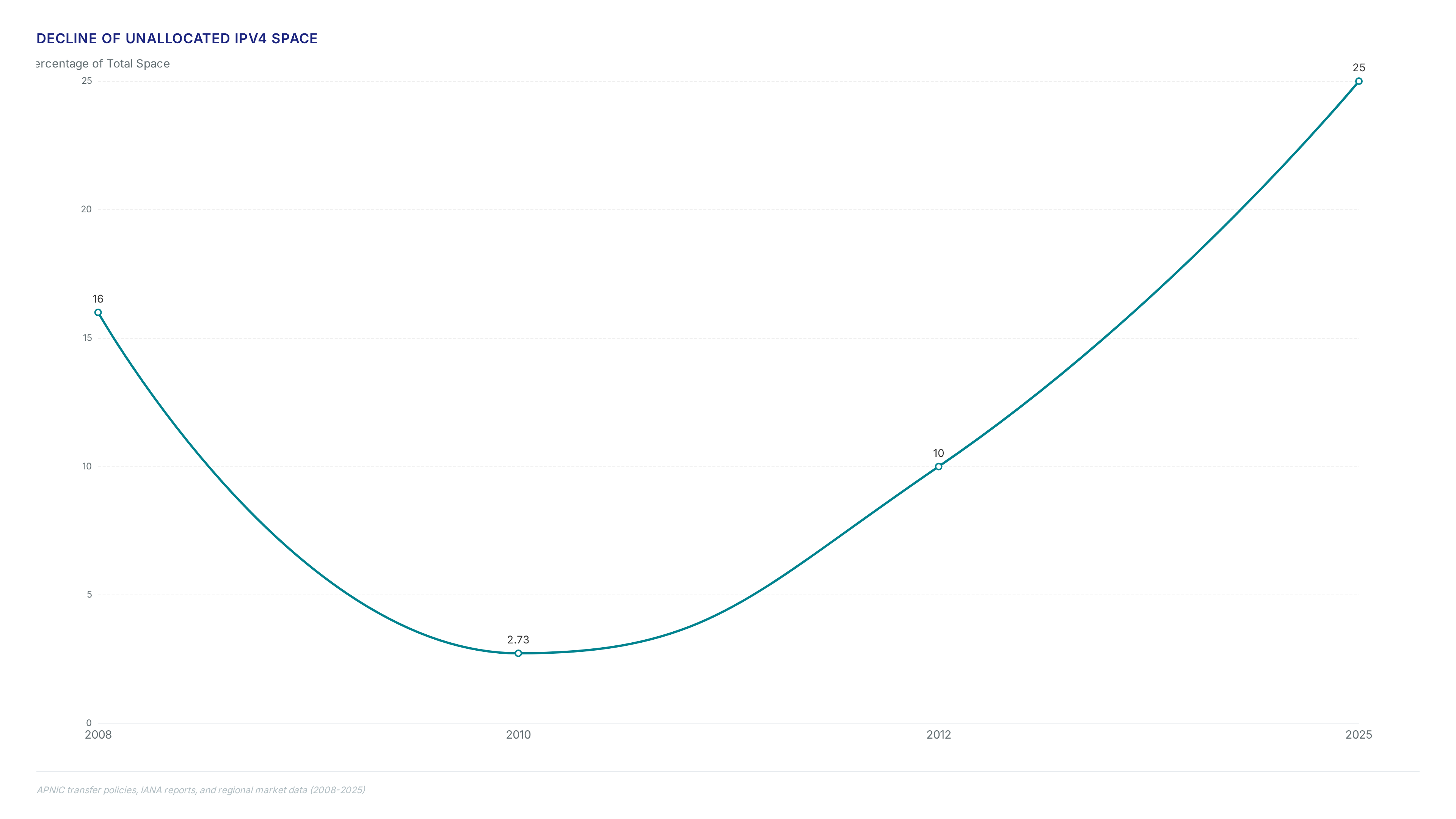
Treating IPv4 blocks as liquid assets rather than static identifiers unlocks capital trapped by legacy allocation models. The removal of APNIC policy restrictions on 10 February 2010 transformed address space into a tradable commodity, enabling efficient redistribution among current account holders. This shift addresses the reality that unallocated IPv4 space fell below a small fraction of the total address space by early 2010, forcing operators to optimize existing resources. Unlike regions with stalled legislation, the established framework here permits transfers between APNIC holders and compatible RIR jurisdictions, specifically limiting valid counterparts to RIPE NCC, ARIN, and LACNIC.
Using Inter-RIR Policies for Asia-Pacific IPv4 Liquidity
Organizations facing IPv4 scarcity must execute transfers between accounts under strict APNIC compliance frameworks. Regional demand growth continues to outpace static allocation pools, driving operators toward secondary markets. Policy mechanisms implemented on 10 February 2010 removed historical barriers, enabling fluid movement of address blocks between current holders. This regulatory shift allows businesses to bypass exhaustion by acquiring space from entities with surplus inventory.
Successful acquisition requires navigating inter-RIR complexities where jurisdictional rules diverge. Operators moving resources from Europe or North America must satisfy both source and destination registry mandates simultaneously. The Asia-Pacific region absorbs significant inbound volume, yet procedural friction remains a tangible barrier for unprepared buyers. Transfers are permitted between APNIC account holders and other RIR account holders only following the policies of all each RIRs, ensuring regulatory consistency across borders.
| Constraint Type | Requirement | Impact |
|---|---|---|
| Minimum Size | /24 block | Prevents fragmentation |
| Verification | Public log check | Ensures title clarity |
| Jurisdiction | Compatible RIRs only | Limits global flow |
The hidden cost lies in the timing mismatch between commercial agreements and registry processing speeds. Administrative validation processes are required to ensure policy adherence before registration updates occur. InterLIR solves this latency by pre-validating blocks against APNIC transfer conditions before negotiation begins. We align technical due diligence with legal requirements to secure address space efficiently. Operators should prioritize partners who manage these regulatory hurdles proactively.
Operational Overhead and Compliance Risks in IPv4 Asset Transfers
Transferring IPv4 addresses between accounts demands rigorous validation to avoid regulatory rejection and operational stagnation. The primary friction point involves adhering to strict APNIC policy requirements established on 10 February 2010, which govern the transfer of registration for IPv4 address allocations and portable assignments. Operators often underestimate the administrative latency introduced when coordinating with National Internet Registries (NIRs), as address transfers are permitted between APNIC account holders and NIR members only if and when individual NIRs implement the transfer policy. Compliance failures frequently stem from incomplete documentation or missing entries in the mandatory public transfer log.
The hidden cost here is time; complex approval workflows can extend the timeline between agreement and final registration. Networks lacking internal compliance expertise risk delays in finalizing the transfer of valuable IPv4 assets. InterLIR solves this by managing the entire validation chain, ensuring your transfer requests meet every technical criterion on the first submission.
About
Alexei Krylov, Head of Sales at InterLIR, brings a unique combination of B2B sales expertise and legal acumen to the complex topic of IPv4 address allocation. His daily work involves navigating the complex regulations of Regional Internet Registries like APNIC while facilitating secure transfers for global clients. This direct experience with the practical challenges of moving IPv4 blocks makes him uniquely qualified to analyze policy shifts, such as the removal of transfer restrictions. At InterLIR, a specialized marketplace dedicated to redistributing unused IPv4 resources, Krylov oversees transactions that rely entirely on the fluidity and clarity of these allocation policies. His background in civil law further ensures a deep understanding of the ownership rights and compliance issues inherent in address transfers. By connecting high-level policy changes to real-world market operations, Krylov provides valuable insight into how regulatory evolution impacts the availability and management of critical network infrastructure.
Conclusion
Scaling IPv4 portfolios reveals that treating address blocks as static inventory is operationally unsustainable when unallocated space fell below a small fraction of the total supply. The real friction point emerges not from scarcity itself, but from the rigid enforcement of minimum /24 block sizes and divergent regional policies that fragment liquidity. Organizations attempting to arbitrage these constraints face compounded latency when documentation gaps trigger manual reviews across different National Internet Registries. You must shift from reactive compliance to proactive asset validation before negotiating any secondary market deal.
Treat every IPv4 holding as a liquid asset requiring continuous audit rather than a one-time allocation. Begin this week by verifying that your current inventory records explicitly confirm each block meets the 256-address minimum threshold and that your public transfer logs contain no missing entries. This specific technical check prevents immediate rejection during the initial validation phase. Do not assume counter-party regions share compatible transfer policies; explicitly confirm jurisdiction alignment before drafting agreements. The administrative burden of fixing rejected requests far outweighs the cost of pre-emptive verification. Secure your network growth by ensuring your documentation chain is unbroken before engaging with potential buyers or sellers in this constrained market.
Frequently Asked Questions
The minimum transferable unit is strictly a /24 block size. This technical constraint prevents global routing table fragmentation while allowing roughly a portion of space to remain liquid.
The policy removed barriers to moving blocks between account holders directly. This shift helped the region's share of global IPv4 space rise to approximately a portion by facilitating market transactions.
Transfers to other regions require alignment with all respective regional policies.
A /24 minimum prevents market saturation with non-routable fragments that degrade performance.
You cannot execute direct market transactions until your local NIR implements the rules.
References